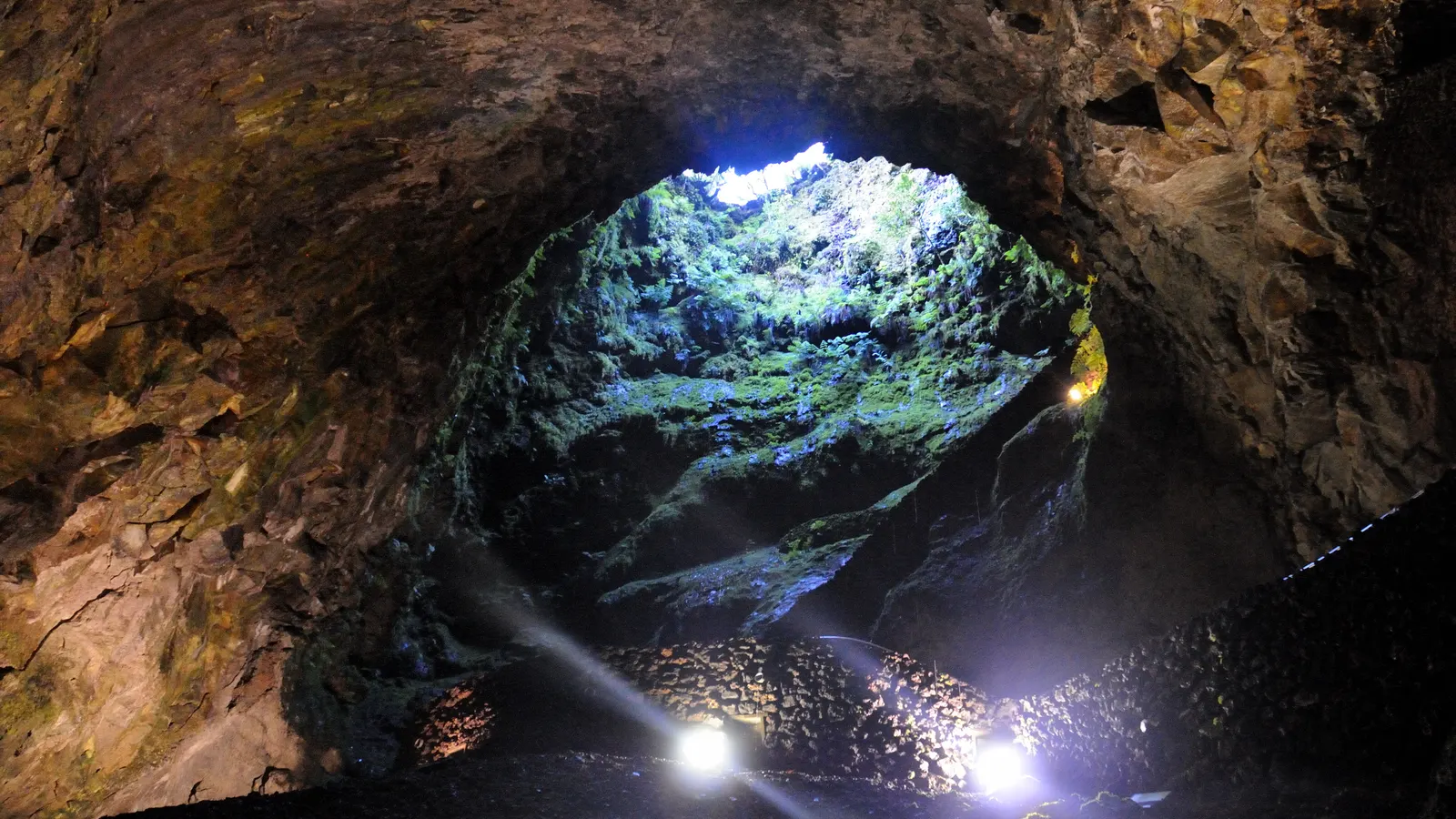
A volcanic vent you walk down into, not a cave you walk along. 338 steps drop through a 44 m tunnel and a series of platforms to a rainwater lake roughly 90 m below the crater, past white amorphous-silica stalactites that the Azores Geopark calls unique among the world's volcanic cavities. The catch in 2026 is the timetable and the building site: the Algar opens afternoons only, four days a week outside high season, and the new visitor centre is still unfinished, so there is no café, no shelter and no toilet at the site. Admission is €10 (about $11.46), cash or card, bought on arrival – there is no way to book ahead.
- TicketsThere is nothing to book.
- Price€10 (about $11.46) – Algar do Carvão, per person, all ages from 12
- OpenAfternoons only, all year, and the days change with the season.
- Best timeJune to September, when both caves open daily from 2pm to 6pm – the only stretch of the year with a four-hour window.
- ClaustrophobiaTell the staff at reception – the operator asks you to.
Three volcanic sites, one afternoon: what each one costs and asks of you
Algar do Carvão
The volcanic vent itself: a 44 m tunnel, then 338 steps down past white silica stalactites to a rainwater lake roughly 90 m below the crater. The crater above measures 15 by 20 metres and lets daylight in, which is what makes the chamber photograph the way it does. About 30 minutes.
The amorphous-silica stalactites and stalagmites reach about 1 m in length and 40 to 50 cm across. The Azores Geopark calls them the most beautiful and rarest in any volcanic cavity in the world; the ProGEO geosite inventory calls them unique in the world's volcano-speleological record.
€10 (about $11.46); under-12s free with a paying adult
Gruta do Natal
A 697 m lava tube 6 km away, walked on its own original floor – uneven, rough, occasionally low enough to duck. Every visitor gets a helmet at reception, where the briefing is given. The circuit is laid out so you do not retrace your steps, and there is one rougher side passage the operator recommends only to the more adventurous. Same 12 to 13 °C, same constant dripping. Around 20 to 30 minutes.
Called Galeria Negra, then Gruta do Cavalo after a horse's bones were found below the entrance hole. It took its present name after a mass was celebrated inside on 25 December 1969 by D. José Vieira Alvernaz, Patriarch of the East Indies. The Christmas mass has been repeated in later years – the Bishop of Angra celebrated it there in 2013 – and the cave has also hosted a christening and a wedding, but it is not an advertised annual fixture and the cave itself is closed on 24 and 25 December. The visitor building dates from 1 December 1998 and the cave opened regularly on 1 June 1999.
€9 ($10.31); under-12s free with a paying adult
Furnas do Enxofre
Not underground and not part of any ticket: a fumarole field of about 14 hectares less than a kilometre from the Algar, crossed by a boardwalk circuit. Free, unfenced, open at any hour. It belongs to the Terceira Nature Park, not to Os Montanheiros, and it is the one part of this afternoon that needs no timetable.
More than twenty vents give off gas at around 95 °C (203 °F) at the surface and about 130 °C (266 °F) half a metre down – roughly 95 per cent carbon dioxide, about 3 per cent hydrogen sulphide, plus sulphur dioxide, hydrogen, nitrogen and methane. The rock around them is being cooked into clays streaked with yellow sulphur crystals, red iron oxides and white aluminium oxides. Stay on the boardwalk: the crust beside it is thin and hot, and heavier-than-air CO2 pools in hollows. Cold, still mornings give the best steam.
free
Tickets and prices
There is nothing to book. The operator states it in plain terms on both cave pages: no reservations, no online sales, no advance purchase, no group rates. Tickets exist only at the door, on the day. Any site selling you an Algar do Carvão entry ticket online is a tour operator selling you a tour.
Official prices
- Algar do Carvão, per person, all ages from 12€10 (about $11.46)
- Gruta do Natal, per person€9 ($10.31)
- Children under 12, with a paying adult, at either cavefree
- Combined ticket Algar do Carvão + Gruta do Natalnot on sale at present; the operator states this on both cave pages. The €15 figure still printed by travel sites is the 2023 rate.
- Holders of a disability card or certificatefree
- Os Montanheiros members with fees paid, plus one guestfree
- Local tour guides on dutyfree
- Members of the Terceira blood donors' association (Associação de Dadores de Sangue da ilha Terceira)about 20 per cent off
- Extra opening for a group, Algar do Carvão, low season only (1 October to 31 March), Sundays, Mondays and Thursdays€330 minimum for up to 30 people (about $378.18); €11 ($12.61) a head above 30
- Extra opening for a group, Gruta do Natal, same conditions€300 minimum up to 30 people ($343.80); €10 ($11.46) a head above 30
- Furnas do Enxofre fumarole field, next doorfree, no ticket, no gate
- Parking at all three sitesfree
- Conversion€1 = $1.1460 as of 20 September 2026; dollar figures rounded to the cent. You pay in euros; your card's rate on the day will differ.
As of 09/2026 · source and direct booking: montanheiros.com/en/algarcarvao
When everything is sold out
Not a concept here. A single queue on a first-come, first-served basis, with no priority for coach groups or free-entry groups. Capacity inside the Algar is 150 people at a time, and may be less; at Gruta do Natal it is 80, and admissions pause when the cave is full. The operator warns to expect a wait under the current temporary arrangements.
Guided cave tours on Terceira
Buying at the door is always cheapest: €10 (about $11.46) for Algar do Carvão, €9 ($10.31) for Gruta do Natal, nothing at all for Furnas do Enxofre. Nobody can sell you a queue-jump, because Os Montanheiros run a single first-come queue and take no bookings of any kind. A tour earns its money in three situations. Without a car you have no other realistic way there – the operator confirms no public transport serves either cave and it runs no transfers. With only one free afternoon on the island, a half-day tour handles the driving and the order of the three sites, which matters when the Algar opens for just two and a half hours from October. And if you want the geology explained rather than glanced at, a guided tour is the only way to get it in English: there is no audio guide, and the staff inside the cave answer questions rather than give a talk. Check whether the entrance fees are included before you book – most island tours include them, and the difference is only €19 a head either way. One thing no tour can promise: the Algar can be suspended at short notice while the visitor centre is finished.
Terceira: Algar do Carvão Lava Caves Tour
Terceira Island: Caves and Craters Tour
Underground Van Tour (Half Day) | Terceira Island
Half-Day Tour - Algar do Carvão Lava Route
Show all 5 offers
Terceira: Volcanic Cave Tour with Guide
Booked through GetYourGuide (affiliate link, advertising). Most offers can be cancelled free of charge up to 24 hours ahead. Prices as of 20 September 2026.
Opening hours and best time
Afternoons only, all year, and the days change with the season. High season, April to September: every day. April and May 2.30pm to 5pm, June to September 2pm to 6pm. Low season, October to December (and January to March at Gruta do Natal): Tuesdays, Wednesdays, Fridays and Saturdays, 2.30pm to 5pm. That means Mondays, Thursdays and Sundays are closed days from October onwards – the single point where most trips come apart, because nothing about the site suggests a four-day week. Both caves shut on 1 January, Easter Sunday, 1 December and 25 December, and on the Portuguese public-service tolerance days: Carnival Tuesday, 24 December and 31 December. On top of that the Algar reopened on 21 March 2026 only provisionally, while the new visitor centre is being finished, and the operator states plainly that visits may be suspended at short notice when the building work requires it, with notice given on its own page. The hours are decided by the association's board and can change without warning; the association's stated reason for the short window is to limit the hours of artificial light in a dark habitat with endemic cave invertebrates.
When it is quietest
June to September, when both caves open daily from 2pm to 6pm – the only stretch of the year with a four-hour window. Arrive in the first hour rather than the last: there is a single queue, a 150-person cap inside, and staff may refuse entry after closing time. Out of season, build the trip around Tuesday, Wednesday, Friday or Saturday and be at the desk by 3pm at the latest for a 5pm close. In 2026 there is a second reason not to leave it late: the visitor centre is unfinished, so there is no shelter to wait in, and at 640 m the weather does what it likes. Check the operator's page or Facebook on the morning you plan to go – short-notice closures for construction work are announced there.
Who it suits
With children
Under-12s go free with a paying adult, and the Algar works for children who can manage a long staircase. The operator advises against bringing babies or toddlers, and against carrying a child. Gruta do Natal is the gentler of the two: flat, short, and you get a helmet.
Minimum age
None published. The operator uses recommendations, not rules.
Wheelchair
Not possible. This is documented rather than assumed: the only way in is a narrow tunnel followed by 338 steps of varying height linking several platforms, and the operator's own safety notes advise against the visit for anyone with physical limitations or balance problems. There is no lift, no ramp and no alternative route. Furnas do Enxofre, a kilometre away, is the level alternative – a boardwalk circuit with no gradient – though its surface is timber and the access track is unsurfaced.
Pushchair
Leave it in the car. Steps throughout, and in 2026 the walk from the temporary ticket desk crosses three to five minutes of volcanic gravel and a building site before you even reach the tunnel.
Dogs
Banned outright at both caves, with no exceptions stated. Assistance dogs are not mentioned either way; ask the association in advance.
Claustrophobia
Tell the staff at reception – the operator asks you to. The tunnel is enclosed and narrow, but the chamber itself is open to the sky through a crater 15 by 20 metres, so daylight reaches a long way down. That makes the Algar easier for most claustrophobic visitors than the fully enclosed lava tube at Gruta do Natal.
What to wear
Trainers, walking shoes or boots, and a waterproof. Humidity is permanently above 90 per cent and water drips constantly, so the cemented floor stays wet and can be slippery. At 12 to 13 °C (54 to 55 °F) with wet air, a fleece or jacket is not optional even in August.
Photography
Allowed, handheld. Photographs and video are permitted at both caves without a tripod; tripods need written permission from the association in advance. Do not film the staff during their explanations without asking. Smoking and eating inside are forbidden, as is taking or breaking any mineral sample.
Getting there
By public transport
There is none, and the operator says so itself: no public transport serves either cave, and Os Montanheiros run no transfers. The scheduled buses of Empresa de Viação Terceirense connect Angra do Heroísmo, Praia da Vitória and the coastal parishes; the caves sit on the central plateau, off that network. Without a car the realistic options are a taxi from Angra or a half-day guided cave tour, which is usually the better value once you count the waiting time.
By car
A hire car is the normal answer, and free parking is available at all three sites. The approach from the main island roads is signposted and surfaced; the last stretch to Furnas do Enxofre is an unsurfaced track to a small car park. At the Algar in 2026, parking is next to the temporary ticket desk, and from there it is a three to five minute walk over volcanic gravel and past the unfinished visitor centre to the tunnel mouth.
From the nearest city
About 12 km from Angra do Heroísmo by road, roughly 20 to 25 minutes, and a similar drive from Praia da Vitória on the other side of the island. Lajes airport (TER), the island's only airport, sits beside Praia da Vitória, about 6 km from the town. The island is small enough that nothing is more than half an hour away; the constraint is the opening window, not the distance. Gruta do Natal is another 6 km from the Algar, 10 to 15 minutes, and Furnas do Enxofre is under a kilometre away – all three fit comfortably into one afternoon, in that order or the reverse.
Tips for your visit
- Check the day of the week before anything else. From October the caves open only Tuesday, Wednesday, Friday and Saturday. Arriving on a Monday or a Sunday in November means a locked gate and a wasted drive.
- Go early in the window, not late. Single queue, 150-person cap, and entry can be refused after closing time. In the low season that leaves a two-and-a-half-hour slot for the whole thing.
- Take cash. Cards work, American Express does not, and the mobile network at 640 m is not dependable – the association's own older guidance asked for cash for that reason.
- Look at the operator's page or Facebook on the morning of your visit. Short-notice suspensions for construction work are announced there and nowhere else.
- Bring a waterproof and a fleece even in August. Above 90 per cent humidity, constant dripping and 12 to 13 °C (54 to 55 °F) make it feel colder than it reads.
- Wear something with grip. The floor is cemented and permanently wet, and the 338 steps vary in height, which is where people stumble on the way back up.
- Plan all three sites as one afternoon: Furnas do Enxofre first while the steam is thickest, then the Algar, then Gruta do Natal – or the reverse. Six kilometres and ten to fifteen minutes separate the two caves.
- No tripod unless you have written permission from the association. Handheld photography and video are fine at both caves.
- In 2026 there is no toilet at the Algar. Use the facilities at Gruta do Natal's visitor centre, which has them, or in Angra before you set off.
What the internet gets wrong
Nobody who prints the figure ever names the other two. What can be documented is narrower and more interesting. Os Montanheiros and the Azores Geopark say the shaft is remarkable because, unlike most volcanic chimneys, it is not blocked by fill or collapse. The obvious comparison is Þríhnúkagígur in Iceland, and it is not the same thing: that is a drained magma chamber entered by cable lift on a seasonal, pre-booked, several-hundred-euro tour. Algar do Carvão is a vent you walk down for €10 (about $11.46). Treat "one of very few" as fair and "one of three" as unsourced.
No measurement of concentration exists anywhere. The Azores Geopark's wording is that the opal stalactites and stalagmites, reaching about 1 m in length and 40 to 50 cm in diameter, are the most beautiful and rarest found in any volcanic cavity in the world; the ProGEO geosite inventory says they are unique in the world's volcano-speleological context and gives the silica content as 77 to 82 per cent. Those are judgements about rarity, not a league table of size or density – and neither source claims they are the largest anywhere.
the price in September 2026 is €10 (about $11.46) a head for Algar do Carvão and €9 ($10.31) for Gruta do Natal. There are no student or senior rates at all. Children go free only under 12, and only with a paying adult.
The combined ticket is not on sale. Both of the operator's 2026 cave pages carry the same parenthesis – no combo tickets Algar do Carvão + Gruta do Natal at present. Pay €10 and €9 separately, €19 for both. The €15 was the 2023 rate and it is still being repeated three years on.
Neither is right, and the morning opening is the dangerous one. The caves never open in the morning. April and May are daily 2.30pm to 5pm, June to September daily 2pm to 6pm, and from October it drops to Tuesdays, Wednesdays, Fridays and Saturdays, 2.30pm to 5pm – Sunday and Monday closed, which is the opposite of "Tuesday through Sunday".
The two Wikipedias contradict each other on whether weekends are the open days or the closed ones, and both are years out of date. The operator's timetable is the only one that holds.
There is nothing to book. The operator states it twice over – no reservations, no online sales, no advance purchase, no group rates; tickets only on arrival. The single exception is the extra opening for organised groups, which exists only between 1 October and 31 March, only on Sundays, Mondays and Thursdays, and costs €330 minimum (about $378.18).
the Algar reopened on 21 March 2026. What is still true, and what those pages miss by being out of date in the other direction, is that the reopening is provisional. The new visitor centre is unfinished, the ticket desk is a temporary hut, there is no bar, shop, toilet, shelter or rest area, and the operator reserves the right to suspend visits at short notice while the building work goes on.
The operator's own answer is 12 to 13 °C (54 to 55 °F), in both caves. Two degrees sounds trivial until you add humidity above 90 per cent and water dripping on you for half an hour.
The step count is right, the depth is not. Ninety metres is the drop from the surface to the lake, and the Azores Geopark and ProGEO put the chimney itself at about 80 m deep. Nor can you reach the water: descending to the lake is forbidden and climbing the retaining walls is too.
90 steps would get you barely past the tunnel. The operator counts 114 steps through the two tunnels to the main platform and 338 in total. The 45 m is the first vertical section below the crater, not the chamber height, and the 100 m is the horizontal length of the cavity including both vaults – ProGEO gives 90 m for that.
the fumarole field is a Regional Natural Monument of about 14 hectares run by the Terceira Nature Park, free, open at any hour, with no gate and no ticket. The name trips people up too – Furna do Enxofre, singular, is a different site altogether, a cave inside the caldera on Graciosa island, and it does charge admission.
The operator's own legacy page at montanheiros.com/novo-algarcarvao/ is still live and still shows the 2023 timetable and the €15 combined ticket. It ranks in search results alongside the current page. The pages that count are montanheiros.com/algarcarvao/ and montanheiros.com/gruta-do-natal/, and the English versions under /en/.
The 3,200 years BP date belongs to charcoal in the older trachytic formations, not to the vent you walk into. The basaltic eruption that opened the shaft was dated by Zbyszewski in 1971 to 2,148 plus or minus 115 years. Two eruptions, two ages, and the round 3,200 has been attached to the wrong one for years.
Coordinates are worth checking before you drive. English Wikipedia gives 38°43'44"N 27°11'7"W; the operator gives 38°43'41.54"N 27°12'59.01"W. The difference is roughly 2.7 km of moorland. Navigate to the operator's figure or to the signposted turning, not to the Wikipedia pin.
History in brief
- Two eruptions built the place. The older, trachytic phase belongs to the Pico Alto system north of the Guilherme Moniz caldera; charcoal trapped in those formations has been radiocarbon-dated to about 3,200 years BP. A later basaltic eruption raised the strombolian cone of Pico do Carvão; a carbonised trunk, probably Azorean juniper, from a quarry at Barraca gave that eruption an age of 2,148 plus or minus 115 years (Zbyszewski, 1971). The ProGEO inventory brackets the basaltic cone at roughly 1,700 to 2,100 years BP.
- The vent survives open because the rising basaltic magma broke sideways through an older trachyte barrier, hollowing out the lake chamber and its two vaults, and then drained back into the magma chamber almost instantly at the end of the eruption. What is left is a volcanic chimney that was never plugged by fill or collapse – the operator's own description, and the reason the site is on the Azores Geopark list.
- The first recorded descent was on 26 January 1893, on a simple rope, by Cândido Corvelo and José Luís Sequeira. Didier Couto followed in 1934 and drew the first profile of the shaft from observation alone.
- Organised descents began on 18 August 1963, using a suspended chair and later a harness. Getting six to eight people down and up took most of a day, which is exactly why the group that became Os Montanheiros started looking for another way in.
- Between 28 May 1965 and 28 November 1966, working weekends and holidays, the association cut a 44 m tunnel into the shaft by hand. It was later widened and lined with concrete. The Geopark dates public opening to 1 December 1968.
- The first internal stairs were wooden and were destroyed by vandalism. The concrete staircase in use today, 300 m of it, was built in 1977 and resurfaced and widened in 2003.
- On 30 November 1973 the landowner José Ataíde da Câmara and his wife gave the association the parcel containing the shaft, along with the strip of land on which the Montanheiros had cut the access road off the Caminho do Cabrito – now a public road.
- Protected first as a Natural Geological Reserve and reclassified as a Regional Natural Monument covering 40.5 hectares. It is a priority geosite of the UNESCO Azores Global Geopark and was a finalist in the Seven Natural Wonders of Portugal competition.
- Closed to visitors in October 2024 so that a new visitor centre could be built without interruption. It reopened provisionally on 21 March 2026, still mid-works: a temporary ticket hut, a marked route past the building site, and no bar, shop, toilets, shelter or rest area.
Frequent questions
How much does it cost to visit Algar do Carvão in 2026?
€10 a head, about $11.46, bought at the door. Gruta do Natal is €9 ($10.31) and Furnas do Enxofre is free. Children under 12 go free at both caves if they are with a paying adult, and holders of a disability card or certificate go free too. There is no student or senior rate, and the combined ticket that English pages still quote at €15 is not currently on sale. Dollar figures use €1 = $1.1460 as of 20 September 2026.
Do I need to book tickets for Algar do Carvão in advance?
You cannot. Os Montanheiros state it twice on their own pages: no reservations, no online sales, no advance purchase, no group rates – tickets only on arrival. Anything sold online as an Algar do Carvão ticket is a guided tour that includes the entrance fee. The only bookable thing is an extra opening for an organised group, and that exists only from October to March on Sundays, Mondays and Thursdays, at €330 minimum (about $378.18).
What time does Algar do Carvão open?
Afternoons only, all year. April and May, daily 2.30pm to 5pm. June to September, daily 2pm to 6pm. October to December, Tuesdays, Wednesdays, Fridays and Saturdays only, 2.30pm to 5pm – closed Sundays, Mondays and Thursdays. It never opens in the morning, whatever some English guides say. The association keeps the window short deliberately, to limit the hours of artificial light in a habitat with endemic cave invertebrates.
Is Algar do Carvão open in winter?
Yes, but only four days a week and only for two and a half hours a day. From October the pattern is Tuesday, Wednesday, Friday, Saturday, 2.30pm to 5pm, and both caves close on 1 January, Carnival Tuesday, Easter Sunday, 1 December, and 24, 25 and 31 December. Note that the Algar's published 2026 timetable runs from 21 March to 31 December; hours for January and February 2027 have not been posted, though Gruta do Natal's low-season pattern covers January to March.
Is Algar do Carvão open in 2026, or still closed for building work?
Open, since 21 March 2026 – but provisionally. It was shut in October 2024 so the new visitor centre could be built, and the works are still in their final phase. In practice that means a temporary ticket hut, a marked route past the building site, a three to five minute walk over volcanic gravel, and no bar, shop, toilets, shelter or rest area on site. The operator can suspend visits at short notice when the work requires it, and announces those closures on its own page. Check it on the morning you go.
How many steps are there in Algar do Carvão?
338 in total, and you climb every one of them on the way out. The operator breaks it down: 36 steps spread along the two tunnels, 78 more from the tunnel mouth to the first platform, another 47 down to the lake viewpoint, and the rest around the chamber known as the Cathedral. Treads vary in height and the floor is permanently wet, which is where people slip. Blogs quoting 90 steps have confused it with something else.
How deep is Algar do Carvão?
About 90 m (295 ft) from the surface down to the lake – a 45 m vertical section below the crater, an 18 m ramp of debris, then another drop. The Azores Geopark and the ProGEO geosite inventory give the chimney itself as roughly 80 m deep and about 90 m long including its two vaulted chambers. The 100 m that circulates in English is nobody's measurement.
Can you swim in the lake at the bottom?
No, and you cannot even reach it. Descending to the lagoon and climbing the retaining walls are both forbidden; swimming was explicitly banned under the older regulations. The lake is rainwater plus a few small submerged springs, covers up to 400 m² (about 4,300 sq ft) and gets to 15 m (49 ft) deep after a wet winter – but in dry years it almost disappears, so what you see depends on the season.
Is Algar do Carvão wheelchair accessible?
No. A narrow tunnel followed by 338 irregular steps, no lift and no alternative route, and the operator advises against the visit for anyone with physical limitations or balance problems. If level access matters, Furnas do Enxofre less than a kilometre away is the one to do: a free boardwalk circuit through the fumarole field with no gradient, though the boards are timber and the access track is unsurfaced.
Is it suitable for children?
Under-12s are free with a paying adult and the Algar suits children who can handle a long staircase and do not mind the dark and wet. The operator advises against babies and children who need carrying. Pushchairs are pointless – steps throughout. Gruta do Natal is the easier of the two for small children: flat, short, and everyone gets a helmet at reception.
What should I wear, and how cold is it inside?
Twelve to thirteen degrees Celsius (54 to 55 °F) in both caves, all year, with humidity above 90 per cent and water dripping constantly. Take a waterproof and a fleece even in August, and wear trainers, walking shoes or boots – the cemented floor stays wet and the steps are slippery. At 640 m above sea level the weather outside is often worse than on the coast, so add a layer for the walk from the car park.
Can you take photos inside?
Yes, handheld, at both caves. Tripods need written permission from the association in advance. Do not film the staff while they are explaining things without asking first. The crater above the Algar is 15 by 20 metres and lets daylight down a long way, which is why the chamber photographs better than most show caves; the silica formations are the reason to look up.
Do I need a guide, and is there a tour in English?
There is no timed guided tour and no audio guide. At the Algar, Montanheiros staff are stationed inside and will explain how the vent formed if you ask – included in the ticket. At Gruta do Natal the briefing comes at reception, along with a compulsory helmet. Island operators run half-day cave tours with an English-speaking guide and the entrance fees included, which is the sensible route if you want the geology properly explained or have no car.
How do I get to Algar do Carvão without a car?
With difficulty. The operator confirms there is no public transport to either cave and that it runs no transfers. The island's bus network links Angra do Heroísmo, Praia da Vitória and the coastal parishes; the caves are on the central plateau, off it. That leaves a taxi from Angra – about 12 km, 20 to 25 minutes – or a half-day guided tour. Given that the site is only open for two and a half hours a day out of season, the tour usually works out better.
Can I do all three sites in one afternoon?
Yes, and it is the obvious plan. Furnas do Enxofre is under a kilometre from the Algar and free, with no opening hours at all; Gruta do Natal is 6 km further, 10 to 15 minutes by car. Budget about 30 minutes underground at the Algar, 20 to 30 at Gruta do Natal and half an hour or so on the boardwalks, plus queueing. Start at the Algar early in the window – it is the one with the cap on numbers and the one that can be suspended at short notice.
Is it worth it?
If you have any interest in how volcanoes are built, yes. You are standing inside the conduit the magma came up, under a crater open to the sky, looking at white silica stalactites that the Azores Geopark calls the rarest in any volcanic cavity in the world – for €10 (about $11.46) and half an hour. What it is not is a big stalactite show cave: the chamber is dark, wet and largely bare rock, and the whole visit is over quickly. The deciding factor for most people is the timetable rather than the price: four days a week from October, afternoons only, and no way to book.
Sources
Show 38 sources – every figure on this page is sourced
- www.montanheiros.com/algarcarvao/ – Operator, Portuguese: 2026 opening days and hours, €10 admission, no combined ticket at present, no reservations, payment methods, closing days and tolerance days, 30-minute visit, 150-person cap, free and discounted categories with the 50-a-day cap, humidity above 90 per cent, 114 and 338 steps, prohibitions including descending to the lagoon, the eight-stage route past the building site, geology, 2,148 ± 115 year dating, 44 m tunnel 1965-66, 300 m staircase 1977, donation of the land 1973, crater 15 x 20 m, lake 400 m² and 15 m, coordinates and altitude 640 m
- www.montanheiros.com/en/algarcarvao/ – Operator, English: the same timetable and rules in the operator's own English wording, including "there are no Combo Tickets Algar do Carvão + Gruta do Natal" and the temporary ticket office with no shop, bar, restrooms or rest areas
- www.montanheiros.com/gruta-do-natal/ – Operator: Gruta do Natal timetable including January to March, €9 admission, 80-person cap, maximum 20 per group, 25 free entries a day, uneven original floor, 697 m lava tube, history from Galeria Negra to the 1969 Christmas mass, visitor building opened 1 December 1998 and regular opening 1 June 1999, coordinates
- www.montanheiros.com/en/gruta-do-natal/ – Operator, English: Gruta do Natal hours and prices, group size, Christmas masses, christening and wedding in the cave, 697 m
- www.montanheiros.com/novo-faq/ – Operator FAQ: no public transport and no transfers, why the visiting window is short, reservations not required, 20-30 minute visits, 338 steps, 12-13 °C in both caves, helmet issued at Gruta do Natal, photography allowed without a tripod, combined-ticket rules, extra openings and why they cost more, distance between the caves 6 km and 10-15 minutes
- www.montanheiros.com/en/novo-faq/ – English version of the operator FAQ: seasons April-September daily and October-March four days a week, 338 steps, 12-13 °C, helmet at Gruta do Natal, no public transport
- www.montanheiros.com/algarcarvao-aberturas-extra/ – Extra openings at Algar do Carvão: 1 October to 31 March only, Sundays, Mondays and Thursdays, €330 minimum up to 30 people or €11 a head above that, booking by e-mail 48 hours ahead with a Friday 3.30pm cut-off, 15-minute punctuality rule
- www.montanheiros.com/gruta-do-natal/grutanatal-aberturasextra/ – Extra openings at Gruta do Natal: €300 minimum up to 30 people, €10 a head above that, same days and booking conditions
- www.montanheiros.com/2026/03/20/reabertura-do-algar-do-carvao/ – Operator's reopening notice of 20 March 2026: reopening on 21 March, Tuesdays, Wednesdays, Fridays and Saturdays 2.30pm to 5pm to the end of March, closure since October 2024, no comfort facilities because the visitor centre is not ready, the visit amounts to buying a ticket and descending
- www.montanheiros.com/novo-algarcarvao/ – The operator's superseded page, still online and still indexed: 2023 timetable, €10 single and €15 combined ticket, the step breakdown 36 + 78 + 47, the preference for cash because of possible mobile-network failures, the ban on swimming, and the note that access to the lagoon is closed for safety
- www.montanheiros.com/speleoazores-home/speleoazores-gruta-natal/ – Operator's speleological page for Gruta do Natal: 697 m lava tube, easy going, little gradient, high ceilings, lava flows, stalactites and lateral ledges
- www.azoresgeopark.com/geoparque_acores/geossitios.php?id_geositio=21 – Azores UNESCO Global Geopark geosite: volcanic chimney 80 m deep ending in a lake at 90 m, obsidian-lined walls, opal stalactites and stalagmites about 1 m long and 40-50 cm across described as the most beautiful and rarest in volcanic cavities in the world, first descent 1893, open to the public since 1 December 1968, priority geosite of international relevance
- www.azoresgeopark.com/geoparque_acores/geossitios.php?id_geositio=24 – Azores Geopark geosite listing for Furnas do Enxofre on Terceira, separate from the Caldeira e Furna do Enxofre geosite on Graciosa
- geossitios.progeo.pt/index.php/geosites/algar-do-carvao – ProGEO geosite inventory: cavity about 90 m long including two vaulted chambers and about 80 m maximum depth, basaltic scoria cone about 1,700-2,100 years BP, charcoal in the trachytic domes 14C-dated to 3,200 years BP, amorphous-silica stalactites at 77-82 per cent Si described as unique in the world volcano-speleological context
- roteirodasminas.dgeg.gov.pt/en/lista-de-pontos/algar-do-carvao-… – Portuguese energy and geology directorate: 90 m deep pit with a lake and amorphous-silica stalactites and stalagmites, silicic formations dated to 3,200 years BP, Azores Geopark site
- en.wikipedia.org/wiki/Algar_do_Carv%C3%A3o – Depth 90 m, length 100 m, 45 m vertical passage, lake up to 15 m or dry, 40.5 ha Regional Natural Monument, 583 m altitude, first descent 26 January 1893, second 1934, organised descents from 18 August 1963; also the outdated claim of "weekly organized tours (except weekends and holidays) through the summer (from May to September)", the classification as a lava tube, and coordinates 38°43'44"N 27°11'7"W that differ from the operator's by about 2.7 km
- pt.wikipedia.org/wiki/Algar_do_Carv%C3%A3o – Detailed geological account after the Diário Insular of 20 May 2001: crater 15 x 20 m, 45 m vertical, 18 m ramp, total about 90 m, lake 400 m² and about 15 m deep, drying out in dry years, amorphous silica confirmed by laboratory analysis in 2001, the diatom hypothesis, 40.5 ha, reclassification as Regional Natural Monument; also the outdated claims that visitors descend "about 100 metres" and that the site opens "at weekends and public holidays, daily from May to 30 September, between 3pm and 5pm"
- www.visitazores.com/en/explore/algar-do-carvao-0 – Official regional tourism portal in English: "A 90 metre-deep volcanic chimney formed approximately 3,200 years ago after the magma drained from the main chimney receding to the magma chamber" – the 3,200-year date applied to the wrong eruption; no hours or prices given
- azoresgetaways.com/en-us/destination/azores/islands/terceira/vo… – Claims "one of only three volcanic chimneys in the world that visitors can walk inside", "you descend 90 steps through tunnels and stairs into a domed chamber 45 meters tall and 100 meters wide", "Entry costs around €6 for adults" and "open from mid-April to mid-October, Tuesday through Sunday, from 10am"
- guidetotheazores.pt/algar-do-carvao-cave-guide-for-terceira-visitors/ – Claims tickets are "usually around €8-10 for adults, with discounts for students and seniors", that advance booking is "recommended during peak season (June-September)", a temperature of "13-15°C (55-59°F)" and a visit of "45 minutes to an hour"
- toazoresislands.com/algar-do-carvao-a-complete-guide/ – Correct on the low-season days and hours and on the 15 m lake, but still sells "the combined ticket (€15)"; confirms no public transport serves the site and that it is unsuitable for wheelchair users
- neblu.pt/en/algar-do-carvao-and-gruta-do-natal-what-to-know-bef… – Claims "temporarily closed since October 2024" with "reopening scheduled for mid-2026", opening "from June to September, 2:00 PM to 5:30 PM", "€8 adults, €4 children (6-12), under 6 free", a combined ticket at "€15 versus €19 separately" and a constant "15°C"; correct that helmets are compulsory at Gruta do Natal and that there is no regular public transport
- www.worldnomads.com/explore/europe/portugal/inside-a-dormant-vo… – Claims "338 stone steps descend 330ft (100m) into the volcano's pit", "one of the only volcanoes on Earth that can be explored inside on foot", "the world's highest concentration of silica stalactites", and hours valid only "until September 30, 2023"
- www.futurismo.pt/blog/algar-do-carvao-inside-a-volcano-in-the-azores/ – Tour operator's guide: 338 steps, 44 m tunnel of 1966, 300 m staircase of 1977, 150-person cap and no booking, lake up to 15 m and 400 m², swimming forbidden, 60,000 entries in 2019 described as the most visited cave in the Azores, and the superseded combined-ticket prices of €12 in 2022 and €15 from 1 January 2023
- eventosterceira.pt/blog/2026/algar-do-carvao-reopening/ – Local events site on the 2026 reopening: 21 March, Tuesdays, Wednesdays, Fridays and Saturdays 2.30pm to 5pm, no shelter, rest area, bar or toilets, the visit being ticket purchase and descent, closures at short notice, and the advice to phone or e-mail the association to confirm
- www.acorianooriental.pt/noticia/algar-do-carvao-reabre-em-2026-… – Regional daily: closure since October 2024 so the new visitor centre could be built without interruption, reopening in 2026, Os Montanheiros as the managing body, Gruta do Natal as the alternative during the closure
- www.travelyesplease.com/travel-blog-gruta-do-natal-terceira/ – First-hand account of Gruta do Natal: compulsory hard hat, one section low enough to crouch through, dim lighting, self-paced route, afternoon-only hours, tickets on site only on a first-come first-served basis
- www.igrejaacores.pt/bispo-de-angra-celebra-missa-na-gruta-do-natal/ – Diocese of Angra: the Bishop celebrated Christmas mass in Gruta do Natal with Os Montanheiros, a tradition dating from 25 December 1969 when the Patriarch of the East Indies first said mass there
- www.terceiraguide.com/en/furnas-enxofre – Furnas do Enxofre: Regional Natural Monument, more than twenty active fumaroles, free access at any time, circular boardwalk route of roughly 1 km with no gradient, 30 to 40 minutes
- territorioluismi.com/furnas-do-enxofre/ – Furnas do Enxofre in practice: about 20 fumaroles, free access, roughly 300 m of boardwalk with one short detour, unpleasant smell, mud after rain, 600 m above sea level, less than a kilometre from Algar do Carvão, unsurfaced access track to a car park
- www.futurismo.pt/pt/blog/furnas-do-enxofre/ – Furnas do Enxofre: about 14 hectares in Posto Santo, Angra do Heroísmo; gases at about 95 °C at the surface and 130 °C at half a metre; composition about 95 per cent carbon dioxide, 3 per cent hydrogen sulphide plus sulphur dioxide, hydrogen, nitrogen and methane; free interpretive circuit; UNESCO Azores Geopark geosite
- pt.wikipedia.org/wiki/Furnas_do_Enxofre – Furnas do Enxofre: location in Posto Santo, classification as a Natural Monument within the Terceira Nature Park, coordinates 38.72898 / -27.23069, secondary volcanism and surrounding clay alteration with sulphur, iron and aluminium minerals
- myazoreshome.com/gruta-das-torres-cave/ – Nearby site Gruta das Torres on Pico: descents suspended on safety grounds after a block fall near the access stairs, visitor centre still open, normal visit about 450 m of a 5,150 m lava tube in an hour with helmet and hand lamp, adult €10
- byacores.com/gruta-carvao/ – Nearby site Gruta do Carvão on São Miguel: longest lava tube on the island at about 1,912 m, explored from 1994 by Amigos dos Açores, Regional Natural Monument since 2005, short and long visits, booking by phone or e-mail
- pt.wikipedia.org/wiki/Grutas_do_Algar_do_Montoso – Algar do Montoso (Algar do Morro Pelado) on São Jorge, not Terceira: 140 m deep, the deepest in the archipelago, two stacked chambers, endemic beetle Trechus isabelae, not suitable for visits without experienced cavers and equipment, still incompletely explored
- www.livescience.com/planet-earth/geology/thrihnukagigur-the-onl… – Comparison case: Þríhnúkagígur in Iceland, a drained magma chamber about 213 m deep entered by cable lift since 2012 – a different kind of void from a volcanic vent, and the only documented example of its type
- www.tripadvisor.com/Attraction_Review-g2359779-d2279749-Reviews… – Visitor reviews repeating superseded prices ("Admission is 8 Euro", "12 Euro which cover two caves") and a range of conflicting seasons and hours; useful as evidence of how confused the English-language picture is, not as a price source
- www.ecb.europa.eu/stats/eurofxref/eurofxref-daily.xml – Euro reference rate used for every dollar figure on this page: €1 = $1.1460, 20 September 2026