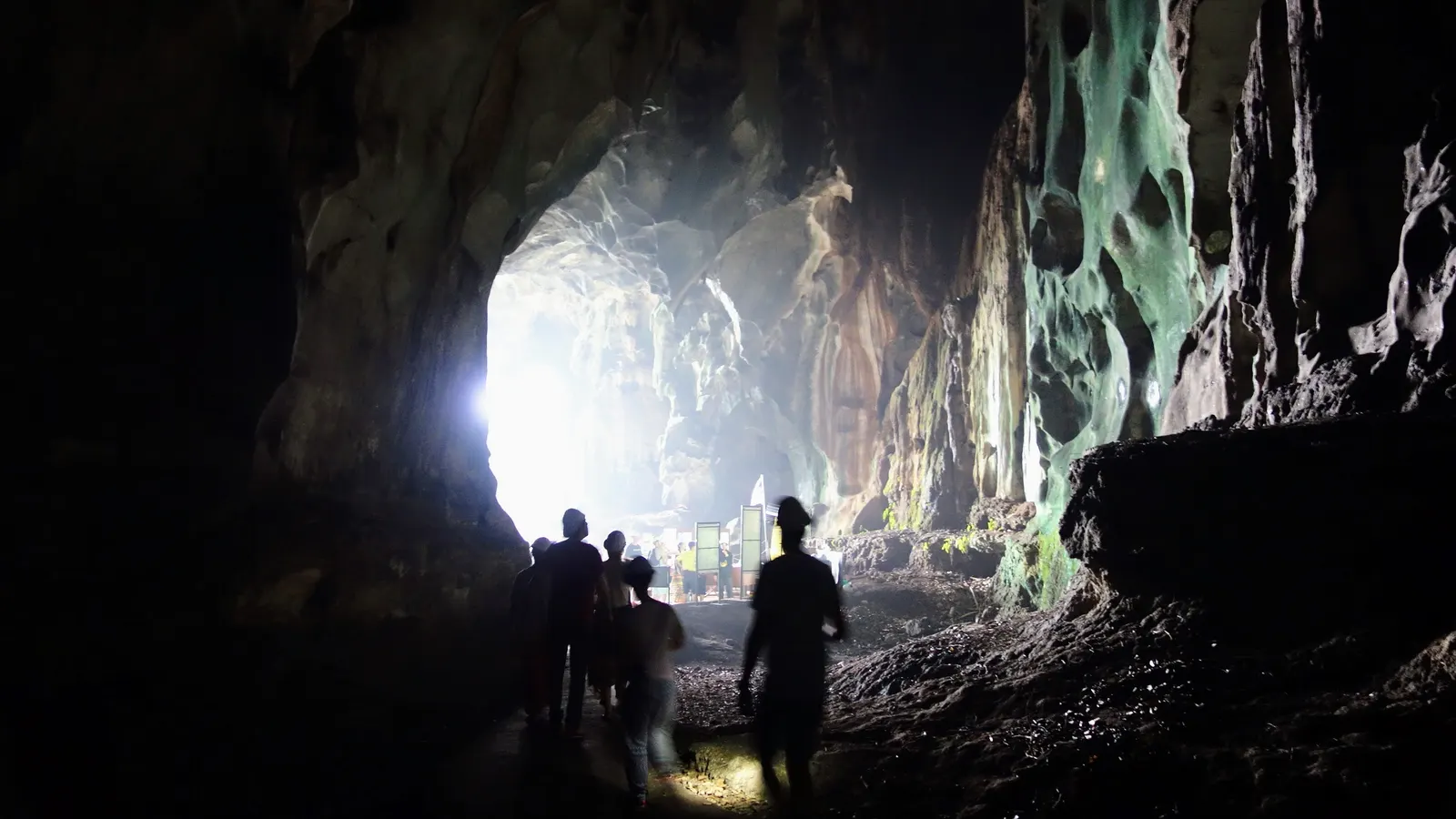
A limestone hill on the northern edge of Kuala Lumpur, roughly 400 million years old, with a Hindu temple inside it since 1891. A staircase of 272 painted steps climbs to the Temple Cave, a hall about 80 metres long under a vault some 100 metres high, with daylight dropping through holes in the roof. Getting into that main cave costs nothing – only the two side caves, Ramayana Cave and Cave Villa, charge admission.
- TicketsNo advance planning needed.
- Pricefree, donations welcome – Temple Cave (Cathedral Cave) – the main cave at the top of the stairs
- OpenThe temple hill is open every day, normally from early morning until about 9 pm.
- Best timeA weekday between 7 and 9 in the morning.
- ClaustrophobiaNot an issue.
The caves compared
Temple Cave (Cathedral Cave)
The main event, and what everyone means by "Batu Caves": a hall about 80 metres long under a vault roughly 100 metres high, with holes letting daylight in. The Murugan shrine has stood at the top since 1891; at the back, more steps climb to a second chamber that is open to the sky. The only way in is up the 272 steps.
The one part of the complex that has never charged admission – and the most impressive. Shoes and socks off before each individual shrine.
free (donation boxes at the shrines)
Ramayana Cave
A separate cave to the left of the staircase, behind the 15-metre Hanuman statue. Inside, the Ramayana is told in groups of brightly painted figures lit in turquoise and violet LED. Kitsch, and none of it old – but far emptier than the main cave.
The only cave in the complex you can see without climbing anything. Parts of the walls are defaced with graffiti.
15 RM for foreign visitors, 7 RM with MyKad (about $3.70 / $1.70); older guides and a good deal of the English-language internet still quote 5 RM
Dark Cave
A roughly two-kilometre undeveloped cave system halfway up the staircase, entered at step 204. The Malaysian Nature Society took groups through it in helmets and headlamps – among other things to see the trapdoor spider Liphistius batuensis, which lives nowhere else. Closed since January 2019; up to our research cut-off on 20 September 2026 we found no reliable confirmation that it has reopened.
The only part of the site that was genuinely dark and tight – and the reason so many English-language guides to Batu Caves are out of date.
no access at present; before the closure 35 RM (Educational Tour) or 80 RM (Adventure Tour)
Cave Villa
A privately run attraction at the foot of the hill: two lit show caves with painted figures from Hindu mythology and portraits of Indian poets, plus a koi pond. At the back, a reptile show with snakes, lizards and turtles.
The animal keeping has drawn heavy criticism in visitor reviews for years – small, dark tanks with no daylight. If you would rather not support that, skip it; the show caves alone barely justify the price.
15 RM for foreign visitors, 7 RM with MyKad (about $3.70 / $1.70)
Tickets and prices
No advance planning needed. There is no ticket at all for the Temple Cave – you simply walk up the stairs. Ramayana Cave and Cave Villa take money at a small booth beside their own entrance.
Official prices
- Temple Cave (Cathedral Cave) – the main cave at the top of the stairsfree, donations welcome
- Ramayana Cave, foreign visitors15 RM (about $3.70)
- Ramayana Cave, Malaysians with MyKad7 RM (about $1.70)
- Cave Villa, foreign visitors15 RM (about $3.70)
- Cave Villa, Malaysians with MyKad7 RM (about $1.70)
- Sarong or wrap at the foot of the stairs if your knees are bare (cash only)5–15 RM (about $1.20–3.70); sources differ on whether this is a hire charge or a purchase
- Dark Cave, Educational Tour (price before the closure)35 RM adults / 25 RM children (about $8.60 / $6.10)
- Dark Cave, Adventure Tour (price before the closure)80 RM adults / 55 RM children (about $19.60 / $13.50)
- Car park at the foot of the hillabout 3 RM (roughly $0.75)
As of 09/2026 · source and direct booking: facebook.com/BatuCavesMuruganTemple
When everything is sold out
Not applicable. Visitor numbers are not capped; at weekends and on public holidays the staircase is simply busy.
Tours and transfers to Batu Caves
You do not need to buy anything to get in: the main cave is free and the KTM Komuter stops right at the forecourt. An operator is worth it only for what the temple does not provide – hotel pickup, someone to explain Murugan and Thaipusam, and other stops around Kuala Lumpur folded into one morning.
Kuala Lumpur: Batu Caves Half-Day Tour with Pick-Up Option
From Kuala Lumpur: Batu Caves Cultural Temple Tour
Kuala Lumpur: Batu Caves, Ramayana Caves & Kanching Falls
Kuala Lumpur: City Tour & Batu Caves Combo
Show all 7 offers
Booked through GetYourGuide (affiliate link, advertising). Most offers can be cancelled free of charge up to 24 hours ahead. Prices as of 20 September 2026.
Opening hours and best time
The temple hill is open every day, normally from early morning until about 9 pm. Sources disagree on the exact hours: showcaves.com and several guidebooks say 6 am to 9 pm, others 7 am to 9 pm or 6.30 am to 8.30 pm. Anyone arriving between 8 am and 6 pm will certainly find it open. The side caves keep shorter hours: Ramayana Cave roughly 9 am to 6 pm, Cave Villa roughly 9 am to 5 pm. At Thaipusam (2027: 22 January) the complex stays open right through the night. The Dark Cave has been closed since January 2019.
When it is quietest
A weekday between 7 and 9 in the morning. It is still bearable at around 25 °C, the coaches have not arrived, and the macaques are less active. From about 10 am the sun is full on the staircase and at 32 to 35 °C with high humidity the 272 steps become genuine work. Late afternoon from 5 pm is the second-best slot, with the risk of the thunderstorms the Klang valley is known for. Avoid weekends and Malaysian public holidays. Unless you have come specifically for the festival, do not plan your visit for Thaipusam (2027: Friday 22 January) – several hundred thousand people are on the hill that day.
Who it suits
With children
Broadly good for children: no ticket, no tight passages, no darkness – the Temple Cave is a bright, airy hall. The 272 steps are hard work for small legs, though, and the monkeys will crowd a child holding food. Bring a carrier rather than a pushchair.
Minimum age
None.
Wheelchair
No. The only way to the Temple Cave is up the 272 steps; there is no lift, ramp or cable car. The temple announced an escalator in 2024; in January 2026 the project was still waiting on approvals from the Selangor state government, and as of our research cut-off on 20 September 2026 nothing was in service. The forecourt with the Murugan statue, the Ramayana Cave and the Cave Villa are all at ground level and can be reached without stairs.
Pushchair
Not workable on the staircase. No problem on the forecourt below.
Dogs
This is a working Hindu temple – dogs do not belong here, and with the macaques around it would be a bad idea anyway.
Claustrophobia
Not an issue. The Temple Cave is an open hall with holes in the vault letting daylight in; there are no narrow passages on the route. The tight crawls were in the Dark Cave, and that is closed.
What to wear
Knees must be covered, and shoulders too – for women and men alike. This is checked at the foot of the staircase. Turn up in shorts or a sleeveless top and you will be sent to the stall for a wrap or sarong, cash only (quoted between 5 and 15 RM), and you will not be allowed up without it. Add firm, non-slip shoes: the steps vary in height, are often damp and are made slippery by pigeon droppings. Carry plenty of water in the heat and humidity – but not loose in your hand, because of the monkeys.
Photography
Photography is allowed across the site and inside the Temple Cave; do not use flash at the shrines. People at prayer are not photographed without being asked, and certainly not close up. Tripods and drones are impractical in the crowds and unwelcome on busy days.
Getting there
By public transport
By KTM Komuter on the Batu Caves–Pulau Sebang line (called the Seremban line until 2016). Batu Caves is the northern terminus and the platform sits right beside the forecourt – 200 metres and you are standing under the Murugan statue. From KL Sentral it is eight stops and 35 to 40 minutes; a single is 2.60 RM (about $0.64) from the machine or 2.30 RM (about $0.56) with a Touch 'n Go card. Trains run roughly every 30 minutes, less often at weekends; the first departure from KL Sentral is around 6.56 am and the last return about 10.46 pm. There is no direct bus from KL Sentral.
By car
There is parking at the foot of the hill for about 3 RM (roughly $0.75). At weekends, on public holidays and above all at Thaipusam it fills early and the access road jams solid. A Grab from the city centre costs 20 to 40 RM (about $4.90–9.80) and takes 20 to 55 minutes depending on traffic – the afternoon run back is usually the slow one.
From the nearest city
13 km north of central Kuala Lumpur. Practically every route goes through KL Sentral: leave the concourse for platform 4 (direction Batu Caves) and stay on to the end – you cannot get off at the wrong stop. Coming from the airport, take the KLIA Ekspres or KLIA Transit from KLIA Terminal 1 or Terminal 2 to KL Sentral: 55 RM (about $13.50), 28 minutes from T1 on the Ekspres, 39 minutes from T2 on the Transit, departures every 20 minutes on the Ekspres. Then change to the Komuter on the same station. A Grab from the airport into the city runs about 60 to 90 RM (roughly $15–22) plus motorway tolls and takes an hour or more in traffic, so the train is both cheaper and more predictable. Do not try to go straight from a morning landing to Batu Caves in rush hour – drop the bags first.
Tips for your visit
- Come early. Between 7 and 9 on a weekday morning you have the staircase, the light and the temperature on your side; after ten it turns hot and crowded.
- Cover your knees before you arrive. The check is at the foot of the stairs, and buying a wrap there costs cash, quoted between 5 and 15 RM. Light long trousers save both the money and the conversation.
- Carry nothing edible in the open. The macaques go for bags, bottles and ice creams. Close your rucksack, wear it on your front, and neither eat nor drink on the stairs.
- Bring small notes. Ramayana Cave, Cave Villa, the sarong stall and the car park all take cash only.
- Shoes and socks off in front of each shrine, onto the racks beside them. On the staircase and in the hall they stay on.
- Take the train, not a car. The KTM Komuter stops right at the forecourt, costs 2.60 RM and skips the queue on the access road.
- Budget your time honestly: main cave including the climb, 45 to 60 minutes; add the Ramayana Cave and it is about two hours. Batu Caves only fills half a day if you also go climbing on the limestone.
- Carry water, but in the rucksack. There are coconuts and vegetarian Indian food on the forecourt below; up in the cave there is nothing.
- In rain the steps turn slippery and the vault drips into the hall. Non-slip shoes help more than an umbrella, which is in the way on the staircase anyway.
- Treat it as a service, not a sight. Step aside for pilgrims carrying offerings, keep your voice down at the shrines, and do not photograph anyone at prayer from close range.
What the internet gets wrong
The Dark Cave has been closed since January 2019 and no reliable source records a public tour since. Pages still selling it in the present tense include theglobalwizards.com (“If you want to visit the Dark Cave, it will cost you RM 35… You will get a guide and the tour lasts around 45 minutes”), hikerhero.com (“in Dark Cave… you can get a guided tour to go deeper”) and shanylou.co.uk (“the Dark Caves cost RM33 per person… includes a helmet, flashlight and a guide”). malaysia-traveller.com has carried it as “closed until further notice” since 2019, and mytravellane.com and timetravelturtle.com both confirm it is still shut in 2026.
Foreverbreak.com, updated for 2026, writes that it “is frequently closed and only opens when demand is high and tour guides are available”, and kuala-lumpur-tickets.com heads its page “Dark Cave: A Must-see on Your Batu Caves Itinerary”, calls the closure one of “over three years” and still advises readers to “book at least a week in advance”. The closure began in January 2019 – that is well over seven years by September 2026, not three – and it is not a pandemic closure either, since it predates the pandemic by about a year.
The Headout travel blog lists “Ticket Price MYR 45” for Batu Caves. Nothing is charged for the Temple Cave and nothing ever has been; batucaves.tours states plainly that “the main Temple Cave, the 272-step staircase, the Lord Murugan statue, and the entire forecourt area are completely free.” The 45 ringgit is a tour package. Only Ramayana Cave and Cave Villa charge, 15 RM each for foreign visitors.
Still quoted by batucaves.tours (“RM 5 per person for all visitors”), foreverbreak.com (“RM5 (USD$1.24)”) and theglobalwizards.com. Visitor reports and guides from 2026 – feastographyblog.com, malaysiauncovered.com, mytravellane.com, nashaplaneta.net – all give 15 RM for foreigners and 7 RM for Malaysians with MyKad, the same two-tier pricing as the Cave Villa. We could not find an official price list online, so bring enough cash for 15.
Hikerhero.com writes “Sure there are nearly 300 of them”, blog.raynatours.com “the 270+ steps”. The figure is exactly 272 concrete steps, built in 1940 and unchanged since – confirmed by the English Wikipedia and by a fact-check in the Malaysian daily The Star. Higher counts such as 373 come from adding the separate flight inside the cave that leads to the rear chamber; we could not verify the size of that inner flight in any reliable source, so we quote only the 272 for the climb.
The temple announced one in January 2024 and held a groundbreaking ceremony on 25 January 2025, with completion targeted for Thaipusam 2026 (varnam.my). That target was missed. In January 2026 Free Malaysia Today and Malaysiakini reported that the state of Selangor and the temple had only reached an understanding “pending technical approvals”, with the chairman saying the matter would be settled “by July”. The 2026 accessibility guide at batucaves-guide.com is unambiguous: “There is no lift, escalator, or ramp alternative to the 272-step staircase.” We found no evidence of one running by 20 September 2026.
None of it holds. The KTM Komuter runs on the Batu Caves–Pulau Sebang line (renamed from the Seremban line in July 2016), Batu Caves is its northern terminus, the platform is 200 metres from the staircase, and trains go roughly every 30 minutes, not hourly. The Port Klang line runs the other way entirely. There is no ticket, no time slot and no registration for the main cave. A tour buys you hotel pickup, an explanation of Murugan and Thaipusam, and other stops in one morning – not access.
Seasia.co says exactly that, and it was true from 2006 until the 44.5-metre (146 ft) Muthumalai Murugan statue was completed at Salem in Tamil Nadu. The Batu Caves statue is 42.7 metres: the tallest statue in Malaysia, and the second-tallest statue of Murugan anywhere, as both the English Wikipedia article and its list of tallest Hindu deity statues state.
History in brief
- The hill's limestone formed in the sea more than 400 million years ago; the cavities inside it are far younger, hollowed out between the late Cretaceous and the early Tertiary, roughly 60 to 120 million years ago.
- From about 1860 Chinese settlers dug bat guano out of the caves to fertilise their vegetable plots; in 1878 the American naturalist William Hornaday described the caves, which brought them into colonial literature.
- In 1891 the Tamil trader K. Thamboosamy Pillai installed a shrine to Murugan in the great cave. The shape of the entrance reminded him of the tip of the vel, the god's spear.
- Thaipusam has been celebrated here since 1892 – today on a larger scale than anywhere else in the world.
- In 1920 the hill got a wooden staircase. As it decayed it was replaced in 1940 by today's 272 concrete steps, finished in time for that year's Thaipusam.
- On 29 January 2006 the 42.7-metre Murugan statue at the foot of the stairs was unveiled: three years of work, 350 tonnes of steel, 1,550 cubic metres of concrete and 300 litres of gold paint. It is the tallest statue in Malaysia and the second-tallest Murugan statue in the world.
- In July 2010 the site got its own station on the KTM Komuter line; in late 2016 a fourth lane was added to the staircase to ease the Thaipusam crush.
- In August 2018 around a hundred volunteers painted the previously grey steps in bright colours over two and a half days, for the Kumbhabhishekam re-consecration that falls every twelve years. The work went ahead without the national heritage department's approval and set off a nationwide argument about conservation; the colours stayed.
- The Dark Cave has been shut to visitors since January 2019. In 2024 the temple administration announced an escalator for elderly and less mobile pilgrims, to be built beside the staircase so as not to touch it. A groundbreaking ceremony was held in January 2025; a year later, in January 2026, the project was still waiting on approvals from the state of Selangor.
Frequent questions
How much does it cost to enter Batu Caves?
Nothing for the main cave. The Temple Cave at the top of the 272 steps is free to enter, with donation boxes at the shrines. Only the Ramayana Cave and the Cave Villa charge – 15 RM each for foreign visitors and 7 RM for Malaysians with MyKad, so about $3.70 and $1.70 (as of 09/2026). Both take cash only. Anything sold online as a "Batu Caves ticket" is a tour, a transfer or a package.
How many steps are there at Batu Caves?
272 concrete steps, laid out in four lanes side by side. They date from 1940 and replaced a wooden staircase of 1920. Inside the cave a further flight climbs to the rear chamber, which is why higher counts circulate. The climb gains about 100 metres; a reasonably fit walker takes 10 to 15 minutes.
How do I get from Kuala Lumpur to Batu Caves without a tour?
Take the KTM Komuter from KL Sentral on the Batu Caves–Pulau Sebang line to the end of the line. The ride is 35 to 40 minutes and costs 2.60 RM from the ticket machine or 2.30 RM with a Touch 'n Go card – about 60 cents. Trains run roughly every 30 minutes and the platform is 200 metres from the staircase. A Grab from the city centre costs 20 to 40 RM and takes 20 to 55 minutes depending on traffic.
How do I get to Batu Caves from KLIA or klia2?
Take the KLIA Ekspres or KLIA Transit to KL Sentral – 55 RM, about $13.50, 28 minutes from Terminal 1 on the Ekspres and 39 minutes from Terminal 2 on the Transit, with Ekspres departures every 20 minutes – then change on the same station to the Komuter for Batu Caves. Total journey time is a little over an hour and a half. A Grab from the airport runs about 60 to 90 RM plus tolls and is slower in traffic.
Is there a dress code at Batu Caves, and what should I wear?
Knees and shoulders must be covered, for women and men equally. This is checked at the foot of the staircase, and anyone in shorts or a sleeveless top has to take a wrap or sarong there for cash – quoted between 5 and 15 RM – and will not be allowed up without it. Head coverings are not required. Wear firm, non-slip shoes; shoes and socks come off in front of each individual shrine inside the cave, but stay on for the staircase.
Can you visit Batu Caves without a guided tour?
Yes, and most people do. There is no ticket, no time slot and no booking for the Temple Cave; the train terminus is 200 metres from the staircase, and the route is one flight of steps with nowhere to get lost. A guide is worth paying for if you want the religious background explained or want Batu Caves combined with other stops around Kuala Lumpur in a morning – not for access.
Is the Dark Cave open?
No. The Dark Cave at step 204 has been closed to visitors since January 2019, and the Malaysian Nature Society's guided tours have not run since. English-language pages still quoting 35 RM, helmets and headlamps are out of date. If you want a genuine undeveloped cave in Malaysia, go to Gua Tempurung near Gopeng in Perak.
How long does a visit to Batu Caves take?
Allow 45 to 60 minutes for the main cave including the climb and a look around. With the Ramayana Cave, the forecourt and a photo stop at the Murugan statue it comes to about two hours. Longer only makes sense if you add the Cave Villa or go rock climbing on the limestone next door.
What is the best time of day to visit Batu Caves?
A weekday between 7 and 9 in the morning. It is around 25 °C rather than 32 to 35, the coaches have not arrived, and the monkeys are calmer. Late afternoon from 5 pm is second best, with the risk of the thunderstorms that the Kuala Lumpur area is known for.
Are the monkeys at Batu Caves dangerous?
They are wild long-tailed macaques habituated to people, not zoo animals, and they go for anything that might be food. In practice: no plastic bag in your hand, rucksack closed and worn on your front, no eating or drinking on the stairs, and no feeding. If one grabs something, let go instead of pulling. After a bite or a deep scratch see a doctor promptly – macaques can carry rabies. Early morning there are far fewer of them.
Is Batu Caves wheelchair accessible? Is there a lift or escalator?
Not the Temple Cave: the 272 steps are the only way up, and there is no lift, ramp or cable car. An escalator was announced in 2024 and broke ground in January 2025, but in January 2026 it was still waiting on Selangor state approvals and was not in service as of September 2026. At ground level you can reach the forecourt with the 42.7-metre Murugan statue, the Ramayana Cave and the Cave Villa.
When is Thaipusam 2027, and should I go that day?
Thaipusam falls on Friday 22 January 2027 and is a public holiday in Kuala Lumpur, Selangor, Penang, Perak, Johor, Negeri Sembilan and Putrajaya. Around a million people come to Batu Caves across the three days. A silver chariot is drawn overnight some 13 kilometres from the Sri Mahamariamman temple in the city centre; devotees carry kavadi frames and pots of milk up the steps, many with hooks and skewers through their skin, fulfilling vows. It is an act of worship, not a show: you stand for hours, move slowly, and the trains and roads are overwhelmed. If you have come for the festival, give it the whole day and arrive at night. If you have come to see the cave, come on another day.
Are Batu Caves worth visiting?
For a free entry and half an hour on the train: yes. The hall with its hundred-metre vault and shafts of daylight is genuinely impressive, and so is the gold statue in front of it. If you are expecting a stalactite cave or a caving experience, you will be disappointed – since the Dark Cave closed, Batu Caves is a temple hill with one very large cave rather than a caving destination.
Do I need to book tickets in advance for Batu Caves?
No. There is no ticket, no time slot and no registration for the Temple Cave, and the two paid side caves take cash at their own entrance. Anything advertised online as a "Batu Caves ticket" is a tour, a transfer or a combination package.
Can I take photos at Batu Caves?
Yes, on the site and inside the Temple Cave. Skip the flash at the shrines and do not photograph worshippers close up without asking. Drones and tripods are impractical in the crowds and unwelcome on busy days.
Sources
Show 42 sources – every figure on this page is sourced
- en.wikipedia.org/wiki/Batu_Caves – 272 concrete steps (1940), wooden staircase 1920, temple 1891, Thaipusam from 1892, Murugan statue 42.7 m (January 2006) and second-tallest Murugan statue, limestone over 400 million years old, cave formation 60–120 million years ago, 20 caves, Hanuman statue 15 m, around 160 climbing routes, 325 m massif, 13 km north of KL
- en.wikipedia.org/wiki/Batu_Caves_Murugan_Statue – Statue: 42.7 m, built 2004–2006, 350 t steel, 1,550 m³ concrete, 300 l gold paint, unveiled 29 January 2006, tallest statue in Malaysia
- en.wikipedia.org/wiki/List_of_tallest_Hindu_deity_statues – Muthumalai Murugan statue at Salem, Tamil Nadu: 44.5 m (146 ft), completed 2020, tallest Murugan statue in the world; Batu Caves statue 42.7 m, second-tallest – basis for correcting the “world's tallest” claim
- www.showcaves.com/english/my/showcaves/Batu.html – Opening hours of the individual caves, prices for Cave Villa (15/7 RM) and Dark Cave (35/25 and 80/55 RM), Temple Cave 80 m long under a 100 m vault, Dark Cave 2,000 m at 24–30 °C and 78 % humidity, entrance at step 204, guano from 1860, station since July 2010
- murugan.org/temples/batumalai.htm – Founded 1891 by K. Thamboosamy Pillai, Thaipusam from 1892 with around 1 million people over three days, administration by the Sri Maha Mariamman Temple Devasthanam, cave “about 400 feet above the ground”, 272 steps
- www.malaysia-traveller.com/batu-caves.html – Dark Cave “closed until further notice” since January 2019, prices for Cave Villa and Ramayana Cave, Gua Damai, around 6,000 visitors a day
- www.timetravelturtle.com/malaysia/batu-caves/ – Status 2026: Dark Cave closed with no prospect of reopening, main cave free, train 2.60 RM from KL Sentral, 272 steps, monkeys on the staircase, visiting independently
- www.mytravellane.com/batu-caves-opening-hours-entrance-fee-and-… – 2026 guide: Temple Cave free, Ramayana Cave 15 RM (“recently increased from the RM5 quoted in older guides”), Cave Villa 15/7 RM, Dark Cave “closed to the public since 2019” and “has not reopened”, hours 6 am–9 pm
- www.klsentral.info/kuala-lumpur-batu-caves-travel/ – KTM Komuter from KL Sentral: 2.60 RM cash or 2.30 RM with Touch 'n Go, about 40 minutes, eighth stop, every 30–60 minutes, first train 6.56 am, last 10.46 pm, no direct bus
- en.wikipedia.org/wiki/KTM_Komuter – Line named Batu Caves–Pulau Sebang since 11 July 2016 (previously the Seremban line), opposite terminus Pulau Sebang/Tampin, separate Tanjung Malim–Port Klang line – basis for correcting the “Port Klang line” claim
- www.train36.com/ktm-kl-sentral-to-batu-caves.html – KL Sentral–Batu Caves Komuter: journey “just over half an hour”, roughly every 30 minutes on weekdays and less often at weekends, tickets sold on the day of travel only
- www.kliaekspres.com/products-fares/klia-transit/ – KLIA Transit and KLIA Ekspres: adult single KL Sentral–KLIA 55 RM, 39 minutes from Terminal 2, trains every 15–30 minutes
- www.cktravels.com/kuala-lumpur-airport-to-city-transport/ – Airport transfer 2026: Ekspres and Transit both 55 RM, 36 minutes from KLIA and 39 from klia2; Grab from klia2 into central KL usually 60–70 RM plus under 10 RM of tolls
- publicholidays.com.my/thaipusam/ – Thaipusam 2027 on Friday 22 January; public-holiday status by state; more than 1 million people at Batu Caves, kavadi and milk pots
- www.freemalaysiatoday.com/category/nation/2026/01/18/go-ahead-f… – 18 January 2026: understanding reached between Selangor and the temple, escalator still “pending technical issues” – evidence that no escalator was operating
- www.malaysiakini.com/news/767027 – Status of the escalator in January 2026: Selangor state approval outstanding, chairman R. Nadarajah says the matter will be settled “by July”
- varnam.my/103586/groundbreaking-ceremony-for-batu-caves-escalat… – Groundbreaking ceremony for the escalator on 25 January 2025, state approval letter promised for 19 January 2025, completion targeted before Thaipusam 2026 – the target that was missed
- www.hinduismtoday.com/hpi/2024/01/28/malaysias-batu-caves-templ… – Escalator announced on 19 January 2024 by R. Nadarajah, construction to start after Thaipusam, aim of access for elderly and disabled pilgrims, 272 steps
- www.therakyatpost.com/news/2024/01/20/escalator-to-be-built-at-… – Escalator to be built beside the 272 steps, multipurpose hall for about 35 million RM, quotes from Nadarajah
- batucaves-guide.com/plan-your-visit/accessibility/ – 2026 accessibility guide: “There is no lift, escalator, or ramp alternative to the 272-step staircase” – the staircase is the only route to the Temple Cave
- batucaves-guide.com/plan-your-visit/faqs/ – Status 2026: no lift, escalator or cable car; Temple Cave without a ticket; Grab 25–40 RM; best time 7–9 am on weekdays
- www.wegowithanuar.com/destinations-in-malaysia/batu-caves/dress-code/ – Dress code (knees and shoulders), check at the foot of the stairs, sarong 15 RM cash only, no head covering required, shoes and socks off at each shrine, photography allowed
- malaysiauncovered.com/batu-caves/ – Prices for Ramayana Cave and Cave Villa, opening hours of the side caves, sarong 15 RM, Grab about 20 RM, train about 35 minutes, more than 1.3 million visitors a year
- www.feastographyblog.com/blog/ramayana-cave – Ramayana Cave: 15 RM for tourists, 7 RM for locals; LED lighting, graffiti on the walls, opening hours
- nashaplaneta.net/asia/malaysia/kuala-lumpur-dostoprimechatelnos… – Status 08/2026: Ramayana Cave 15 RM, Temple Cave free, Dark Cave with no regular tours, sarong 15 RM, Grab 20–40 RM, trains every 30–40 minutes, monkeys stealing food and water
- guideyourtravel.com/how-to-plan-your-visit-to-batu-caves-kuala-… – Opening hours 6 am–9 pm, Dark Cave closed indefinitely, sarong about 5 RM, train 2.60 RM and about 35 minutes, do not feed the monkeys, best time 6–8 am, length of visit
- theendlesstravellers.com/visiting-batu-caves/ – Dress code enforced, monkeys active from about 8 am, train 2.60 RM and about 40 minutes, Grab from about 15 RM, visit 1–2 hours, avoid weekends
- www.thestar.com.my/news/true-or-not/2023/02/03/quickcheck-were-… – Malaysian daily fact-check: “272 concrete steps” as the correct figure, and the original wooden staircase
- en.wikipedia.org/wiki/Kuala_Lumpur – Climate: annual mean about 27.8 °C, daytime highs 32–35 °C, humidity around 81 %, frequent thunderstorms in the Klang valley
- www.ecb.europa.eu/stats/policy_and_exchange_rates/euro_referenc… – ECB reference rate 1 EUR = 4.6763 MYR on 18 September 2026
- www.ecb.europa.eu/stats/policy_and_exchange_rates/euro_referenc… – ECB reference rate 1 EUR = 1.1460 USD on 18 September 2026 – cross-rate with the MYR rate gives 1 USD = 4.0805 MYR, the basis for every dollar figure here
- www.xe.com/en-us/currencyconverter/convert/?Amount=1&From=USD&To=MYR – Cross-check: 1 USD = 4.0841 MYR at 14:23 UTC on 20 September 2026
- www.facebook.com/BatuCavesMuruganTemple/ – Official presence of the Batu Caves Sri Subramaniar Swamy Temple – the temple administration's only channel; there is no website of its own and no ticket sales
- theglobalwizards.com/visiting-the-batu-caves-near-kuala-lumpur-… – Evidence for two English-language errors: “If you want to visit the Dark Cave, it will cost you RM 35 … and RM 25 for children. You will get a guide and the tour lasts around 45 minutes”, and “The Ramayana Cave is RM 5”
- hikerhero.com/batu-caves/ – Evidence for two English-language errors: “Sure there are nearly 300 of them” about the steps, and “in Dark Cave … you can get a guided tour to go deeper”
- shanylou.co.uk/a-guide-to-batu-caves/ – Evidence for an English-language error: “Entrance to Batu Caves is FREE and the Dark Caves cost RM33 per person”, “The Dark Caves ticket includes a helmet, flashlight and a guide”
- foreverbreak.com/travel/malaysia/kuala-lumpur/batu-caves/ – Evidence for two English-language errors in a guide updated for 2026: the Dark Cave “is frequently closed and only opens when demand is high and tour guides are available”, entry “RM33 (USD$8.16)”, and “Ramayana Cave … RM5 (USD$1.24)”
- www.kuala-lumpur-tickets.com/batu-caves/dark-cave/ – Evidence for an English-language error: the page is headed “Dark Cave: A Must-see on Your Batu Caves Itinerary”, describes the closure as “for over three years”, quotes “RM 35 for a 40-minute session” and advises readers to “book at least a week in advance”
- batucaves.tours/batu-caves-entry-fee – Correct on the free main cave (“the main Temple Cave, the 272-step staircase, the Lord Murugan statue, and the entire forecourt area are completely free”) and on the Dark Cave being closed since January 2019, but evidence for the price error “Entry to the Ramayana Cave costs RM 5 per person for all visitors”
- www.headout.com/blog/batu-caves/ – Evidence for the misleading price figure “Ticket Price MYR 45”; also guano mining from the 1860s, William Hornaday 1878, wooden staircase 1920 and concrete staircase 1940, 272 steps
- seasia.co/2025/10/07/visit-batu-caves-home-to-the-worlds-talles… – Evidence for the English-language error “the tallest Murugan statue in the world” (height correctly given as 42.7 m, launched 2006); also entry free and 272 steps
- blog.raynatours.com/batu-caves-temple-dress-code/ – Evidence for the vague step count “the 270+ steps”; also dress code with knees covered and sarongs at MYR 15, described as rental