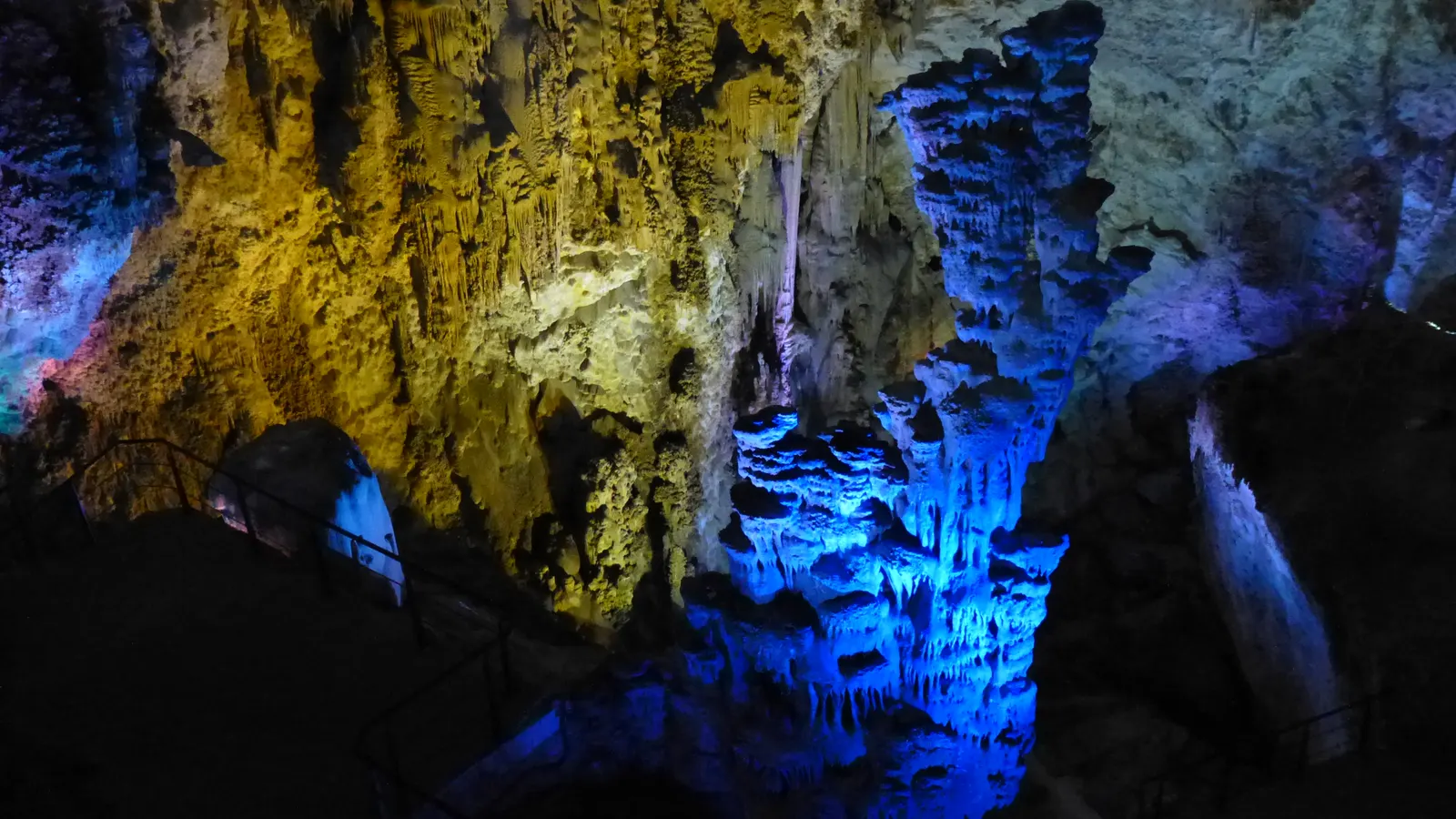
One enormous chamber rather than a system of passages: the vault above you is 70 m (230 ft) high and the operator calls it one of the highest in Spain. You walk in through a 45 m tunnel that Republican troops blasted through the rock in the Civil War, when the chamber was an aircraft-engine workshop; the platforms you stand on date from the same work. Guided tours only, about 45 minutes, every 40 minutes, in Spanish with a shorter English summary. Admission is €12 (about $13.75) and includes the ethnic music museum down in the village.
- TicketsEvery ticket is for a named pass at a named time.
- Price€12 (about $13.75) – Adult from 16, cave plus the Ethnic Music Museum in Busot
- OpenTwo seasons, and the winter one is the long one.
- Best timeA weekday morning outside the Spanish school holidays, on the first or second pass of the day – reviewers who were the first group in say the difference is real, and the parking is easiest then.
- ClaustrophobiaThe chamber is the opposite of tight – it is 70 m high and you can see the whole of it from the entrance platform.
Tickets and prices
Every ticket is for a named pass at a named time. The town council's booking system colours each day green for available, amber for last places and red for full or closed. On 20 September 2026 every open day for the following ten days was amber, while most of October was still green – so a week or two ahead is usually enough, a day or two at a weekend often is not. Tickets are released well beyond the current month.
Official prices
- Adult from 16, cave plus the Ethnic Music Museum in Busot€12 (about $13.75)
- Children 5 to 16€5 ($5.73)
- Under 5free
- Pensioners€6 ($6.88)
- Holders of a Carnet Jove or a university card€6 ($6.88)
- Adults from 16 with a recognised disability of 33 per cent or more€6 ($6.88)
- Children up to 16 with a recognised disabilityfree
- Organised groups from 20 people, per person€7 ($8.02)
- Residents registered in Busotfree
- Ethnic Music Museum on its own, adult€2.50 ($2.87)
- Ethnic Music Museum on its own, concessions and children 5 to 15€1.50 ($1.72)
- Car park at the cavefree
- Souvenir photograph taken at the tunnel mouth, sold afterwards with a booklet and a QR code to further images€6 ($6.88) reported by a visitor in 2024; the operator publishes no price
- Guided tours from Alicante or Benidorm with transfer and admission, sold by resellersfrom about £44–£47 (about $59–$63)
- Conversion€1 = $1.146 and £1 = $1.34, reference rates of 20 September 2026; dollar figures rounded to the cent
As of 09/2026 · source and direct booking: turismobusot.com/que-ver/las-cuevas-del-canelobre
When everything is sold out
Individual passes go before whole days do. For Tuesday 22 September 2026, checked on 20 September, only six of the day's passes were still on sale online: 11.00, 11.40, 13.00, 13.40, 15.00 and 16.20. The gaps in a 40-minute grid are the passes already gone.
Tours to the Canelobre Caves from Alicante and Benidorm
Buying at the cave is far cheaper: the town council charges €12 (about $13.75) for an adult, €5 for a child of 5 to 16, and the same price online as at the ticket office. Every tour on the resale platforms costs several times that – from about £44 to £47 (roughly $59 to $63) – because what you are paying for is the drive, not the entrance. That is a fair trade in one case: there is no bus to the cave. The village of Busot is served four times a day on weekdays and the cave is another 3 km up a narrow mountain road, so without a car a tour with transfer is the realistic way there. Groups are small, most run 2.5 to 3.5 hours and most add the village of Busot. If you are driving, book the operator's own timed pass instead and put the difference towards lunch. One thing no reseller can sell you is an English tour: the guide in the cave works in Spanish and adds a shorter English version, whoever brought you.
Alicante: Canelobre Caves & Busot Tour including transfer
Alicante: Canelobre Caves & Busot – Local Guided Tour
Alicante: Canelobre Caves + Busot | Exclusive sightseeing tour with transport
Alicante: Canelobre Caves and Busot Tour
Show all 7 offers
Booked through GetYourGuide (affiliate link, advertising). Most offers can be cancelled free of charge up to 24 hours ahead. Prices as of 20 September 2026.
Opening hours and best time
Two seasons, and the winter one is the long one. Winter, 1 September to 30 June: closed Mondays, Tuesday to Friday 10.30am–4.50pm, Saturdays, Sundays and public holidays 10.30am–5.50pm. Summer, 1 July to 31 August: daily 10.30am–7.30pm. Easter 2026 (30 March to 6 April): daily 10.30am–6.20pm, and on 11 and 12 April only until 2pm, as on 24 December. Closed 1 January and 25 December. Those times are the ticket office, not the last tour; guided passes leave every 40 minutes, and on the winter weekday checked here the latest pass on sale was 4.20pm. Do not arrive at 4.45pm expecting to get in. The operator does not publish a list of pass times at all – you see them only after picking a date and a number of people in its booking system.
When it is quietest
A weekday morning outside the Spanish school holidays, on the first or second pass of the day – reviewers who were the first group in say the difference is real, and the parking is easiest then. The cave holds 17 to 19 °C all year, so the hotter it is outside the better the visit feels: in August you climb out of 30-plus degrees into a cool chamber. Against that, August is when the passes fill, the car park fills and the road is busiest. Winter weekdays are the quiet option, but note the short day: the office shuts at 4.50pm from September to June and the last pass goes well before that. Mondays are closed all winter.
Who it suits
With children
Good for children who can manage stairs. A Spanish visitor in August 2026 reported a five-year-old thinking a 45-minute visit too short. The under-5s go free, 5 to 16 pay €5, and the shapes-in-the-rock style of commentary is aimed squarely at families. The operator's published conditions require under-14s to be accompanied by an adult.
Minimum age
None published for the cave.
Wheelchair
Realistically no. The tunnel is level and there is a viewing platform just inside it from which you can see the chamber, but the visit proper is a stepped descent to the floor and a different stepped route back up, roughly 130 steps in total. Spanish guides describe the site as having adapted approaches while warning that parts of the route need stairs. If mobility is the question, write to cuevascanelobre@ebusot.com before you book rather than after.
Pushchair
Not usable on the route. Leave the pushchair at the tunnel mouth or in the car and carry a small child.
Dogs
No published rule for the cave. The museum that shares the ticket does publish one: no animals except guide dogs. Assume the same at the cave and ask first if it matters.
Claustrophobia
The chamber is the opposite of tight – it is 70 m high and you can see the whole of it from the entrance platform. The narrow part is the 45 m entrance tunnel, which takes a couple of minutes to walk. One thing nobody warns you about: a visitor in August 2026 abandoned the visit because the tunnel ceiling was covered in large spiders. If that would end your day, ask at the ticket office.
What to wear
17 to 19 °C (63 to 66 °F) all year with humidity near saturation, so a light jacket or jumper even in August, when you will have come from 30 °C outside. Closed, non-slip shoes: the steps and the platforms get slippery, and one visitor noted people arriving in flip-flops. Nothing drips on you to speak of, but the rock is wet.
Photography
Cameras and phones are not allowed inside. The operator does not print this anywhere, which is why so many English pages say the opposite, but visitor reports from 2024 and 2025 are unanimous: "No photos allowed", "we can't to make photos", "I can't add photos as it wasn't allowed". An official photographer takes your picture against a backdrop at the tunnel mouth and sells it afterwards – €6 in 2024, with a booklet carrying a QR code to a set of images of the cave. Photography outside, of the tunnel façade and of the view down to the coast, is unrestricted and that view is worth the walk on its own.
Getting there
By public transport
Effectively none, and that is not a matter of awkward connections but of arithmetic. No bus goes to the cave. Two Vectalia country routes serve the village of Busot: the C-51 from Mutxamel, which in the winter timetable runs four times each way on weekdays (from Mutxamel 7.40am, 12.15pm, 2.50pm, 8.40pm; back from Busot 7.20am, 8.45am, 2.30pm, 3.45pm), twice on Saturdays and twice on Sundays and holidays; and the C-52 to El Campello, which on weekdays runs once, out of Busot at 8am and back from El Campello at 2.10pm. Both stop at Sant Josep–Ermita in the village centre. From there the cave is another 3 km up the CV-776, climbing all the way, with no pavement. A taxi from the village or a booked tour is the practical answer; the nearest railway is the TRAM at El Campello, about 12 km away.
By car
Free car park at the cave, right by the tunnel entrance and the ticket office – you do not walk 1 km to get in, whatever one English family guide says. The catch is size: reviewers call the parking limited and the road up from Busot a mountain road, tarmacked but narrow, with bends and a steady climb. Coaches do it, but with drivers who know it. Go early or late in the day in high season, both for the space and for meeting less oncoming traffic.
From the nearest city
From the city of Alicante it is about 24 km and 25 to 30 minutes: the CV-773 off the Alicante–Alcoy road to Busot, then the CV-776 to its end. Alicante–Elche Airport (ALC) is roughly 36 km, around 35 minutes. Benidorm is about 45 km, three quarters of an hour by the N-332 or AP-7. El Campello, the nearest coast, is about 12 km. Valencia is 170 km away and is not a sensible day trip for this.
Tips for your visit
- Book online a week ahead in high season and a day or two ahead the rest of the year. The ticket office is real and sells for the same price, but it can only sell you passes that still have space.
- Read up on the Civil War workshop before you go. It is the most interesting thing about the place and the part of the commentary most likely to be cut short in the English summary.
- Take a jumper. 18 °C sounds mild until you have stood still in it for 45 minutes at close to 100 per cent humidity, having arrived from a Costa Blanca afternoon.
- Wear closed shoes with grip. There are roughly 130 steps, and the steps and platforms are damp.
- Leave the camera in the bag. Photography is not allowed inside; the only picture you will come home with is the one the house photographer takes at the tunnel mouth, which you can buy or decline.
- Do the view. The terrace outside the tunnel looks north over the Cabeçó d'Or and down to the Mediterranean, and it costs nothing; several reviewers rate it as highly as the cave.
- Drive up early or late. The CV-776 is narrow with bends, the car park is small, and meeting a coach coming down is nobody's idea of a holiday.
- Use the museum half of your ticket, or at least know you are not using it. It is in Busot village five minutes away, it closes for lunch between 2.30pm and 3.30pm, and on its own it would cost €2.50 – so the "combined ticket" is, in effect, the cave price plus a small extra.
- If steps are a problem, say so at the ticket office before you buy. You can see the whole chamber from the platform inside the tunnel without descending; that may be enough.
What the internet gets wrong
All long out of date, and the age bands have moved as well. The town council charges €12 (about $13.75) for adults from 16, €5 ($5.73) for children 5 to 16 and €6 ($6.88) for pensioners, students and adults with a disability. The €7 that these pages quote is now the per-person rate for organised groups of 20 or more. The rise came in steps: €8 to €9 from 27 January 2024, with the adult band still starting at 14, and €12 with the band starting at 16 by February 2025, when a visitor recorded paying it.
2026 Prices, Hours & Family Guide" is the title kidvoyage.com gives its page, which then lists ticket prices of "4 EUR, 8 EUR, 5 EUR". None of those is a 2026 price. The same page invents the approach: "There is a small footpath about 1 km long that leads to it." The free car park is beside the tunnel entrance.
Not close. Spain's deepest cave is the Torca del Cerro del Cuevón in Asturias at −1,589 m; its longest is the Sistema del Mortillano in Cantabria, with Ojo Guareña next at around 110 km. Canelobre is essentially one large chamber that you can see all of from the entrance platform. What it has is height, not depth or length.
"It is officially referred to as the 'Sagrada Familia'." Two errors in one paragraph. The operator's own wording is "one of the highest vaults in all of Spain", never the highest, and no ranking of Spanish cave chambers by height could be verified; showcaves.com gives the cave a vertical range of 50 m. And the Sagrada Familia is not the vault: it is a separate group of formations built around a column of more than 25 m. The same page then says the column "lends its name to the entire cave complex", which belongs to a different formation again – El Canelobre, the candelabra, the stalagmite in the middle of the chamber.
www.busot.es or www.cuevasdecanelobre.com" (granalacantadvertiser.com), and explorecostablanca.com, which tells readers to "check the website for current prices" at the same address: that domain lapsed. On 20 September 2026 www.cuevasdecanelobre.com served a Turkish gambling-affiliate page. The live site is turismobusot.com, run by the town council, which is also where the booking system lives.
The cave's number is +34 615 17 14 85, answered from 11am, and the address for questions is cuevascanelobre@ebusot.com.
Passes go every 40 minutes, not every hour, and the operator publishes no list of times – you see them only inside the booking system after choosing a date. On Tuesday 22 September 2026 the passes still on sale were 11.00, 11.40, 13.00, 13.40, 15.00 and 16.20.
Cameras and phones are not allowed inside, as visitor after visitor records, and the vault is 70 m, not 30. A house photographer takes one picture at the tunnel mouth and sells it to you afterwards.
There is no daylight in the chamber. It is lit electrically, in colour, which is itself the commonest complaint in the reviews. The same page dates the discovery to the year 740; the Spanish sources say the 10th or 11th century.
The documented wartime use is industrial, not humanitarian – a Republican workshop for aircraft engines, for which the present tunnel was blasted and platforms built inside. No source for a hospital could be found, and the hospital story looks like a transplant from the Coves de Sant Josep near Castellón, where a field hospital is documented.
For 2026 the operator gives 30 March to 6 April daily 10.30am–6.20pm, and then a detail neither page carries – 11 and 12 April open only until 2pm. showcaves.com is at least honest about its data being from 2021, which is more than most.
True enough to mislead. The tour is conducted in Spanish. English is added as a summary by the guide, and reviewers agree it is markedly shorter – "probably spoke a lot more comprehensively in Spanish. The English translation was quite short" (July 2025) – while one visitor in August 2025 got "Spanish explanation and prerecorded English 'translation' played from recorder". You cannot book a pass by language, and there is no English leaflet.
on its own it costs €2.50, it is in Busot village rather than at the cave, and it closes for an hour in the middle of the afternoon. It is a genuinely good collection – over 4,000 instruments from 145 countries, gathered by the musicologist Carlos Blanco Fadol – but it is a separate outing, not a bonus room.
History in brief
- The cave is a karst cavity in Upper Jurassic limestone about 145 million years old, in the Sierra del Cabeçó d'Or – one of the few Jurassic outcrops of the Prebetic in the province of Alicante. The University of Alicante describes it as a roughly circular shaft developed downwards over several tens of metres, with the possibility of deeper, unexplored continuations.
- Its discovery is attributed to the Moors. The operator says the 10th century; the University of Alicante's geological guide says the 11th, during Arab mineral prospecting. Next to nothing is documented until the 19th century, when there are records of casual visits but no exploration.
- The original entrance is the natural one, higher up the hillside at about 700 m above sea level. You can still walk up to it from inside – about 100 extra steps, according to one visitor account – but it is not the way anyone enters today.
- During the Spanish Civil War the Republican army took the chamber over as a workshop for aircraft engines. This is the one thing every source agrees on: the operator, the Spanish show-cave association and the University of Alicante all use the same words, taller de reparación de motores de aviación.
- To get lorries and parts in, the Republicans drove the present 45 m access tunnel through the rock and built the ashlar façade outside it, along with several metal platforms inside the chamber. The blasting destroyed thousands of stalactites and stalagmites; at roughly a centimetre a century, that damage is permanent in any human timescale, and the shot marks are still visible on the ceiling.
- What exactly was made there is where the sources thin out. The regional daily El Español reported in 2023 that engines were built for the Soviet Polikarpov I-16 fighter – the Mosca to the Republicans, the Rata to the other side – in Types 5 and 6, on three metal platforms. That detail comes from journalism and local history writing rather than from an archive citation, and the cautious version is the one the operator and the university use: engine repair and aircraft work, in a province that held out against Franco longer than any other.
- The platforms you walk on are not the wartime ones. The originals were destroyed after the war; the walkways date from the conversion for tourism.
- After the war the cave was rehabilitated and fitted out for visitors, and it opened to the public in the 1960s – 1960 according to several Spanish and English pages, though no primary document for a precise date could be found. The town council of Busot has run it ever since.
- The acoustics made it a concert hall. Performances in the chamber are documented from the 1990s onwards, and in 2026 the Fundación SGAE ran the second Festival Mediterráneo de Cantautores here, from 25 April to 3 May, with Marina Rossell opening and Ismael Serrano selling out the closing night.
Frequent questions
How much does it cost to visit the Canelobre Caves in 2026?
€12 (about $13.75) for adults from 16, €5 ($5.73) for children aged 5 to 16, free under 5. Pensioners, holders of a Carnet Jove or a university card, and adults with a recognised disability of 33 per cent or more pay €6 ($6.88); organised groups of 20 or more pay €7 ($8.02) a head. The price is the same online and at the ticket office and includes the Ethnic Music Museum in Busot village. English pages still quoting €7 or €9 are years out of date.
Do I need to book tickets in advance?
Not compulsory, but sensible. There is a real ticket office at the cave selling for the same price, and on a quiet winter weekday you will get in. In July and August, at Easter and at weekends, individual passes sell out before whole days do: on 20 September 2026, checking for two days later, only six of that Tuesday's passes were still on sale. The booking system colour-codes each day, and in the ten days ahead every open day was already marked "last places".
Is the guided tour in English?
Partly. The tour runs in Spanish and the guide then gives a shorter English version – reviewers from 2024 to 2026 say the English is noticeably briefer, and one visitor in 2025 got a recorded translation played from a machine rather than a live one. You cannot book by language, there is no English handout, and the operator's website has no English version either; the flags on it run a machine translator. Read the history before you go and you will lose much less.
How long does the visit take?
About 45 minutes inside the cave, with passes leaving every 40 minutes. Allow around two hours door to door from Alicante if you drive, more if you add the Ethnic Music Museum in the village, which your ticket covers.
Can you visit the caves without a guide?
No. Entry is by guided pass only. Several visitors record driving up, being told there are no unguided visits and having to wait for the next tour or leave – so do not plan to wander in.
How high is the vault really – is it the highest in Spain?
70 m (230 ft), which is the figure the operator, the Spanish show-cave association and both Wikipedias give. But the operator says "one of the highest in Spain", not the highest, and the English pages that upgrade it are adding something the source does not say. No verified ranking of Spanish cave chambers by height exists, and showcaves.com puts the cave's whole vertical range at 50 m. It is still one big room: you stand at roughly a third of the chamber's height when you come in.
What happened here in the Spanish Civil War?
The Republican army used the chamber as a workshop for aircraft engines. To get access they blasted the 45 m tunnel you walk in through, built the stone façade outside it and erected metal platforms inside – work that destroyed thousands of formations, as the shot marks on the ceiling still show. Local reporting adds that engines for the Soviet Polikarpov I-16 fighter, the "Mosca", were built on three platforms; that detail rests on journalism rather than an archive citation, while the engine workshop itself is confirmed by the operator and by the University of Alicante.
Are there many steps, and is it wheelchair accessible?
Around 130 steps – a visitor counted 120 down and 120 back up, on two different stepped routes, with an optional 100 more up to the original natural entrance. That rules out wheelchairs and pushchairs for the visit proper. The tunnel itself is level and there is a viewing platform just inside it from which the whole chamber is visible, which may be enough; ask at the ticket office or email cuevascanelobre@ebusot.com first.
Can you take photos inside?
No. The operator publishes no rule, which is why English pages get this wrong in both directions, but visitors report consistently that cameras and phones are not allowed in the chamber. A photographer takes your picture at the tunnel mouth and sells it afterwards – €6 in 2024, with a booklet and a QR code to further images. Outside, photograph as much as you like; the view down to the coast is the free half of the trip.
How cold is it inside and what should I wear?
17 to 19 °C (63 to 66 °F) all year, measured over a full annual cycle by the University of Alicante, with humidity close to saturation. Bring a light jacket, especially in summer when you arrive from 30 °C, and wear closed shoes with grip: the steps and platforms are damp.
Can you get there by bus from Alicante?
Not usefully. No bus serves the cave. The Vectalia C-51 runs from Mutxamel to Busot village four times each way on weekdays in winter, twice at weekends; the C-52 links Busot and El Campello once a day on weekdays. From the village stop it is another 3 km uphill on a narrow road with no pavement. Without a car, take a tour with transfer or a taxi from the village.
Is it open on Mondays?
Not between 1 September and 30 June. In that season it opens Tuesday to Friday 10.30am–4.50pm and Saturdays, Sundays and public holidays 10.30am–5.50pm. In July and August it opens every day, 10.30am–7.30pm. It closes on 1 January and 25 December, and on 24 December it shuts at 2pm.
Is it suitable for children?
Yes, if they can handle stairs. Under-5s are free, 5 to 16 pay €5, and the commentary is built around spotting animals and shapes in the rock, which works well on younger children and irritates some adults. Under-14s must be accompanied. One warning that appears nowhere official: a visitor in August 2026 found the entrance tunnel ceiling covered in large spiders and could not go through.
Is it worth it if I have already seen Nerja or the Mallorca caves?
It is a different kind of cave. There is no walk through galleries, no boat, no lake – one enormous chamber that you look into from a platform and then descend through. The draw is the scale of the room, the coloured lighting, which divides opinion sharply, and the wartime tunnel you walk in through. At €12 and 45 minutes it is a half-morning, best combined with the village of Busot and the view from the terrace.
Are there concerts in the cave, and are dates published for 2026?
Yes, and the 2026 series has already happened. The Fundación SGAE held the second Festival Mediterráneo de Cantautores in the chamber from 25 April to 3 May 2026, with Marina Rossell, Inma Serrano and a sold-out Ismael Serrano. As of 20 September 2026 no further concerts inside the cave were listed on the ticket platform that handles the venue – the two autumn concerts on the town's own calendar, on 6 August and 18 September 2026, were at village venues, not in the cave. If you want the acoustics, check in spring.
Is there parking, and what is the road like?
Free parking right at the entrance, next to the ticket office, the shop and the picnic area – but limited, and full at busy times. The last stretch, the CV-776 up from Busot, is a tarmacked mountain road, narrow, with bends and a steady climb over about 3 km. Coaches manage it with experienced drivers. Go early or late in the day in high season.
Sources
Show 40 sources – every figure on this page is sourced
- turismobusot.com/que-ver/las-cuevas-del-canelobre/ – Operator's own page: all 2026 prices (€12/6/5/7, free categories), winter, summer and Easter 2026 hours, the 11/12 April and 24 December 2pm closes, closures on 1 January and 25 December, passes every 40 minutes, 70 m vault as "one of the highest in all of Spain", 45 m tunnel, more than 80,000 m², 700 m altitude, 145-million-year-old Upper Jurassic limestone, La Sagrada Familia column over 25 m, El Canelobre stalagmite over 100,000 years, Civil War aircraft workshop and the tunnel and platforms it produced, opening to the public "past the middle of the 20th century", concerts and caving, phone +34 615 17 14 85 and cuevascanelobre@ebusot.com. The former domain cuevasdecanelobre.com, still cited by several English pages, served an unrelated gambling-affiliate site when checked on 20 September 2026 and is deliberately not linked here
- turismobusot.com/entradas-para-las-cuevas-del-canelobre/ – Official ticket page with the embedded booking system: ticket types and prices as sold (Adulto €12, Niño 5–16 €5, Pensionista €6, Carnet Joven/Universitario €6, Discapacidad adulto €6, Discapacidad niño free), availability calendar for September and October 2026, and the pass times still on sale for Tuesday 22 September 2026 (11.00, 11.40, 13.00, 13.40, 15.00, 16.20)
- turismobusot.com/que-ver/museo-de-musica-etnica-de-busot/ – Ethnic Music Museum: separate price €2.50 adult and €1.50 concession, the same combined tariff, opening hours including the 2.30–3.30pm break, five minutes by car from the cave, free public parking in the village, Carlos Blanco Fadol collection of more than 4,000 instruments from 145 countries
- turismobusot.com/wp-content/uploads/condiciones_visita_museo_2024.pdf – Published visit conditions for the museum that shares the ticket: no animals except guide dogs, under-14s must be accompanied, no exchange or refund once bought, right of admission reserved
- turismobusot.com/category/eventos/ – The town's own 2026 events list: Concierto Pasión y Tradición on 18 September 2026 at Mezzo Forte and the Alejandro Sanz tribute on 6 August 2026 at the Casa de Cultura – both in the village, not in the cave
- geoalicante.es/storage/pdfs/publications/16_CUEVA_CANELOBRE.pdf – Andreu, Cañaveras and Estévez, University of Alicante, in Geología de Alicante (2004): cave temperature 17–19 °C measured June 2003–March 2004 with the maximum at the end of September, relative humidity close to saturation, CO2 250–800 ppm, drip water 15–16 °C, discovery attributed to the 11th century during Arab prospecting, Civil War repair of aviation engines with the access tunnel and exterior ashlar façade built then and heavy damage inside, post-war rehabilitation for tourism, run by the town council, 60,000–80,000 visitors a year, natural entrance higher at 700 m, morphology of a roughly circular shaft, access by CV-773 then CV-776
- www.cuevasturisticas.es/cueva-del-canelobre – ACTE, the Spanish show-cave association: 70 m vault, 45 m tunnel, more than 80,000 m², La Sagrada Familia over 25 m, El Canelobre over 100,000 years, discovery attributed to the Arabs in the 10th century, Civil War aircraft repair workshop and the tunnel driven then, opening to the public in the second half of the 20th century – and outdated prices of €7 combined, €4.50 concession and €3.50 for children 5 to 14
- es.wikipedia.org/wiki/Cuevas_de_Canelobre – Coordinates 38.51028 / −0.41139, 23 km from Alicante, 700 m altitude, vault of about 70 m as "one of the highest in Spain", visitable chamber given as more than 80,000 m³, tunnel of about 45 m opened during the Civil War and used by Republican aviation, the Sagrada Familia column of more than 25 m, El Canelobre over 100,000 years, the range of speleothems, use for musical events
- en.wikipedia.org/wiki/Canelobre_Cave – English Wikipedia: 70 m vault, 700 m entrance altitude, area given as "at least 18,950 m²" citing a 2007 botanical survey, list of speleothem types, references to the University of Alicante microclimate and drip-water studies
- www.showcaves.com/english/es/showcaves/Canalobre.html – showcaves.com, data marked 2021: chamber length 150 m, vertical range 50 m, area 80,000 m², 3 km north of Busot and 24 km north-east of Alicante, coordinates 38.509893 / −0.411816, Easter week 10:30–18:30, admission EUR 9 for adults, old phone +34-965-699-250, history of the Civil War aircraft repair shop and the tunnel, trails and platforms still in use, note on coloured lighting and coach parties
- www.tripadvisor.co.uk/Attraction_Review-g1222297-d2415982-Revie… – 714 reviews, 4.1 of 5. Visitor evidence for: Spanish commentary with a shorter English version and, in one case, a pre-recorded English translation; roughly 120 steps down and 120 up plus 100 to the old entrance; photography not allowed and the €6 souvenir photograph with booklet and QR code; guided visits only; free but limited parking; shop, café, toilets and picnic area; 40-minute waits for the next pass; the card payment failure of August 2025; spiders on the tunnel ceiling in August 2026; tickets €12 including the music museum
- www.elespanol.com/alicante/vivir/20230822/cuevas-canalobre-alic… – El Español, August 2023: the Republicans built engines for the Polikarpov I-16 Types 5 and 6, the "Mosca"; the entrance they blasted is the one tourists still use, the original being higher up; thousands of formations destroyed at a growth rate of one centimetre a century; 70 m vault, over 80,000 m², 700 m altitude, 45 m tunnel
- restosguerracivilenalicante.blogspot.com/2012/02/ – Local Civil War documentation blog: three metal platforms for building Polikarpov I-16 engines, use as a refuge and munitions store, a tunnel given here as 150 m, and the claim that the present platforms date from a 1963 rebuild for tourism
- www.todoalicante.es/alicante-provincia/sube-precio-entradas-cue… – TodoAlicante, January 2024: the town council raised the adult ticket from €8 to €9 with effect from 27 January 2024, with the adult band then starting at 14, free entry for Busot residents and under-5s, interior temperature given as 17–19 °C
- fundacionsgae.org/actividad/ii-festival-mediterraneo-de-cantaut… – Fundación SGAE: the second Festival Mediterráneo de Cantautores in the cave, 25 April to 3 May 2026, with Marina Rossell, Esmeralda Grao, Aitor Carrasco, Pilar Arejo, Inma Serrano, Richard Vond and a sold-out Ismael Serrano; organised with the SGAE council for the Valencian Community, Casa Mediterráneo, the newspaper Información and Busot town council
- ticketandroll.com/local/cuevas-del-canelobre – The ticketing platform that handles the venue: no events listed for Cuevas del Canelobre as of 20 September 2026
- alicante.vectalia.es/linea/linea-c-51mutxamel-busot/ – Vectalia line C-51 Mutxamel–Busot: full stop list ending at Sant Josep–Ermita in Busot village, winter timetable with four weekday departures each way (Mutxamel 7.40, 12.15, 14.50, 20.40; Busot 7.20, 8.45, 14.30, 15.45), two on Saturdays and two on Sundays and holidays
- alicante.vectalia.es/linea/linea-c-52busot-el-campello/ – Vectalia line C-52 Busot–El Campello: weekdays only, one departure each way, Busot 8.00 and El Campello 14.10; stops in the village, not at the cave
- exploraalicantetours.com/cuevas-de-canelobre-en-alicante-guia-c… – Alicante tour operator's 2026 guide: about 130 steps, constant temperature around 18 °C, limited parking
- www.getyourguide.com/en-gb/canelobre-caves-l163559/ – Reseller inventory on 20 September 2026: twelve Canelobre products, all including transport from Alicante or Benidorm, from about £44 to £47 for the standard small-group trips, 2.5 to 3.5 hours; no admission-only product
- www.alicante.es/es/noticias/visitas-refugios-antiaereos-ofrecen… – Nearby site: Alicante city council, six guided routes to the city's eight visitable Civil War air-raid shelters including R31 Séneca and R46 Doctor Balmis from 20 March 2026, €4.95 general and €2.97 for schools, weekdays 5pm and weekends 10am, booking by refugios@guiasoficialescv.com
- www.alicante.es/es/equipamientos/pozos-garrigos – Nearby site: the Pozos de Garrigós, 19th-century underground cisterns beneath Alicante, free entry as part of the municipal water museum and the city's first public climate refuge
- www.cuevasturisticas.es/cueva-rull-alicante – Nearby site: Cova del Rull at la Vall d'Ebo, 250 m open to the public, 19 m of drop, guided visits of about 25 minutes, adults €4
- covatallada.org/reservas/ – Nearby site: Cova Tallada in the Montgó natural park, free but requiring a Generalitat permit in the 2026 regulated periods 28 March–13 April, 28 April–5 May and 15 June–15 October, maximum stay 90 minutes, reached on foot from Les Rotes or by kayak
- covesdesantjosep.es/tarifas-y-horarios/ – Nearby site: Coves de Sant Josep at La Vall d'Uixó, adult admission €18
- en.wikipedia.org/wiki/List_of_caves_in_Spain – Spain's deepest cave, the Torca del Cerro del Cuevón–Torca de las Saxifragas in Asturias at −1,589 m, and the longest systems, Mortillano and Ojo Guareña – the basis for correcting the "deepest and longest cave in Spain" claims
- www.servigroup.com/en/blog/canelobre-caves/ – English claim "7€ for adults, children between 5 and 14 years old 3.50€", plus correct winter and summer hours, 45-minute tours, 70 m vault and 48 km / 38 minutes from Benidorm
- costasonline.com/canelobre-caves-busot/ – English claims "Tickets are prices at 7 € for adults, 4.50 € for pensioners and 3.50 € for children", a "40 minute walk through the caves", the old information line "+34 965 69 92 50" and "Saturday and Sunday after Easter open until 15.00pm"
- www.granalacantadvertiser.com/cuevas-del-canelobre/ – English claims "It is known to be Spain's largest and deepest cave system", "Adults: €7 … Children ages 5 to 12: €3.50", "hourly guided tours", and referral to the lapsed websites www.busot.es and www.cuevasdecanelobre.com and to instantticket.es; heading "WINTER HOURS" over the July–August timetable
- explorecostablanca.com/alicante/canelobre-caves/ – English page that sends readers to the lapsed official domain cuevasdecanelobre.com for prices and hours; otherwise correct on 45-minute tours, 70 m, 18 °C and 24 km from Alicante
- www.alicantetravel.co.uk/area-guides/cuevas-de-canelobre/ – English claims "thought to be the deepest and longest in the whole of Spain", a "175-metre route", "There are usually English-speaking guides available" and Easter hours "10.30am-6.30pm"
- kidvoyage.com/things-to-do/spain/costa-blanca/canelobre-caves – Page titled "2026 Prices, Hours & Family Guide" listing ticket prices of 4, 8 and 5 EUR and describing "a small footpath about 1 km long that leads to it"
- visitcostablancaspain.com/canelobre-caves-busot/ – English claims "among the largest and deepest cave systems in the Valencian region", "Some even say the caves housed a secret hospital during this time", opening to the public in 1960 and a Cathedral Vault "covering an area of about 80,000 square metres"
- www.barcelo.com/guia-turismo/en/spain/alicante/things-to-do/cue… – English claims "the highest cave vault in Spain", "It is officially referred to as the 'Sagrada Familia'", the 25 m column that "lends its name to the entire cave complex", tours "delivered in various languages", a Moors and Christians festival held in the vault every year, and 23 km of serpentine road from Alicante; correct on the 45 m tunnel and the Republican aircraft-engine workshop
- aliolitoursalicante.com/tours-alicante/canelobre-caves/ – Tour listing labelled "Photo Friendly" and describing a cavern that "stretches over 80 meters in length and reaches a height of up to 30 meters"; tour price €60–65 per person
- www.destinationlosalcazares.se/en/cuevadelcanelobre – Page crediting its text to "Open AI/Chat GTP", claiming discovery in 740 and "The light that penetrates through the cracks in the ceiling gives the cave a mysterious and enchanting atmosphere"
- www.immoabroad.com/es/spain/cuevas-de-canelobre-en-busot-guia-c… – Spanish page claiming "Está permitido tomar fotografías sin flash" and that the site has adapted access for reduced mobility although some areas need stairs; temperature about 18 °C and humidity above 90 per cent
- www.fascinatingspain.com/articulo/what-to-see-in-valencian-comm… – English-language Spanish tourism portal: opening to the public in the 1960s, 80,000 m³, 70 m dome, 45 m tunnel, 75,000 visitors a year, Polikarpov I-16 engine assembly on metal platforms, "one of the highest domes in the Valencian Community and in the whole of Spain"
- www.tuscasasrurales.com/blog/cuevas-del-canelobre/ – Spanish page with the current 2026 tariff (€12/6/5) and the correct 700 m altitude, used as a cross-check on the operator's prices
- www.rome2rio.com/es/s/Aeropuerto-De-Alicante-Elche-ALC/Cuevas-d… – Journey planner: Alicante–Elche Airport to the cave, about 36 km by road and roughly 33 minutes by car; no direct public transport connection