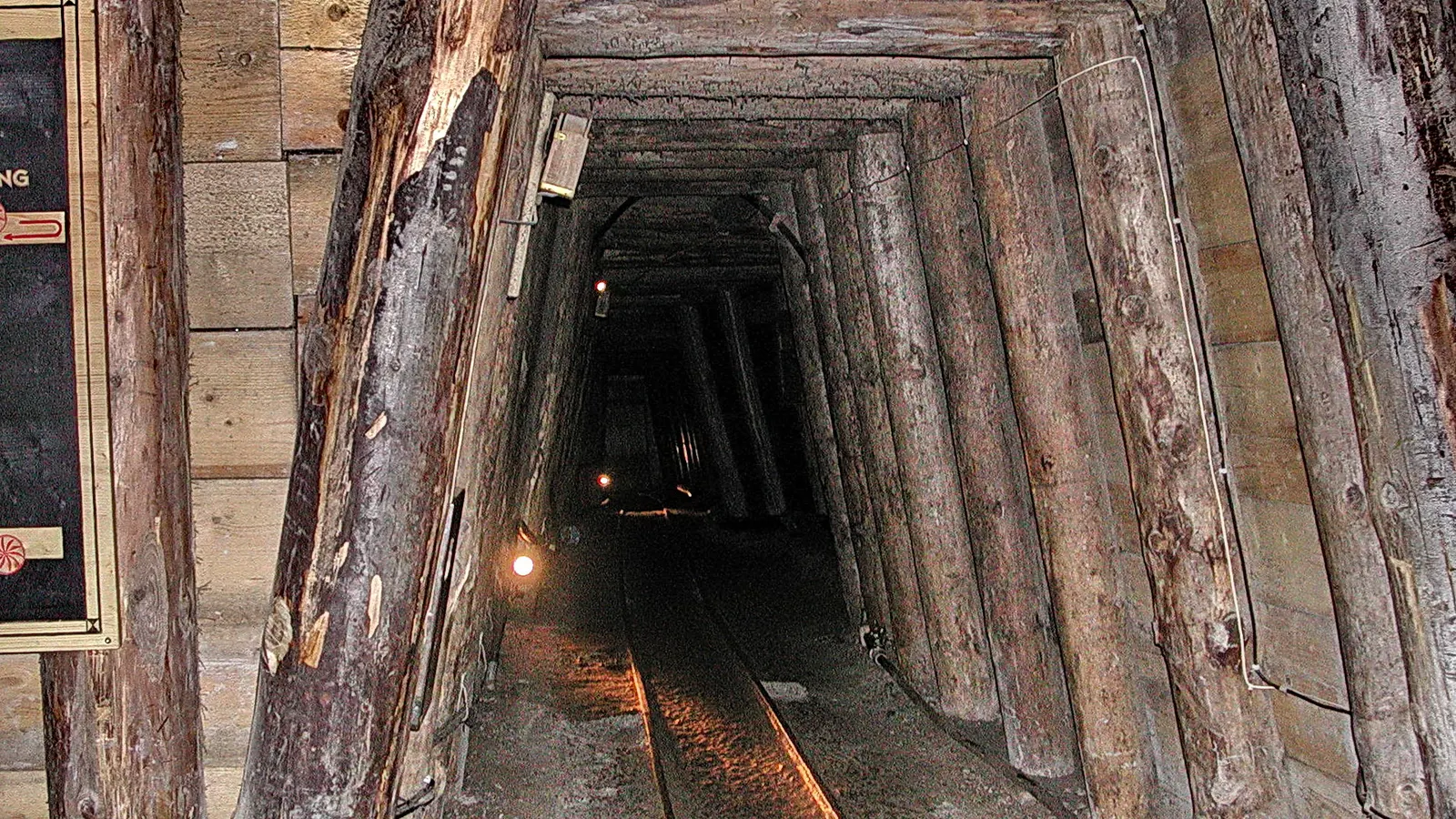
Salzwelten is the brand over three Austrian salt mines you can walk into, and the one the English-speaking world comes for is Hallstatt – the world's oldest salt mine by the operator's reckoning, above a village of 750 people that takes up to 10,000 visitors on a peak day. It shut for a year while the funicular was rebuilt and reopened on 29 August 2026, so almost every English page about it is out of date. The tour is 90 minutes, about 2 km on foot at a steady 8 °C, with a mine train, an underground salt lake, the Bronze Age Cinema 400 metres down and a 64-metre wooden miners' slide at the end of it. The other two are quite different trips: Hallein is 19 km from Salzburg, open every day of the year and €14 cheaper; Altaussee is the working mine with the Nazi looted-art story and only four tours a day. This page gives the operator's own 2026 prices in euro and US dollars, the times the crowds are not there, what the funicular really costs, and the things English guides keep getting wrong.
- TicketsTickets are sold at tickets.salzwelten.at, where you pick the site first – Hallstatt, Salzburg or Altaussee are three separate shops – and then a date and a tour time.
- Price€49 (about $56.15) – Salzwelten Hallstatt, combined ticket: salt mine plus funicular up and down, adults
- OpenAll three mines are guided-tour operations, and the times below are the start of the last tour of the day.
- Best timeFor Hallstatt the answer is early.
- ClaustrophobiaThe operator advises people with claustrophobia against the visit, in those words.
The three Salzwelten mines and Bad Ischl, compared
Salzwelten Hallstatt (Upper Austria) – the main site on this page
The world's oldest salt mine by the operator's reckoning: salt has been taken out of this mountain for about 7,000 years and organised underground mining is documented from around 1500 BC. The tour is 90 minutes and about 2 km on foot, with a mine train, an underground salt lake, the Bronze Age Cinema 400 metres down around Europe's oldest wooden staircase, and a 64-metre wooden miners' slide.
Reopened on 29 August 2026 after a full year shut, with a new Doppelmayr/Garaventa funicular: 360 vertical metres in about three minutes, 60 people per cabin, up to 42 degrees of gradient, double the old capacity, and barrier-free. New valley and top stations came with it, plus a 300 m² flagship store and the Weitblick 7000 bistro. The serpentine footpath into the high valley is still closed, so the funicular is the only way up.
Combined ticket with the funicular: adults €49 (about $56.15), children 4–15 €23 (about $26.36). Funicular alone €29 / €14. Mine without the funicular €33 / €16 (09/2026)
Salzwelten Salzburg – Bad Dürrnberg above Hallein
The oldest show mine in the world: guests have been taken into this mountain for some 400 years. After the mine train you walk about a kilometre through four eras – modern workings, Baroque with a raft ride across the underground salt lake, the Middle Ages and the Celts. Two miners' slides take you deeper, and somewhere along the way you cross the only underground national border in Europe, into Bavaria and back.
The practical choice from Salzburg: 19 km out, free parking with EV chargers, open every single day. Above ground the SALINA Celtic village, a themed playground and Austria's only demonstration salt pan are all inside the ticket. No dogs, at all.
Adults €35 (about $40.11), children 4–15 €16 (about $18.34), Celtic Mountain included (09/2026)
Salzwelten Altaussee (Styria)
Austria's largest working salt mine – around 400,000 tonnes a year, mined since 1147, with tours running since the 1920s. Stretches of the gallery cut through pure rock salt that glows orange-red under the lamps. The set pieces are the Barbara Chapel built entirely of salt blocks 700 metres inside the mountain, two miners' slides, and a salt lake holding six million litres of brine with a stage and a light show on it.
From 1943 the Nazis stored some 7,000 works of art here, much of it looted – Michelangelo's Bruges Madonna, the Ghent Altarpiece, Vermeer and Bruegel. Local miners defeated the order to blow the mine up in 1945, the story told in the film The Monuments Men. The original 270 m² storage chamber, the Springerwerk, is staged as an exhibition, and a themed tour, "Bombs on Michelangelo", runs every Friday at 4 p.m.
Adults €27 (about $30.94), children 4–15 €13 (about $14.90), graphic-novel exhibition included (09/2026)
Bad Ischl – no mine tour, but the brine pipeline trail
There is no salt mine you can go into at Bad Ischl. Salzwelten runs only a shop in the town centre. What survives is the Soleleitungsweg, a 32-kilometre trail following the brine pipeline opened in 1607 from Hallstatt through Bad Goisern and Bad Ischl to Ebensee – built from 13,000 hollowed-out tree trunks plugged into one another, which makes it the oldest industrial pipeline in the world. Brine still flows along the modernised line to the Ebensee saltworks today.
Salzwelten re-signed the route in 2023/24 under a LEADER project; the boards carry QR codes with audio in German and English. Some sections are not open to bikes and not passable with a pushchair.
The trail is free; the Bad Ischl shop has no admission (09/2026)
Tickets and prices
Tickets are sold at tickets.salzwelten.at, where you pick the site first – Hallstatt, Salzburg or Altaussee are three separate shops – and then a date and a tour time. The desk on site sells exactly the same fares: there is no online discount at any of the three mines, and no booking fee either, so booking ahead buys you the time slot and nothing else. At Hallstatt the operator asks you to be at the valley station 45 minutes before your tour, because you still have the funicular and a 15- to 20-minute walk ahead of you; at Hallein 15 minutes at the desk; at Altaussee 15 minutes at the Steinberghaus.
Official prices
- Salzwelten Hallstatt, combined ticket: salt mine plus funicular up and down, adults€49 (about $56.15)
- Salzwelten Hallstatt, combined ticket, children 4–15€23 (about $26.36)
- Salzwelten Hallstatt, combined ticket, groups of 20+ / school and youth groups€47 (about $53.86) / €23 (about $26.36)
- Salzbergbahn funicular only, up and down, including the Skywalk, adults / children 4–15€29 (about $33.23) / €14 (about $16.04)
- Salzbergbahn funicular, season pass, adults / children€80 (about $91.68) / €55 (about $63.03)
- Salzwelten Hallstatt, mine without the funicular ("for hikers"), adults / children 4–15 – see the note on the closed footpath€33 (about $37.82) / €16 (about $18.34)
- Hallstatt, Prehistoric Expedition with archaeologists (July/August, Tue and Thu 11.00, max 12 people, age 10+, funicular included), adults / children 10–15€98 (about $112.31) / €49 (about $56.15)
- Hallstatt Exclusive / Private Tours, 4 hours, max 10 people€125 (about $143.25) per person plus a €500 (about $573) flat fee
- Salzwelten Salzburg (Hallein/Dürrnberg), adults – Celtic Mountain included€35 (about $40.11)
- Salzwelten Salzburg, children 4–15 (under 4 not admitted to the mine at all)€16 (about $18.34)
- Salzwelten Salzburg, groups of 20+ (every 21st person free)€33 (about $37.82)
- Salzwelten Salzburg, Sally's children's tour, German only, including a gift and the slide photo€25 (about $28.65)
- Celtic Mountain above ground on its own: adults / child 4–15 / family 2 adults + 3 children€7.50 (about $8.60) / €3 (about $3.44) / €19 (about $21.77)
- Salzburg Sightseeing package: return shuttle bus from Mirabellplatz plus admission, adults / children€69 (about $79.07) / €35 (about $40.11)
- "Salzburg Exclusive" private tour, 2 hours, max 60 people€60 (about $68.76) per person plus a €400 (about $458.40) flat fee
- Salzwelten Altaussee, adults – graphic-novel exhibition included€27 (about $30.94)
- Salzwelten Altaussee, children 4–15 / groups of 20+€13 (about $14.90) / €25 (about $28.65)
- Altaussee, themed tour "Bombs on Michelangelo" (Fridays 4 p.m., about 90 minutes, recommended age 12+), adults / children€27 (about $30.94) / €13 (about $14.90)
- Altaussee, graphic-novel exhibition on its own, adults (children 0–15 free)€6 (about $6.88)
- Altaussee, Sally's children's tour (July/August, Mon, Fri, Sat, Sun 3 p.m.)€23 (about $26.36)
- Salzkammergut Summer/Winter Card discount, adult ticket at Salzwelten Salzburg – at the ticket desk only€31.50 (about $36.10) instead of €35
- Ferry Stefanie, Hallstatt station to Hallstatt Markt, single / return – cash only€4 (about $4.58) / €8 (about $9.17)
- Coach slot for Hallstatt, per coach, from 1 May 2026 – booked at hallstatt-parking.com, minimum stay 2 h 20 min€126 (about $144.40), €105 (about $120.33) before that date
- Conversion€1 = $1.1460, the European Central Bank reference rate of 18 September 2026; dollar figures rounded
As of 09/2026 · source and direct booking: salzwelten.at/en/hallstatt
When everything is sold out
The operator says plainly that individual tours and whole days can sell out. Hallstatt is the one to watch: a village of 750 residents that sees up to 10,000 visitors on a peak day, with coach groups and Danube cruise excursions arriving mid-morning. Altaussee has a different problem – only four departures a day, so turning up on spec can mean two hours of waiting. Hallein is the safe one, open every day of the year with tours running through the day.
Hallstatt tours, tickets and day trips
Nothing here beats the operator on price: Salzwelten charges €49 (about $56.15) for the mine and funicular together and sells the same fare at the desk, with no online discount. What a booking buys is the journey, and for Hallstatt that is worth real money – it is 2 h 16 min by train from Salzburg and around 3 h 33 min from Vienna, each with a change at Attnang-Puchheim and a ferry at the end, and Salzwelten has no visitor car park in the village at all. Three things to check in any listing. Which mine it actually enters, because "Salzburg salt mine" trips usually go to Hallein, and some go to Berchtesgaden in Germany. Whether mine admission is included or you are paying for a coach seat and buying the ticket yourself. And how long you get in Hallstatt: coaches must pre-book a slot with a minimum stay of 2 h 20 min, which is barely enough for the funicular, the walk and a 90-minute tour.
Vienna: Hallstatt Day Trip with Skywalk Option
From Salzburg: Half-Day Tour to Hallstatt
Day trips from Vienna: Hallstatt& Salzburg Scenic Experience
Salzburg: Hallstatt and Sound of Music Tour
Show all 11 offers
Salzburg: Sound of Music and Salt Mines Tour
Salzwelten Altaussee: Salt Mine Entrance Ticket
From Salzburg: Salt Mines Package - The White Gold Adventure
From Salzburg: Private Day Trip to Hallstatt with St. Gilgen
From Vienna: Melk, Salzburg, and Hallstatt Private Tour
Bratislava: Melk, Hallstatt, and Salzburg Private Tour
From Salzburg: Private Tour of Hallstatt
Booked through GetYourGuide (affiliate link, advertising). Most offers can be cancelled free of charge up to 24 hours ahead. Prices as of 20 September 2026.
Opening hours and best time
All three mines are guided-tour operations, and the times below are the start of the last tour of the day. Salzwelten Hallstatt, open again since 29 August 2026: mine 29.8.–24.10.2026 from 9.30 a.m. to 4.30 p.m., 25.10.2026–6.1.2027 from 9.30 a.m. to 3.00 p.m.; the last ride up the funicular is 30 minutes before the last tour. The funicular itself runs 29.8.–24.10.2026 from 9.00 a.m. to 6.00 p.m. (last descent) and 25.10.2026–6.1.2027 from 9.00 a.m. to 4.30 p.m. The mine stayed shut on 18 September 2026 for the new funicular's first night run, and nothing has been published for the period after 6 January 2027. Salzwelten Salzburg (Hallein/Dürrnberg) is the only one open daily all year: 1.1.–27.3.2026 9.00 a.m.–3.00 p.m., 28.3.–1.11.2026 9.00 a.m.–5.00 p.m., 2.11.2026–10.1.2027 9.00 a.m.–3.00 p.m. Salzwelten Altaussee runs four fixed tours a day – 9.00, 11.00, 1.00 and 3.00 – from 1 September to 2 November 2026, then closes completely for maintenance from 3 to 30 November; 1–18 December the same four times, and from 19 December 2026 to 10 January 2027 hourly from 9.00 a.m. to 3.00 p.m., shut on 24 and 31 December. The themed tour "Bombs on Michelangelo" runs every Friday at 4.00 p.m.
When it is quietest
For Hallstatt the answer is early. The funicular starts at 9.00 a.m., the first mine tours at 9.30, and the coaches and cruise excursions arrive later in the morning – on a peak day the village takes up to 10,000 people for 750 residents. Book the first or second tour of the day, or come after about 3 p.m. in the long season, when the last tour is 4.30 p.m. From 25 October 2026 the last tour is 3.00 p.m., which shortens the day considerably; nothing is published beyond 6 January 2027. Underground it is 8 °C whatever the weather, so this is a reliable wet-weather plan and a genuine relief in a heatwave. Hallein is best on a weekday late morning or early afternoon outside the Austrian school holidays – school groups come mostly in spring – and it is the only one of the three open every day of the year. Altaussee is the quiet one, with four departures a day and no crowd to beat, but it shuts completely from 3 to 30 November 2026 for maintenance.
Who it suits
With children
From 4 years old, and this is the single most important thing to plan around: a family with a toddler cannot go into the mine together, at any of the three sites. Above ground there is plenty for the younger ones – at Hallein the Celtic Mountain with its village, playground and open salt pan, at Hallstatt the funicular and the Skywalk, both of which under-4s ride free.
Minimum age
4 years, without exception, including babies in a carrier. The basis is Austrian mining law, not house rules. The Prehistoric Expedition at Hallstatt is 10 and over, and the "Bombs on Michelangelo" tour at Altaussee is recommended from 12.
Wheelchair
None of the three mine tours is wheelchair accessible – the operator says so on each site's page. What is barrier-free at Hallstatt is the new funicular, the path to the Skywalk and the bistro at the top station, so the view and the World Heritage panorama are reachable even if the mine is not.
Pushchair
Not possible underground – mine train, slides, uneven rock floor. Free lockers for small bags at all three sites, and luggage lockers at the new Hallstatt valley station, which is worth knowing if you are coming through with a suitcase.
Claustrophobia
The operator advises people with claustrophobia against the visit, in those words. The chambers are wide and well lit; the connecting galleries are narrow, dark and long, and you are underground for an hour and a half with a group of up to 70 at Hallstatt.
What to wear
The white miner's suit is compulsory and handed out on site – it protects your clothes and is part of the safety kit on the slides. Underneath you want a jumper or fleece and proper closed shoes: it is around 8 °C (46 °F) all year at Hallstatt and Altaussee and around 10 °C (50 °F) at Hallein, and the ground is stony. The suit is not insulated, which is the detail most English packing lists miss.
Photography
Allowed everywhere, phones included, no camera fee. A camera fires automatically on each miners' slide and the picture is on sale after the tour; on Sally's children's tour at Hallein the slide photo is in the €25 price. Nobody has to slide: there are stairs with a handrail beside every slide, and skipping it costs you nothing but the photo.
Getting there
By public transport
Hallstatt: trains run on the Attnang-Puchheim–Stainach-Irdning line to Hallstatt Bahnhof, which is on the far side of the lake from the village – the little ferry Stefanie meets every train, crosses in a few minutes and costs €4 (about $4.58) single, €8 return, cash only, no cards, and it runs 365 days a year. From the jetty it is a short walk to the funicular valley station. By bus, lines 542 and 543 serve the Hallstatt Lahn terminal. Hallein/Dürrnberg: S-Bahn or regional train from Salzburg Hbf to Hallein, about 20 minutes, then city bus 41 to the stop "Bad Dürrnberg Salzbergwerk"; ÖBB also sells an Erlebnisticket bundling train, regional bus and admission, valid for standard tours only. Altaussee: regional bus 955 from Bad Aussee station to Altaussee Kurhaus, then the on-demand Salzkammergutshuttle 810 straight to the mine, booked by phone or app; on foot it is about 1.6 km uphill from the Altaussee Scheiben stop.
By car
Hallstatt is the hard one. Salzwelten has no visitor car park there at all, and the operator tells you to allow at least an hour to find a space and recommends public transport instead. Coaches cannot simply drive in: since 1 June 2020 every coach carrying passengers to Hallstatt must pre-book an entry and exit slot at hallstatt-parking.com, €126 per coach from 1 May 2026 (€105 before), with a minimum stay of 2 hours 20 minutes – which is why so many day tours give you barely two hours in the village. Hallein/Dürrnberg is the opposite: free parking right at the entrance, with EV chargers. Altaussee also has free car and coach parking at the adit entrance, about 3 km above the village, reachable only by car or on foot.
From the nearest city
Flying in, the three usable airports are Salzburg (SZG), Munich (MUC) and Vienna (VIE). From Salzburg Hbf to Hallstatt Bahnhof is about 2 h 16 min or 2 h 41 min by train with one change at Attnang-Puchheim, from €9.90 (about $11.35) on an advance Sparschiene fare, plus the ferry – so Hallstatt from Salzburg is a full day, not a morning. From Vienna Hbf it is 3 h 33 min or 3 h 58 min, again changing at Attnang-Puchheim, from €19.90 (about $22.81); a Vienna day trip means roughly eight hours on trains for a 90-minute tour, which is why the coach excursions sell so well. By car, Salzburg to Hallstatt is around two hours depending on the route. Hallein/Dürrnberg is the half-day option: 19 km from Salzburg, 20 to 25 minutes by car, and on Fridays and Saturdays a shuttle leaves the Mirabellplatz bus terminal at 9.15 a.m. and returns at 12.15 p.m., about 3.5 hours door to door. Hallstatt and Altaussee are only about 25 road kilometres apart, so those two pair naturally into one trip.
Tips for your visit
- Take the first or second tour of the day at Hallstatt. The funicular opens at 9.00 a.m. and the first mine tours are at 9.30, before the coaches and the cruise excursions land; a village of 750 people can hold 10,000 visitors on a peak day and you can feel every one of them by lunchtime.
- Be at the Hallstatt valley station 45 minutes before your tour time, not five. Between the queue, the funicular and the 15- to 20-minute walk from the top station to the mine entrance, that margin is real, and a missed tour is not rebooked.
- The funicular is not in the mine ticket unless you buy the combined one. Mine plus funicular is €49 (about $56.15); the €33 fare is the mine alone and is sold for people arriving on foot – and the serpentine footpath into the high valley is still closed, so ask the operator before you buy it.
- The age limit of 4 is absolute and it is law, not policy. With a younger child nobody gets underground at any of the three sites, not even carried. Plan the funicular and the Skywalk at Hallstatt instead, or the Celtic Mountain at Hallein.
- Nobody has to slide. There are stairs with a handrail beside every miners' slide, and taking them costs you nothing except the automatic photo at the bottom. The white suit is compulsory but it is not warm – wear a fleece under it and closed shoes.
- Booking online costs exactly the same as the desk at all three mines, with no online discount anywhere. What it buys is the time slot, and in the school holidays individual tours and whole days do sell out. Discount cards are the reverse: ÖAMTC, ARBÖ, SalzburglandCard, Salzkammergut Card and guest cards are only honoured at the window.
- Do not drive to Hallstatt if you can avoid it. Salzwelten has no visitor parking there and tells you to allow an hour to find a space; the train to Hallstatt Bahnhof plus the ferry Stefanie (€4 single, cash only, no cards) puts you a few minutes' walk from the valley station. Bring notes for the boat.
- If you only have a half day out of Salzburg, go to Hallein, not Hallstatt. Nineteen kilometres, free parking, open every day of the year, €35 rather than €49, and a raft ride across an underground lake that Hallstatt does not have.
- Check the calendar before you commit to Altaussee: four tours a day and nothing else, closed completely from 3 to 30 November 2026 for maintenance, and shut on 24 and 31 December. Turning up on spec can cost you two hours.
- Dogs: Hallstatt only, muzzled on the funicular, with free outdoor kennels by the Knappenhaus for the duration of the tour. Altaussee has two shaded kennels at the entrance. Hallein allows no animals at all.
What the internet gets wrong
It does not, and neither does the €35 version of the same claim. In the operator's own price list for 2026 the €33 (about $37.82) fare is the mine on its own, sold for visitors who arrive on foot, and the funicular is not in it; mine plus funicular up and down is €49 (about $56.15) for adults and €23 (about $26.36) for children 4–15, and the funicular by itself is €29 / €14. machupicchu.org publishes “Salt mine admission costs €34 for adults in 2026, which includes round-trip funicular transportation”; nomadepicureans.com has “Basic tickets cost €35 for adults, €18 for children, including a funicular ride and guided tour” – €35 is in fact the adult fare at a completely different mine, Hallein, 80 km away. Older figures still circulating are from before the rebuild: mountain-tours.at and hallstattaustria.eu both quote “€43 adults / €24 funicular”, thetripverdict.com “€24 per adult”, traveliyo.com “€40 (funicular + salt mine tour)”, and bigboytravel.com “40€ round trip for Adults”, “24€ for Adults” for the tour alone and “18€ round trip” for the lift.
There is no walk-up route at the moment. The Salzkammergut tourist board's own page for the mine states that “The trail leading into the Hallstatt High Valley remains closed due to construction work, even after the Salzwelten reopens.” mountain-tours.at sells the climb as a free alternative, thetripverdict.com calls it “A free alternative taking 45–60 minutes”, and hallstattaustria.eu points hikers at the “Panorama Trail”. The operator still lists a €33 hikers' fare, but with the serpentine path shut there is no published way of using it – ask Salzwelten before you buy that ticket rather than after.
The reopening date was 29 August 2026, for the mine, the funicular and the Skywalk together. travelerstoday.com ran “will reopen on September 1, 2026”, thetripverdict.com still says the complex “remains strictly off-limits until the summer of 2026” and promises “June 2026 completion”, nomads-travel-guide.com has “Until Summer 2026: Closed for renovation work”, and im-salzkammergut.at carries both dates on two different pages – one headed “from 1st of September 2026”, the other “from 28th of August 2026”. Two dates matter after that: the mine was shut on 18 September 2026 for the new funicular's first night run, and the published season currently ends on 6 January 2027.
Not this mine. Hallstatt runs 9.30 a.m.–4.30 p.m. (last tour) to 24 October 2026 and 9.30 a.m.–3.00 p.m. from 25 October to 6 January 2027, with nothing announced beyond that, and Altaussee closes completely from 3 to 30 November 2026 for maintenance and again on 24 and 31 December. Only Hallein is genuinely open every day of the year. nomadepicureans.com claims year-round opening “except Christmas” with “Winter (November-March): 10:00 AM – 3:00 PM daily”; the opposite error is just as common – kidvoyage.com lists the season as “Daily, 21 April – 20 September” and “21 September – 1 November”, machupicchu.org as “early April through early November, with the mine closed during winter months”, mountain-tours.at as “April to November”, and bigboytravel.com invents a closure “for 4 weeks from early January until early February”.
The reverse is true. The operator's own FAQ says “Instead of the slides, you are also welcome to use the stairs with hand railings right next to them”, at all three mines. Sliding is voluntary, the automatic camera at the bottom is the only thing you miss, and the white suit is issued partly as protection for the slide. The dimensions get mangled too: nomadepicureans.com describes “two exhilarating wooden slides descending twenty meters”, bigboytravel.com puts the first at “79 feet (24 meters)”. Salzwelten's Hallstatt experience page gives the long one as 64 metres, its press and private-tour pages as 65, and calls it Europe's longest underground miners' slide. machupicchu.org is the source of the “must use the slides” line.
Nothing of him survives to see. Three miners did find a body preserved in the salt in 1734, but, as Earth magazine puts it, “No archaeological analysis was performed on the mummy before it was reburied in the Hallstatt cemetery” – and the burial spot was never recorded. Salzwelten's own English pages list the highlights of the tour as the mine train, the miners' slides, the underground salt lake and the Bronze Age Cinema; no body is among them. The prehistoric finds from this mountain are in the Hallstatt Museum down in the village and with the Natural History Museum Vienna, which has run the excavations since the mid-19th century. bigboytravel.com carries the claim.
Two different muddles, both common. Hallstatt is in the Salzkammergut in Upper Austria, on Lake Hallstatt; the Gastein valley under which kidvoyage.com files it is a separate region an hour and a half south of Salzburg, and the same page's “1.5 hours” by train from Salzburg is wrong as well – it is 2 h 16 min or 2 h 41 min with a change at Attnang-Puchheim, plus the ferry. On price, freewalkingtoursalzburg.com says the mines “adjusted the prices and are now nearly the same price”; the 2026 adult fares are €49 at Hallstatt with the funicular, €35 at Hallein and €27 at Altaussee, and a fourth mine often sold from Salzburg as a “salt mine tour”, Berchtesgaden, is in Germany altogether.
Seat61.com, which is right about almost everything else on this route, puts the Stefanie at “around €3 per crossing”. The operator, Hallstatt Schifffahrt, charges €4.00 (about $4.58) one way and €8.00 (about $9.17) return, and states “No card payment possible – cash only!” The boat meets every train and runs 365 days a year, so the crossing itself is never the problem – arriving at the jetty without banknotes is.
History in brief
- Salt has been taken out of the Hallstatt mountain for more than 7,000 years, with organised underground mining documented from about 1500 BC – no older salt mine has yet been evidenced anywhere in the world, which is the basis for the operator's "oldest salt mine" claim.
- An entire European epoch is named after the burial ground above the village: the Hallstatt period, roughly 800 to 450 BC. The graves were extraordinarily rich, which is how archaeologists know how much the salt was worth.
- In 1734 three miners found a body preserved in the salt, the "Man in Salt", a prehistoric miner killed in an accident around 1000 BC. Nobody examined him: he was reburied in the Hallstatt cemetery and the spot was not recorded.
- In 2002 a wooden staircase was found inside the mountain and dated to 1344 BC – the oldest wooden staircase in Europe. It is the centrepiece of the Bronze Age Cinema, 400 metres down on the tour route.
- At Dürrnberg the Celts began mining underground around 600 BC. The salt later made the prince-archbishops of Salzburg rich; Wolf Dietrich von Raitenau paid for the Baroque rebuilding of the city with it.
- By the 17th century the archbishops' mine managers were already taking selected guests down into the Dürrnberg – the reason it is called the oldest show mine in the world. Before the First World War a few thousand visitors came each year; in 1969 the old tour route counted 166,863.
- The wooden brine pipeline from Hallstatt to Ebensee opened in 1607, over 30 kilometres of hollowed tree trunks – the oldest industrial pipeline in the world, still in service in modernised form.
- Altaussee is documented as a salt mine from 1147. From 1943 the Nazis stored roughly 7,000 works of art there; the order to blow up the mine in 1945 was defeated by local miners, the story behind The Monuments Men.
- Industrial salt production at Dürrnberg ended in 1989 and the mine became purely a visitor attraction. In 2005 Salinen Austria AG brought the three sites together under the Salzwelten name.
- From 1 September 2025 to 28 August 2026 the Hallstatt mine, funicular, Skywalk and high valley were all shut. The 1980 funicular had carried around seven million passengers in 45 years; its replacement went into service on 29 August 2026.
Frequent questions
Is the Hallstatt salt mine open in 2026?
Yes. It closed on 1 September 2025 for the funicular to be rebuilt and reopened on 29 August 2026, together with the new Salzbergbahn and the Skywalk. Tours run from 9.30 a.m. to 4.30 p.m. (last departure) until 24 October 2026 and then to 3.00 p.m. until 6 January 2027. It was shut for one day, 18 September 2026, for the funicular's first night run. Nothing has been published yet for after 6 January 2027.
How much does the Hallstatt salt mine cost, and is the funicular included?
The combined ticket – mine plus funicular up and down – is €49 (about $56.15) for adults and €23 (about $26.36) for children aged 4 to 15. The funicular on its own, which also gets you to the Skywalk, is €29 / €14. The €33 / €16 fare covers the mine without the funicular and is meant for people who walk up, which at the moment is not possible. Prices are the operator's, checked September 2026.
How long does a visit to the Hallstatt salt mine take?
The guided tour itself is about 90 minutes, but Salzwelten asks you to allow at least three hours and to be at the valley station 45 minutes before your tour time. That covers the queue, the three-minute funicular ride, the 15- to 20-minute walk from the top station to the mine entrance, changing into the suit and the trip back down.
Can you visit the salt mine without a guided tour?
No, at none of the three Salzwelten mines. The operator's FAQ states that for safety reasons entry is only permitted as part of a guided tour, and the guide is included in every ticket price. Standard tours run in German and English at no extra charge, and there is a free audio-guide app on top.
What is the best time of day to avoid the crowds?
Book the 9.30 or 10.00 tour. The funicular starts at 9.00 a.m., and the coach groups and cruise excursions tend to arrive through the mid-morning – Hallstatt has 750 residents and takes as many as 10,000 visitors on a peak day. Late afternoon works too while the last tour is still 4.30 p.m., but from 25 October 2026 that moves forward to 3.00 p.m.
Can I hike up instead of taking the funicular?
Not at the moment. The serpentine path into the Hallstatt high valley is still closed after the building works, which the regional tourist board states explicitly for the period after the reopening. The €33 hikers' ticket still exists on the price list but there is no published route to use it with, so check with Salzwelten before buying one.
What happens if the funicular is not running?
You have no second way up: the footpath is shut, and the mine entrance sits 360 vertical metres above the village. Salzwelten publishes no weather or wind policy for the new funicular, so if you are travelling a long way for this, check the operator's page on the morning and keep the Hallstatt Museum, the village and Lake Hallstatt as the fallback – or drive the 25 km to Altaussee, which needs no cable car at all.
Can children go into the mine, and can they use the slide?
Children from the age of 4 can, and younger children cannot – it is Austrian mining law, and it applies even to a baby in a carrier. There is no separate age or height limit for the miners' slides: children who are on the tour may slide, in the same suit as everyone else, and anyone who would rather not takes the stairs with the handrail beside it. Under-4s ride the funicular free and can wait above ground at the Skywalk and the bistro.
How cold is it and what should I wear?
Around 8 °C (46 °F) all year at Hallstatt and Altaussee, around 10 °C (50 °F) at Hallein. The white miner's suit is compulsory and handed out on site, but it is not insulated – it protects your clothes and helps on the slide. Wear a jumper or fleece under it and closed, sturdy shoes; the floor is stony and uneven in places.
How do I get to Hallstatt from Salzburg or Vienna without a car?
From Salzburg Hbf it is about 2 h 16 min or 2 h 41 min by train, changing at Attnang-Puchheim, from €9.90 on an advance fare. From Vienna Hbf it is 3 h 33 min or 3 h 58 min, same change, from €19.90. Trains arrive at Hallstatt Bahnhof on the far side of the lake; the ferry Stefanie meets each one, costs €4 single and €8 return, and takes only cash. From the jetty the funicular valley station is a short walk.
Is Hallstatt really the world's oldest salt mine?
That is the operator's claim and the evidence behind it is solid, though it is a claim rather than a settled fact. Salt has been worked here for about 7,000 years, organised underground mining is documented from roughly 1500 BC, the oldest wooden staircase in Europe was found inside the mountain and dated to 1344 BC, and the burial ground above the village gave its name to a whole European epoch. No older salt mine has been evidenced elsewhere. Do not confuse it with the neighbouring superlative: Hallein calls itself the oldest show mine in the world, meaning the longest history of taking visitors underground, about 400 years.
Can I see the Hallstatt Man, the body found in the salt?
No. The body three miners found in 1734 was reburied in the Hallstatt cemetery without being examined, and the place was never recorded. What you see underground is the mine itself and the Bronze Age Cinema built around the 1344 BC staircase. The prehistoric finds from this mountain are on show in the Hallstatt Museum in the village and held by the Natural History Museum Vienna, which has excavated here since the mid-19th century.
Which of the three is worth it – Hallstatt, Hallein or Altaussee?
Hallstatt for the history, the 64-metre slide and the World Heritage view: €49 with the funicular, a full day from Salzburg or Vienna, and the crowds that come with the most photographed village in Austria. Hallein for a half day out of Salzburg: 19 km, free parking, open every day of the year, €35, a mine train, two slides, a raft ride across an underground lake and Europe's only underground national border. Altaussee for quiet and for the looted-art story, €27, a mine still producing 400,000 tonnes of salt a year – but only four tours a day and closed for the whole of November 2026.
Can our tour coach or camper just drive into Hallstatt?
Coaches cannot. Since 1 June 2020 every coach bringing passengers to Hallstatt has to pre-book an entry and exit slot through hallstatt-parking.com, at €126 per coach from 1 May 2026 (€105 before), with a minimum stay of 2 hours 20 minutes. Cars are not banned but Salzwelten has no visitor car park in Hallstatt at all and tells drivers to allow at least an hour to find a space – the train and the ferry are genuinely easier.
Sources
Show 35 sources – every figure on this page is sourced
- www.salzwelten.at/en/hallstatt – Hallstatt site page in English: "world's oldest salt mine", 7,000 years of salt mining, reopening from 29.8.2026, no visitor parking and the advice to allow at least an hour to park, highlights of the tour
- www.salzwelten.at/en/hallstatt/prices-opening-hours – Hallstatt prices and hours from 29.8.2026: combined ticket €49/€23, groups €47/€23, funicular €29/€14, season pass €80/€55, mine without funicular €33/€16, opening hours for mine and funicular, Hallstatt Exclusive €125 + €500, audio guide in 12 languages
- www.salzwelten.at/en/hallstatt/discover-experience – Hallstatt: "64-metre-long miners' slide", 90-minute tour, at least 3 hours in total, about 2 km underground, constant 8 °C, age 4 and over, meeting point 45 minutes before, 360 metres of ascent, dogs with muzzle and free kennels, Skywalk, Europe's oldest wooden staircase
- www.salzwelten.at/en/blog/hallstatt-archaeology – The 1734 find of the "Man in Salt", a prehistoric miner who died around 1000 BC; the wooden staircase dated to roughly 1344 BC and displayed in the Bronze Age Cinema; salt extraction from around 5000 BC and organised mining from 1500 BC; Natural History Museum Vienna's role
- www.salzwelten.at/en/salzburg – Hallein/Dürrnberg: "the oldest show mine in the world", 19 km from Salzburg, free parking with EV chargers, open daily, Celtic Mountain and 2,600 years of Celtic mining
- www.salzwelten.at/en/salzburg/prices-opening-hours – Hallein prices and hours 2026: €35/€16/€33, Celtic Mountain €7.50/€3/€19, VIP tour €60 + €400, shuttle package €69/€35, opening 28.3.–1.11.2026 and 2.11.2026–10.1.2027
- www.salzwelten.at/en/salzburg/discover-experience – Hallein: about 90 minutes, roughly 1 km on foot, around 10 °C year-round, age 4 and up, two miners' slides, the underground border to Germany, mine train, raft ride on the salt lake, Celtic Mountain included, no animals, not suitable for wheelchairs
- www.salzwelten.at/en/salzburg/faq – Operator FAQ in English: minimum age 4 set by law, visits only as part of a guided tour, "Instead of the slides, you are also welcome to use the stairs with hand railings right next to them", compulsory protective clothing, photography allowed, advice against visiting with claustrophobia, German and English at no extra charge, payment methods, discounts only at the ticket window, tours and whole days can sell out
- www.salzwelten.at/en/altaussee/prices-opening-hours – Altaussee prices and hours 2026: €27/€13/€25, graphic novel €6, tour times 9/11/13/15, closed for maintenance 3–30 November, closed 24 and 31 December, "Bombs on Michelangelo" every Friday at 4 p.m.
- www.salzwelten.at/en/altaussee/discover-experience – Altaussee: 90 minutes, about 2.5 km, around 8 °C, age 4 and up, Barbara Chapel of rock salt, salt lake, the Nazi art store and The Monuments Men, meeting point 15 minutes before at the Steinberghaus, no wheelchairs, dog kennels
- tickets.salzwelten.at/en/2/date – Ticket shop: each site booked separately by date and tour time, no cross-site combined ticket
- dachstein.salzkammergut.at/en/oesterreich-poi/detail/401006/hal… – "The trail leading into the Hallstatt High Valley remains closed due to construction work, even after the Salzwelten reopens"; arrival by train to Hallstatt Bahnhof plus ferry; bus lines 542/543 to Hallstatt Lahn; compulsory coach slot at hallstatt-parking.com; maximum 70 people per tour; 360 metres of ascent; combined ticket €49/€23
- www.salzkammergut.at/en/oesterreich-poi/detail/430003930/salzbe… – Funicular hours given as 9.00 a.m.–4.00 p.m. (29.8.–24.10.2026) and 9.00 a.m.–2.30 p.m. (25.10.2026–6.1.2027), differing from the operator; prices €49/€23 and €29/€14; accessibility of the new railway
- hallstattschifffahrt.at/en – Ferry Hallstatt station to Hallstatt Markt: €4.00 single, €8.00 return, "No card payment possible – cash only!", the Stefanie runs 365 days a year, timetable valid to December 2026
- www.seat61.com/international-trains/other-cities/trains-from-Ha… – Train times and fares: Salzburg–Hallstatt 2h16 or 2h41 from €9.90, Vienna–Hallstatt 3h33 or 3h58 from €19.90, change at Attnang-Puchheim; the ferry meets the trains; the outdated ferry fare of "around €3"
- www.hallstatt-parking.com/en/FAQ – Coach slot booking: entry and exit only with a booked slot, €105 per coach and €126 from 1.5.2026, minimum stay 2 h 20 min
- peb-hallstatt.com/en/coaches/ – "Since June 1st, 2020. all coaches taking passengers to Hallstatt are required to book an entry/exit slot via a booking platform"; exit slot at least 2:20 hours after entry; checks at the terminal entrance
- www.thelocal.at/20250723/hallstatt-overtourism-why-locals-want-… – Hallstatt overtourism: 750 residents, up to 10,000 tourists on peak days, local proposal to cap arrivals at 5,000 to 5,500 a day, coach visits limited and regulated by time slots
- www.earthmagazine.org/article/travels-geology-austrias-salzkamm… – The 1734 "Man in Salt": "No archaeological analysis was performed on the mummy before it was reburied in the Hallstatt cemetery"; finds from the mine displayed in the Hallstatt Museum in the town centre
- www.ecb.europa.eu/stats/eurofxref/eurofxref-daily.xml – ECB euro foreign exchange reference rate of 18 September 2026: 1 EUR = 1.1460 USD, used for every dollar figure on this page
- www.machupicchu.org/hallstatt-salt-mine-experience-2026-complet… – False claims: "€34 for adults in 2026, which includes round-trip funicular transportation", season "early April through early November, with the mine closed during winter months", and visitors "must use the slides to descend between mining levels, as the historical access stairs have been removed or blocked"
- www.nomadepicureans.com/europe/austria/visiting-hallstatt-salt-… – False claims: "Basic tickets cost €35 for adults, €18 for children, including a funicular ride and guided tour" (the Hallein fare), year-round opening "except Christmas" with winter hours 10 a.m.–3 p.m., and "two exhilarating wooden slides descending twenty meters"
- www.bigboytravel.com/europe/austria/hallstatt/saltmine/ – Outdated and false claims: 40 € combined, 24 € tour only, 18 € funicular, "The tour lasts 70 minutes", a closure "for 4 weeks from early January until early February", a first slide of "79 feet (24 meters)", and the Man in Salt – "you can still make out pieces of skin and hair"
- mountain-tours.at/en/salt-mine-hallstatt-guide/ – Outdated claims: "Combo ticket €43 adults / €21 children", "Salzberg Funicular €24 adults", "On foot to the entrance: free – approx. 45-minute climb from the Old Town", season "spring to late autumn (April to November)"
- www.thetripverdict.com/skywalk-hallstatt – Outdated claims: the complex "remains strictly off-limits until the summer of 2026", completion in June 2026, funicular "€24 per adult", and hiking up as "A free alternative taking 45–60 minutes"
- www.hallstattaustria.eu/hallstatt-funicular-tickets-prices-tips… – 2025 prices still published: funicular €24 adults / €12 children, combined €43/€21, and the Panorama Trail recommended as the walking alternative
- traveliyo.com/hallstatt-salt-mine-salzwelten/ – False claims: "Adults €40 (funicular + salt mine tour)" and "Self-guided tours are possible but less informative"
- kidvoyage.com/things-to-do/austria/gastein/hallshtatt-salt-mine – False claims: season "Daily, 21 April – 20 September" and "21 September – 1 November", "Adults 40 EUR" and "Children (4 - 15) 18 EUR", the mine filed under the Gastein valley, and 1.5 hours by train from Salzburg
- www.travelerstoday.com/articles/60393/20260716/hallstatt-salt-m… – Reopening wrongly dated: "will reopen on September 1, 2026"; prices €49/€23 and €29/€14 correctly quoted
- www.nomads-travel-guide.com/places/salt-mine-visitor-center/ – "Until Summer 2026: Closed for renovation work" alongside correct 2026 prices and opening hours; luggage lockers at the new valley station
- www.im-salzkammergut.at/events/hallstatt/daily-tours-through-th… – Two different reopening dates on two pages of the same site – "from 1st of September 2026" in one heading and "from 28th of August 2026" in the other – plus a season given as mid-April to early November
- freewalkingtoursalzburg.com/salzburg-salt-mines/ – Claim that the mines "adjusted the prices and are now nearly the same price"; bus routes from Salzburg to Hallein (bus 170 or S3, then bus 41), Berchtesgaden (bus 840) and Hallstatt
- www.salzwelten.at/en/hallstatt/construction-diary – Construction diary for the new funicular: Doppelmayr/Garaventa, 60 people per cabin, 5.5 m/s, up to 42 degrees of gradient, the Weitblick 7000 bistro and the 300 m² flagship store, the old railway's last run on 31.8.2025, over 490,000 guests a year
- www.salzwelten.at/en/hallstatt/special-tours – Prehistoric Expedition in July and August, Tuesdays and Thursdays at 11.00, €98/€49, age 10 and over, maximum 12 people, funicular included; Private Tours €125 plus €500, with the 65-metre slide mentioned
- www.oebb.at/en/tickets-kundenkarten/freizeit-urlaub/oebb-plus/o… – ÖBB Salt Adventure combined rail-and-admission ticket for Hallstatt