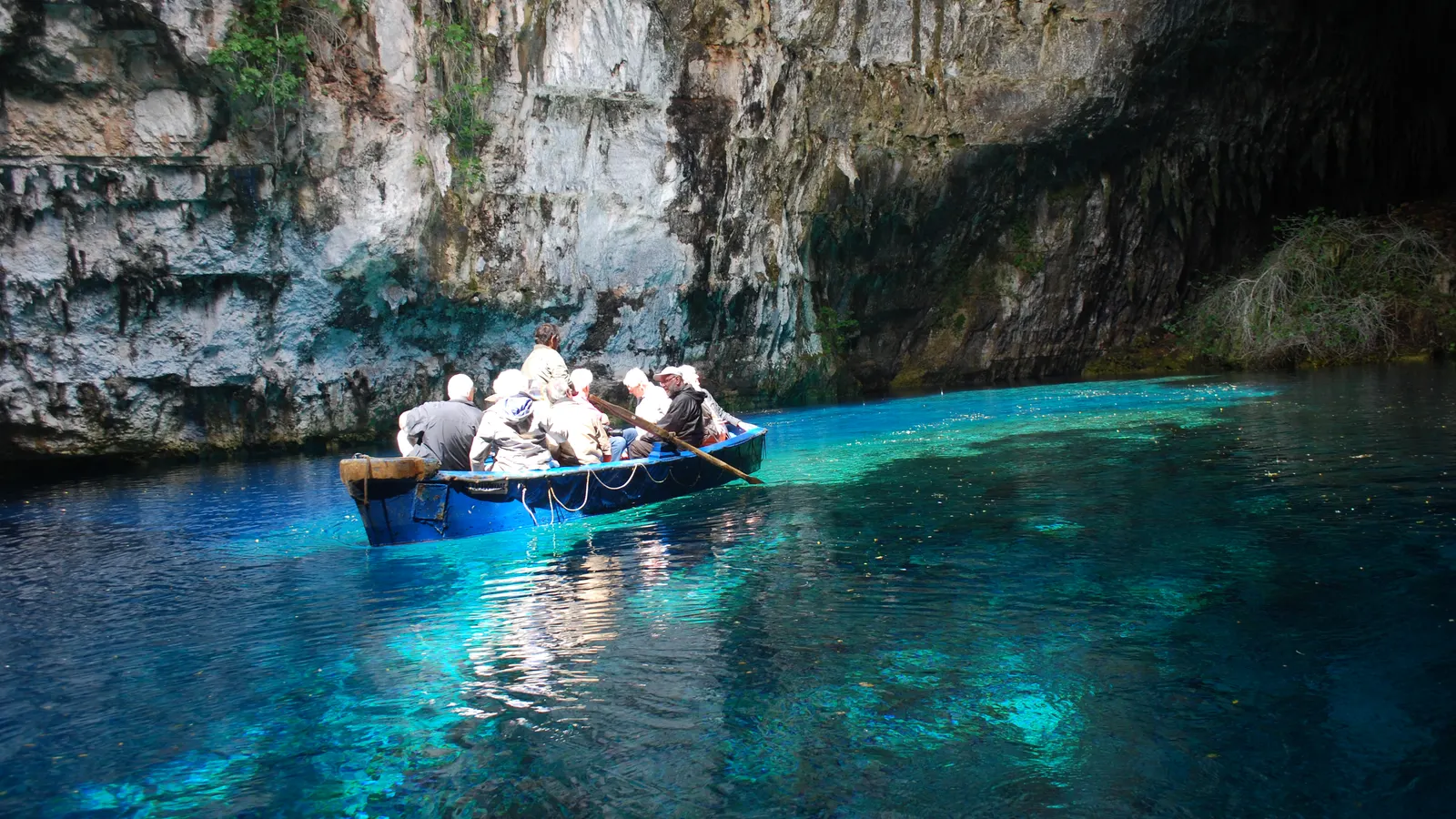
Two caves, ten minutes apart, run by the same small town council. At Melissani you sit in a rowing boat on a brackish lake 20 m under a hole in the roof; at Drogarati you walk down into a 65 by 45 metre chamber that has been used as a concert hall. The 2026 prices are published, in euro, on the council's own page – €10 for Melissani, €6 for Drogarati, and €4 for Drogarati if you show a Melissani ticket. Almost everything else you will read in English about the two – the opening hours, the combined ticket, the best hour for the light – is either out of date or was never right.
- TicketsThere is nothing to book.
- Price€10 (about $11.46) – Melissani, adult
- OpenThere is no annual timetable.
- Best timeTwo separate questions, and English pages answer both badly.
- ClaustrophobiaMelissani is the gentler one: you are under an open hole in the roof for the first half of the boat ride, and the closed chamber is 18 m high.
The sites compared
Melissani Lake Cave (Λιμνοσπήλαιο Μελισσάνης)
A collapse doline – a cenote – on the slope of Frydi hill above Karavomylos, 2 km north-west of Sami. A 70 m tunnel takes you down to a jetty 20 m below ground; from there a boatman rows you across a lake 60 by 40 metres and 10 to 35 metres deep, first under the open hole in the roof, then through a narrow channel beside a 30 m islet into a closed chamber 18 m high. The water is brackish – about five parts fresh to one part sea – and it is the same water that disappeared into the Argostoli sinkholes on the far side of the island.
Excavations on the islet – by Ioannis Petrocheilos, who first went down on ropes in 1951, and by Spyridon Marinatos in 1963 – produced lamps, relief plaques and a figurine of Pan, dated to the 4th and 3rd centuries BC. It is the Cave of the Nymphs. The stalactites on the walls grow crooked, pulled out of true by air currents and shifting blocks; they have been dated to between about 16,400 and 20,400 years old. Rock pigeons nest on the walls and European eels, critically endangered, live in the water.
Adults €10 (about $11.46), reduced €5 ($5.73), under-6s free
Drogarati Cave (Σπήλαιο Δρογκαράτης)
A dry show cave at Chaliotata, 120 m above sea level on the Sami–Argostoli road. You go down a staircase built into a collapsed doline – once part of the cave itself – and arrive 21 m below the entrance on the "Royal Balcony", a natural ledge looking down into the main chamber. That chamber, the "Sala of Apotheosis", is about 65 by 45 metres and 20 metres high, flat-floored and semicircular, and it is the richest cave in Greece for formations: stalactites, straws, columns, curtains, helictites and rimstone pools. 18 °C (64 °F) and 90 per cent humidity all year.
The acoustics in the Apotheosis chamber are the reason it is the only Greek cave used as a concert hall; it has been fitted out for audiences of around 500, with the musicians in a recess in the wall. Maria Farantouri and the soprano Efi Karagianni have sung here, and the best-documented recent event was the Bavarian Philharmonic in 2014, brought in by a cruise ship. Nothing is scheduled there in the Municipality of Sami's Cultural Summer 2026 programme. Cave divers have shown it connects underground to the Aggalaki and Agioi Theodoroi caves.
Adults €6 (about $6.88), or €4 ($4.58) on production of a Melissani ticket; reduced €3 ($3.44); under-6s free
Katavothres, the Argostoli sinkholes
The other end of the system, on the Lassi headland by the Agioi Theodoroi lighthouse, 15 km away on the west side of the island. Sea water pours into fissures in the limestone at up to 3 m a second and vanishes. An Englishman named Stevens harnessed it for a mill in 1835; Miliaressis built a second in 1857. Both were destroyed in the 1953 earthquake, and one wheel has been rebuilt on the site.
This is where the 160 kg of uranine went in on 26 February 1963. Without Katavothres, Melissani is just a pretty hole; with it, the two are the visible ends of a 15 km underground crossing of the island.
Free – it is an open roadside site with a café
Karavomylos Lake
Where the water comes back out. A near-circular brackish pool about 50 m across and only a metre deep, 80 m from the sea and walled off from it, fed from the bottom by a karst spring and draining straight into Sami bay. Cave divers have followed the feeder siphon 260 m in, to a maximum depth of 15 m. A waterwheel-driven mill once worked here; the village is named after it.
The dye from the Argostoli sinkholes appeared here on 13 and 14 March 1963. Maurin and Zötl measured the springs of this bay at about 15 °C in both February and August – the water is cooled by its passage under the mountain, not by the season. Eels live in it.
Free
Aggalaki Cave (Σπηλαιοβάραθρο Αγγαλάκι)
The largest of the roughly seventeen caves and potholes scattered round Sami besides the two show caves. A shaft with an opening about 20 to 30 m across, formed when the roof fell in, dropping 49 m to a chamber with a lake; a second chamber and a second small lake lie beyond. A large bat colony lives in it, and blind eels have been found in the eastern lake – evidence that it too is plumbed into the same brackish network.
Melissani, Drogarati and Aggalaki lie on one natural line, all developed at 40–50 m above sea level and reaching up to 15 m below it, and are thought to be connected underground.
No admission charge – there is no ticket desk
Zervati Cave (Σπήλαιο Ζερβάτη), the "Blue Cave"
A second cenote at the southern edge of Karavomylos, 250 m from the sea and 15 m above it. A 50 by 30 m collapse opening, a debris cone over 10 m high in the middle, and two brackish lakes on either side of it, 4 and 5 m deep, with the roof still standing above them. The visible part is 75 m long, the whole cave 235 m; the water sits at about 16 m depth, roughly sea level.
Its lakes have almost the same chemistry as the Karavomylos springs, and cleaner water than Melissani's, because rainwater dilutes it on the way through. Rare aquatic plants, fish and eels live in it.
No charge and no ticket – but see below
Tickets and prices
There is nothing to book. The Municipality of Sami runs no ticket shop of its own, sells no timed slots and takes no reservations for individual visitors. You join the queue at the desk, pay, and go in with the next boat or the next group. What the council does sell is a way round the queue: a €40 ($45.84) priority ticket at each cave, four times the normal Melissani admission and nearly seven times Drogarati's.
Official prices
- Melissani, adult€10 (about $11.46)
- Drogarati, adult€6 (about $6.88)
- Drogarati, adult, on production of a Melissani ticket€4 ($4.58) – both caves for €14 ($16.04) rather than €16
- Melissani, reduced: children 6–18, students, over-65s, families with many children€5 ($5.73)
- Drogarati, reduced: children 6–18, students, over-65s, families with many children€3 ($3.44)
- Both caves, children under 6, visitors with disabilities, the unemployed, permanent residents of the Municipality of Samifree
- Group ticket, parties over 20, issued only by the council's finance office on working days€9 ($10.31)
- Priority ticket (queue jump), each cave€40 ($45.84)
- Private tour outside peak hours, each cave€400 ($458.40)
- Parking at both cavesfree
- Conversion€1 = $1.146, the reference rate used across this site on 20 September 2026; dollar figures rounded to the cent
As of 09/2026 · source and direct booking: sami.gov.gr/discover/melissani-drogkarati
When everything is sold out
The caves do not sell out; they back up. The council's own bilingual notices name the days: on 9 and 13 July 2026 and again on 6 August 2026 it warned that cruise ships were arriving together and advised anyone not on an organised excursion to come the next day or in the early afternoon. Visitor reports from July and August describe waits of forty minutes to more than an hour and a half at Melissani.
Tours and transfers to Melissani and Drogarati
Admission is not the thing to buy here. At the desk you pay €10 (about $11.46) for Melissani and €6 ($6.88) for Drogarati, or €4 ($4.58) for Drogarati once you show the Melissani ticket — €14 ($16.04) for both, cash or card, no booking possible. A booked tour earns its keep for two reasons, and neither is the ticket price. The first is transport: the caves sit on opposite sides of Sami, Drogarati has no bus stop at all, and the Argostoli bus leaves you at Melissani with a return at 17:50. The second is the queue — the Municipality of Sami issues its own warnings on days when several cruise ships call, and independent visitors have reported waits of well over an hour in July and August, while the coach parties go straight through. Check whether admission to both caves is actually included or only to one, and whether the itinerary reaches Melissani in the early afternoon rather than at nine in the morning, because the light through the collapsed roof peaks around 13:30 to 14:00. Half-day tours usually bundle the caves with Myrtos beach or Antisamos; the full-day versions add Assos and Fiskardo and give you about twenty minutes underground. If you have a hire car, skip all of it and buy at the desk — the only official queue-jump is the council's own priority ticket at €40 ($45.84) per cave.
From Argostoli: Melissani Lake & Drogarati Caves Tour
Kefalonia: Melissani, Myrtos, Fiscardo & Wine Tasting
Argostoli: Melissani Lake, Drogarati Cave, and Myrtos Beach
Kefalonia: Melissani Lake, Drogarati Cave, & Myrtos Day Trip
Show all 7 offers
Booked through GetYourGuide (affiliate link, advertising). Most offers can be cancelled free of charge up to 24 hours ahead. Prices as of 20 September 2026.
Opening hours and best time
There is no annual timetable. The Municipality of Sami publishes the hours in short blocks, sometimes a fortnight at a time, and each announcement replaces the last. The one in force on 20 September 2026 dates from 2 July 2026: since Friday 3 July both caves have been open daily, 09:00 to 18:00. Earlier in the same season the council had published a day-by-day table for 4 to 20 May 2026 – 10:00 to 16:00, last admission 15:30. Out of season it collapses to almost nothing: for the whole of November 2025 the caves opened on five days only – Thursday 6th, Sunday 9th, Tuesday 11th, Friday 14th and Wednesday 26th – from 11:00 to 13:00, with anything else by arrangement on +30 26743 60500. In April 2025 the pattern was Tuesdays, Thursdays and Saturdays, 10:00 to 12:00. So: roughly May to October you can turn up; from November to April you must phone first, and the season's exact start and end are never announced in advance. The two caves keep the same hours, because the same office sets them.
When it is quietest
Two separate questions, and English pages answer both badly. For the light at Melissani: the sun has to be steep enough to drop through a hole 15 by 25 metres in a roof 20 metres above the water. That happens around solar noon – and solar noon in Kefalonia is not 12:00. Under Greek summer time it falls at about 13:39 on 21 June, 13:43 in mid-July, 13:42 in mid-August and 13:31 on 20 September. The window worth aiming at in high summer is therefore roughly 12:30 to 14:30 local time, not the "11am to 1pm" or "noon to 2pm" that English guides copy from one another. Season matters more than the hour: at midsummer the sun stands about 75° above the horizon here, in late September about 53°, at the winter solstice about 28° – which is one reason the caves barely open in winter and, when they do, open from 11:00 to 13:00, straddling solar noon. For the queue: the Municipality of Sami itself tells independent visitors to avoid the middle of the day on cruise-ship days and to come in the early afternoon or the following day. The two pieces of advice pull in opposite directions, and the early afternoon is where they meet – after the organised excursions have gone, and still inside the light window. Failing that, a day with no ship in Sami or Argostoli. May, early June and late September give you the light, the season and the fewest coaches.
Who it suits
With children
Both caves work for children and neither publishes a minimum age. Melissani is the easier of the two: a short walk down, a boat, fifteen minutes on the water. Drogarati is a long flight of wet steps down and back up, which small children manage but tired ones resent.
Minimum age
None published for either cave. Under-6s go free at both.
Wheelchair
Neither cave is accessible. Melissani is reached through a sloping tunnel 70 m long that ends at a jetty 20 m below ground level, and you then have to step down into a rowing boat that is floating free; Drogarati is a staircase down a collapsed doline to a chamber 21 m below the entrance. Admission is free for visitors with disabilities, which is not the same as the caves being usable. The viewpoint over the Melissani doline, above the cave, is the part most people with limited mobility can realistically reach.
Pushchair
Leave it at the car park. Steps and a boat at Melissani, a long staircase at Drogarati; there is nowhere to push a pram at either site and no left-luggage.
Dogs
No published rule. In practice a dog cannot go in the Melissani boat, and nobody wants one on the Drogarati stairs.
Claustrophobia
Melissani is the gentler one: you are under an open hole in the roof for the first half of the boat ride, and the closed chamber is 18 m high. The 70 m tunnel is the part people dislike. Drogarati is entirely enclosed once you are past the doline, although the main chamber is the size of a small church. Neither cave lets you turn back easily once the boat has left or the group is moving.
What to wear
Drogarati sits at a constant 18 °C (64 °F) with 90 per cent humidity – in August a relief, in April cold, and wet enough that the steps are genuinely slippery. Closed shoes with grip, not flip-flops. Melissani is milder and shorter, but you are on water in the shade; take a layer if you feel the cold.
Photography
No ban was found at either cave, and photography inside is routine – the boatmen at Melissani habitually take pictures of passengers with their own phones. Drogarati is one of the few Greek caves with bright electric lighting, which makes it unusually easy to photograph. No published rule on tripods or drones could be traced; a drone over the Melissani doline is a separate matter of Greek aviation law, not of cave rules.
Getting there
By public transport
Possible, but it eats the day. KTEL Kefalonias runs buses from Argostoli to Karavomylos/Melissani: on the timetable valid 11 to 25 September 2026, departures from Argostoli at 10:00 and 13:00 on weekdays and 10:00 at weekends, with returns from Karavomylos at 07:45 and 17:50 on weekdays and 17:50 only at weekends. Take the 10:00 out and the next bus back is at 17:50 – nearly eight hours for a fifteen-minute boat ride, unless you walk into Sami or down to Karavomylos lake to fill the gap. Buses from Argostoli to Sami itself leave at 07:15, 10:00 and 13:00 on weekdays. Drogarati has no stop of its own: it is on the Sami–Argostoli road at Chaliotata, and the practical options are a taxi from Sami or the walk uphill. Winter timetables are much thinner. Tell the driver where you are going, because the bus will not always stop otherwise.
By car
A car is the honest answer. Both caves have their own free car parks with a café beside them, and they are about ten minutes apart by road. From Sami, Melissani is 2 km towards Karavomylos and Agia Efimia; Drogarati is 3 to 5 km the other way, signposted off the Argostoli road. The roads are narrow and winding but paved throughout.
From the nearest city
Argostoli, the island capital, is about 30 km and 40 minutes away over the mountain. Kefalonia airport (EFL) at Svoronata is roughly 34 km from Sami, about 45 minutes by car; there is no direct bus from the airport to Sami, so it is a taxi or a change in Argostoli. By sea, Sami itself is a ferry port with a year-round link to Patras, about three hours; the busier short crossing is Kyllini to Poros in the south of the island, about 90 minutes, with several sailings a day in season, and Poros is then an hour's drive from Sami. Cruise ships call at both Sami and Argostoli, which is exactly why the queues at the caves are unpredictable.
Tips for your visit
- Buy Melissani first. Drogarati then costs €4 (about $4.58) instead of €6 on production of the Melissani ticket – €14 ($16.04) for both. There is no combined ticket and the discount does not work the other way round.
- Phone before you drive out between November and April. The council publishes the winter days one month at a time and there may be five of them. The numbers are +30 26740 23302 (Melissani), +30 26740 22997 (Drogarati) and +30 26743 60504 (town hall).
- Check the cruise-ship calls for Sami and Argostoli for your date. The municipality's own advice on ship days is to come in the early afternoon or the day after – and the early afternoon is also when the light is best.
- Aim for 12:30 to 14:30 rather than noon. Solar noon in Kefalonia is around 13:30 to 13:45 under summer time, so the steepest light arrives later than every English guide says.
- Carry euro notes even if you mean to pay by card. The boatmen are tipped in cash, a euro or two, and no operator statement on card acceptance exists.
- Wear shoes with grip for Drogarati. The staircase is long, wet and genuinely slippery at 90 per cent humidity; nothing at the cave is adapted for anyone unsteady on steps.
- Take a layer. Drogarati holds 18 °C (64 °F) all year – welcome in August, cold in April after twenty minutes standing still.
- Walk down to Karavomylos lake afterwards. Five minutes from the Melissani car park, free, and it is where the water from Argostoli comes back out – the half of the story the boatman will not have time for.
- Do not count on the bus for both caves. Drogarati has no stop; the Argostoli–Karavomylos service leaves you at Melissani with returns at 07:45 and 17:50 on weekdays, 17:50 only at weekends.
What the internet gets wrong
There is no combined ticket. The Municipality of Sami's own price table lists a single reduction – Drogarati at €4 ($4.58) "with presentation of Melissani ticket", against the normal €6. Melissani stays at €10. Both caves cost €14 ($16.04), and you have to do them in that order.
All out of date. In September 2026 the council charges €10 ($11.46) for Melissani and €6 ($6.88) for Drogarati, with reductions of €5 and €3 for children 6–18, students, over-65s and large families, and free entry for under-6s and visitors with disabilities.
No such weekly winter pattern exists. For the whole of November 2025 the Municipality of Sami opened the caves on five named days – 6, 9, 11, 14 and 26 November – from 11:00 to 13:00, and otherwise only by arrangement by telephone. In April 2025 the pattern was Tuesday, Thursday and Saturday, 10:00 to 12:00. The schedule is republished in blocks and changes without notice.
Four different answers to a question with one source. The council's announcement of 2 July 2026, still in force on 20 September, sets both caves at 09:00 to 18:00 daily from Friday 3 July. In May 2026 the same office had published 10:00 to 16:00 with last admission at 15:30. Nobody publishes an annual season, including the council.
The sun is not overhead at noon in Kefalonia. Under Greek summer time solar noon at Melissani falls at about 13:39 on 21 June, 13:43 in mid-July and 13:31 on 20 September. The whole copied window sits an hour and a half too early. Aim for roughly 12:30 to 14:30 in high summer.
The advice everyone gives – go at midday – is the opposite of what the operator says on the days that matter. Ahead of 9 and 13 July and 6 August 2026 the Municipality of Sami issued bilingual notices advising visitors "other than those participating in organized excursions" to come "the following day or during the early afternoon hours", because cruise ships were arriving together and the mornings would be jammed. English guides send every independent visitor into exactly the hour the council is trying to clear.
The lake is 60 by 40 metres, 10 to 35 metres deep, and the accessible part of the cave is 160 metres long, with the roof of the closed chamber 18 metres above the water. "The lake is about 164 metres long and 35 metres wide" (kefaloniaway.com) confuses the cave's length with the lake's.
The other way round, and not by that margin. The Kefalonia-Ithaca Geopark and the Greek speleological literature both give a ratio of five parts fresh water to one part sea water at Melissani. Maurin and Zötl measured about six to one at the Karavomylos springs next door, rising to eight and a half to one after the exceptional rains of winter 1961-62.
The only measurement anyone has published is Ioannis Petrocheilos's 15 °C in September 1951. It fits the springs of the same system, which Maurin and Zötl found at 15.0 °C in February and 15.1 °C in August at Phridi, and 14.9 °C at Karavomylos – water that has crossed the island underground and arrives at mountain temperature whatever the season.
the figure that goes back to Ioannis Petrocheilos's 1952 survey is 95 metres of passage, with the main chamber 21 metres below the entrance. The geopark's English page renders the 95 m as a depth, which is probably where the confusion started; 60 m appears to be nobody's measurement of anything.
The Kefalonia-Ithaca Geopark dates the limestone Drogarati formed in to the Paleogene, 65.5 to 33.9 million years ago. Melissani's rock is the older of the two, Upper Cretaceous, 100.5 to 66 million years. Neither number describes the cave, which is very much younger than the rock it is cut into.
Farantouri and the soprano Efi Karagianni are documented in Anna Petrochilou's standard work on the caves of Greece. Callas is not, in any source that could be checked, and the story is told as rumour even by the pages that repeat it.
1959 is when Maurin and Zötl started their survey of the island. The dye went in on 26 February 1963 – 160 kg of uranine – and the first colour surfaced on 12 March, fifteen days later. Melissani's lake was among the resurgences that turned, on 13 and 14 March.
"Melissani Cave - Tickets, Tours & Visitor Information | Official Site" is the page title melissani-cave.com carries, and it invites you to "check the official website" for hours. It is not the official site. The caves belong to the Municipality of Sami, which publishes prices and schedules at sami.gov.gr and nowhere else. The site in question prints a combined ticket that does not exist, a table of "Historical Pricing Trends" from 2015 to 2026 that no source supports, and dated visitor quotes from "Maria, UK (June 2026)" and "Thomas, Germany (May 2026)".
History in brief
- Melissani was a sanctuary long before it was an attraction. Finds from the islet in the lake – three relief plaques, a relief disc showing Pan playing the syrinx among dancing nymphs, a figurine of Pan, three lamps and fragments of a pointed vessel – date the cult of Pan and the nymphs there to the 4th and 3rd centuries BC. Hence the cave's other name, the Cave of the Nymphs.
- The name itself has three explanations and no settled one: the nymph Melissanthi, who drowned herself when Pan rejected her; a shepherd girl of the same name who fell in looking for a lost sheep; or, least likely, Homer's "home of the bees" where Odysseus recognised Ithaca.
- The speleologist Ioannis Petrocheilos descended into Melissani on ropes through the roof opening in 1951 with his wife Anna and found a Hellenistic lamp on the islet. He measured the water at 15 °C that September. He surveyed Drogarati in the same campaign and published it in the bulletin of the Hellenic Speleological Society in February 1952; it was Anna Petrochilou who named Drogarati's great chamber the Sala of Apotheosis.
- The earthquakes of August 1953, which flattened much of Kefalonia, brought down a large part of the Melissani roof and left the oval opening, about 15 by 25 metres, that the sunlight comes through. The wider doline measures roughly 40 by 50 metres.
- 1963 was the year everything happened at once. The access tunnel was driven and both caves opened to visitors; Spyridon Marinatos excavated the islet during the works; and on 26 February the Austrian hydrogeologists Viktor Maurin and Josef Zötl tipped 160 kg of uranine into one of the Argostoli sinkholes.
- The dye test was the end of a four-year study funded by the Austrian Research Council, begun in 1959. Two Greek geologists, A. Dounas and A. Morikis, supervised the pour; about 580 water samples were then taken across the island until 10 April. The first colour appeared on 12 March, fifteen days later, at a spring near Vlachata between Sami and Agia Efimia. On 13 and 14 March it reached the Phridi and Karavomylos springs and the lake inside Melissani. Nothing appeared at Livadi bay or near Poros. The results were published as "Salt water encroachment in the low-altitude karst water horizons of the island of Kephallinia" at the IAHS symposium on the hydrology of fractured rocks in 1965.
- What the experiment proved is specific and still slightly uncanny: sea water enters the rock on the west coast at Argostoli at up to 3 metres a second, crosses about 15 kilometres of limestone under the island, mixes with fresh water percolating off Mount Ainos and Agia Dynati, and comes back out as brackish water on the east coast – in Melissani, at Karavomylos and along the shore of Sami bay. It takes a fortnight or more. No convincing single mechanism has ever been agreed on; tides and wind were ruled out because the inflow never stops.
- The sea mills at Katavothres, which ran on that inflow, were built by the Englishman Stevens in 1835 and by Miliaressis in 1857; the flow later powered a generator and an ice factory until the Second World War. The 1953 earthquake destroyed both mills. One wheel stands there again today.
- Drogarati's chamber has been used for concerts since it opened – Maria Farantouri and the soprano Efi Karagianni among the singers. The documented recent occasion was the Bavarian Philharmonic in 2014, off a cruise ship at Argostoli.
- In 2026 a team from the University of Athens published a multi-sensor 3D survey of both caves in the journal Geomorphology – the first modern instrumental mapping of Melissani and Drogarati together. Greek Wikipedia, citing it, reports that the rock above the northern chamber at Melissani is only about three metres thick.
Frequent questions
How much does it cost to visit Melissani and Drogarati in 2026?
Melissani is €10 for adults (about $11.46) and Drogarati €6 ($6.88), both from the Municipality of Sami's published table. Show your Melissani ticket at Drogarati and it drops to €4 ($4.58), so both caves cost €14 ($16.04). Children aged 6 to 18, students, over-65s and large families pay €5 and €3; under-6s and visitors with disabilities go free. Dollar figures use €1 = $1.146 on 20 September 2026.
Is there a combined ticket for the two caves?
Not as such. English pages advertise a combo at €10, €13 or "a ticket covering both". What the council actually offers is a reduction in one direction: buy Melissani at €10, show the stub at Drogarati and pay €4 instead of €6. Do it in the other order and you save nothing. Keep the ticket.
Do I need to book Melissani tickets in advance?
You cannot. The municipality sells no tickets online and takes no reservations from individual visitors – you queue at the desk at each cave. The only official way to skip the queue is a priority ticket at €40 (about $45.84) per cave, which is four times the normal Melissani admission. Tour operators sell excursions that include admission, but that is a coach seat, not a timed entry.
What time should I go for the blue light at Melissani?
Later than you have been told. The sunlight has to fall almost vertically through a hole 15 by 25 metres in a roof 20 metres above the lake, so you want solar noon – and solar noon in Kefalonia is about 13:39 on 21 June, 13:43 in mid-July and 13:31 on 20 September, Greek summer time. Roughly 12:30 to 14:30 is the honest window in high summer. The "11am to 1pm" that English guides copy from each other is an hour and a half early.
Is it worth going if the sky is overcast?
Nobody official has ever answered this, and the blogs contradict each other. What is certain: the turquoise comes from direct sun refracting through water 10 to 35 metres deep, so under thick cloud you get a clear green-grey lake, a lit chamber of stalactites and the same fifteen-minute boat ride – the cave, without the photograph. If the light is the only reason you are going, and the forecast is solid cloud, keep the €10 and go to Drogarati instead, which has electric lighting and does not care what the sky is doing.
How long does the Melissani boat ride last?
Ten to fifteen minutes on the water. The municipality publishes no figure at all, which is why English pages range from 10 to 30 minutes; the consistent accounts, including the Greek national tourism board's, give about fifteen. Allow half an hour for the whole visit – the walk down the 70 m tunnel, the boat, the walk back up – and then add the queue, which in July and August is the longest part.
How bad are the queues in summer?
Bad enough that the council warns about them by name. Before 9 and 13 July and 6 August 2026 the Municipality of Sami published notices advising independent visitors to come the next day or in the early afternoon, because several cruise ships were calling at once. Visitor reports from July and August describe waits from forty minutes to over ninety. Check the cruise schedules for Sami and Argostoli before you fix a date.
Are the caves open in winter?
Barely. There is no published annual season. In November 2025 the two caves opened on five days in the whole month – 6, 9, 11, 14 and 26 November – from 11:00 to 13:00, plus visits by arrangement on +30 26743 60500. In April 2025 it was Tuesdays, Thursdays and Saturdays, 10:00 to 12:00. From 3 July 2026 both have been open daily 09:00 to 18:00. Between November and April, phone first and do not trust any website's winter hours, including the ones that say Thursdays and weekends.
Can I swim in Melissani lake?
No. The lake is reached only through the tunnel and only in the boat, and nobody gets out. English pages say swimming is prohibited; no written rule from the municipality could be found, but it makes no practical difference. Antisamos beach near Sami is ten minutes away.
Is Melissani or Drogarati wheelchair accessible?
Neither. Melissani means a 70 m sloping tunnel down to a jetty 20 m below ground and then a step down into a free-floating rowing boat. Drogarati means a long, wet staircase down a collapsed doline to a chamber 21 m below the entrance. Admission is free for visitors with disabilities, which is not the same as the caves being usable. The viewpoint over the Melissani doline, from the surface, is the part that is realistically reachable.
How cold is it inside, and what should I wear?
Drogarati is a constant 18 °C (64 °F) with 90 per cent humidity all year – pleasant in August, cold in April once you stop moving, and wet enough that the steps are slippery, so wear closed shoes with grip. Melissani is milder and much shorter, but you are sitting on water in the shade; the water itself was measured at 15 °C (59 °F) by Ioannis Petrocheilos in September 1951, and the springs of the same system hold about 15 °C in both February and August.
Can I get there without a car?
To Melissani, yes; to Drogarati, barely. On the KTEL timetable valid 11 to 25 September 2026, buses leave Argostoli for Karavomylos/Melissani at 10:00 and 13:00 on weekdays and 10:00 at weekends, returning at 07:45 and 17:50 on weekdays and 17:50 only at weekends – so the round trip from Argostoli eats the day. Drogarati has no bus stop of its own; from Sami it is a taxi or an uphill walk. If you are staying in Sami itself, Melissani is a 2 km walk and Drogarati 3 to 5 km.
Can I pay by card?
Probably, but bring cash anyway. The council publishes nothing about payment; visitors report that cards are taken at both desks. You will want euro notes regardless, because tipping the Melissani boatman a euro or two is the custom and there is no other way to do it.
Is Drogarati still used for concerts?
The chamber is still fitted out for about 500 people and the acoustics are the reason the cave is known at all, but nothing is scheduled there in the Municipality of Sami's Cultural Summer 2026 programme. The best-documented recent performance was the Bavarian Philharmonic in 2014, brought over by a cruise ship. Treat a concert as a rare event, not something you can plan a trip around – and ignore the claim that Maria Callas sang the first one, which no source supports.
Are there other caves on Kefalonia worth seeing?
Roughly seventeen caves and shafts ring Sami, but only two are set up for visitors. Aggalaki, near Poulata, is the largest of the rest – a 49 m shaft with a lake and a bat colony, railed at the rim so you can look in, but enterable only with ropes on an organised trip. Zervati at Karavomylos is a second cenote with two blue lakes; the regional tourism site states it is not open to the public, whatever the blogs say. Katavothres at Argostoli and Karavomylos lake are free, open and part of the same story.
What is the connection between Katavothres and Melissani?
It is a proven one, not a legend. On 26 February 1963 the Austrian hydrogeologists Viktor Maurin and Josef Zötl poured 160 kg of uranine into one of the sinkholes at Argostoli, under the supervision of two Greek geologists, and then sampled water across the island – about 580 samples, until 10 April. The first colour surfaced on 12 March, fifteen days later, near Vlachata; on 13 and 14 March it reached the Phridi and Karavomylos springs and the lake inside Melissani. Sea water enters the rock on the west coast at up to 3 metres a second, crosses about 15 kilometres of limestone, mixes with fresh water from Mount Ainos and comes out brackish on the east coast. The mechanism has never been fully explained.
Sources
Show 44 sources – every figure on this page is sourced
- www.sami.gov.gr/discover/melissani-drogkarati/ – Operator: the full bilingual 2026 price table for both caves (adult €10/€6, reduced €5/€3, zero ticket, group €9, Drogarati €4 with a Melissani ticket, priority €40, private tour €400), daily 09:00–18:00 from Friday 3 July, ticket-desk and town-hall telephone numbers
- www.kefaloniapress.gr/topika/oikonomia/article/881161/melissani… – Municipality of Sami press release of 2 July 2026 in Greek and English: both caves daily 09:00–18:00 from Friday 3 July 2026
- www.kefaloniapress.gr/topika/oikonomia/article/864625/melissani… – Municipality of Sami, 3 May 2026: day-by-day table for 4 to 20 May 2026, 10:00–16:00 with last admission 15:30, and the note that future changes come by separate announcement
- www.kefaloniapress.gr/topika/oikonomia/article/817033/dimos-sam… – Municipality of Sami, 3 November 2025: the caves open on five days in November – 6, 9, 11, 14 and 26 – from 11:00 to 13:00, otherwise by arrangement on 26743 60500
- www.kefaloniapress.gr/topika/oikonomia/article/882478/kefalloni… – Municipality of Sami advisory of 8 July 2026, Greek and English: on 9 and 13 July, cruise ships arriving together, independent visitors advised to come the next day or in the early afternoon
- www.kefaloniapress.gr/topika/oikonomia/article/888751/kefalonia… – Municipality of Sami advisory of 4 August 2026: the same warning for Thursday 6 August, with the explicit note that the caves are not closing, only that mornings will be jammed
- kefaloniageopark.gr/en/node/302 – Kefalonia-Ithaca UNESCO Global Geopark, geosite 25 (Melissani): lake 60×40 m and 10–35 m deep, 20 m below ground, 160 m accessible length, 70 m artificial tunnel, 15×25 m roof opening attributed to the 1953 earthquakes, 30 m islet, 18 m ceiling, 240 m siphon, fresh-to-salt ratio 5:1, stalactites 16,400–20,400 years old, Upper Cretaceous limestone, Pan and nymph cult of the 4th–3rd centuries BC, eels and rock pigeons
- kefaloniageopark.gr/en/node/530 – Geosite 27 (Drogarati): 120 m altitude, Paleogene limestone 65.5–33.9 My, 18 °C and 90 per cent humidity, the collapsed doline and the staircase, the "Apotheosis Room" 65×40 m and about 20 m high and the "Royal Balcony", open as a show cave since 1963, proven connection to the Aggalaki and Agioi Theodoroi caves
- kefaloniageopark.gr/en/node/525 – Geosite 14 (Sinkholes of Argostoli): inflow at 3 m/s, the Stevens mill of 1835 and the Miliaressis mill of 1857, both destroyed in 1953, power plant and ice factory until WWII, Zötl and Maurin's 160 kg of uranine in 1963 and the 15 km straight-line distance
- kefaloniageopark.gr/en/node/526 – Geosite 26 (Karavomilos Lake): 50 m across, about 1 m deep, 80 m from the sea, 260 m siphon to a maximum depth of 15 m, the Maurin & Zötl connection certified in 1963 with detection after 14 days, mixing with fresh water from Mount Ainos
- kefaloniageopark.gr/en/node/531 – Geosite 32 (Zervati Cave, the "Blue Cave"): 15 m altitude, 250 m from the sea, total length 235 m, visible part 75 m, 50×30 m collapse entrance, debris cone over 10 m, two lakes 4 and 5 m deep at about 16 m depth, groundwater connection with Melissani and Aggalaki, water cleaner than Melissani's
- www.kefaloniageopark.gr/en/node/557 – Geosite list for Kefalonia: Aggalaki doline with its stone wall and railing, 20 m opening, chamber and lake, bat colony; Agia Eleousa 50–70 m shaft with a 300 m siphon; Chiridoni-Sotira; Lake Avithos 11 m deep
- el.wikipedia.org/wiki/%CE%9B%CE%B9%CE%BC%CE%BD%CE%BF%CF%83%CF%8… – Greek Wikipedia on Melissani, citing the geopark and Anna Petrochilou: 40×50 m natural entrance, lake 20 m down and 10–30 m deep, 160 m developed length, 15×25 m opening after the 1953 earthquakes, 5:1 fresh-to-salt, 15 °C measured in September 1951, the 1951 lamp find by Ioannis Petrocheilos and the 1963 clay disc, Marinatos's 1963 excavation and its finds, the 240 m siphon, the 3 m roof thickness of the northern chamber citing Konsolaki et al. 2026
- el.wikipedia.org/wiki/%CE%A3%CF%80%CE%AE%CE%BB%CE%B1%CE%B9%CE%B… – Greek Wikipedia on Drogarati, citing Ioannis Petrocheilos's 1952 survey and Anna Petrochilou's book: 5 km from Sami, entrance at 120 m, length 95 m, 18 °C, main chamber 21 m below the entrance, "Sala of Apotheosis" 65×45 m and about 20 m high named by Anna Petrochilou, fitted for 500 listeners with the musicians in a wall recess, concerts by M. Farantouri and the soprano Ef. Karagianni
- en.wikipedia.org/wiki/Melissani_Cave – English Wikipedia: Melissani as a coastal karst cenote with brackish water, outflow at Fridi beach, and the reference to Maurin & Zoetl, "Salt water encroachment in the low-altitude karst water horizons of the island of Kephallinia", IAHS symposium on the hydrology of fractured rocks, 1965/1967
- fr.wikipedia.org/wiki/Katav%C3%B3thres_d%27Argostoli – The detailed account of the 1959–1963 Austrian study: 160 kg of uranine poured into a Fanari sinkhole on 26 February 1963 under A. Dounas and A. Morikis, about 580 samples taken until 10 April, first colour on 12 March near Vlachata, colour at the Phridi and Karavomylos springs and in Melissani's lake on 13 and 14 March, no colour at Livadi or Poros, fresh-to-salt ratios of 3.5:1 at Phridi and 6:1 at Karavomylos, spring temperatures 15.0 °C in February and 15.1 °C in August at Phridi and 14.9 °C at Karavomylos
- www.topoguide.gr/islands/ionian/advs_kefalonia/kefalonia_caves.php – Greek outdoor guide: about 17 caves in the Sami area, Melissani/Drogarati/Aggalaki on one natural axis at 40–50 m above sea level and reaching 15 m below it, Aggalaki 49 m deep with a 30 m opening, blind eels in the eastern lake and bats in the western, the history of the Katavothres mills, the Phridi spring at Agia Efimia, Megali Grouspa, Lake Avithos
- ktelkefalonias.gr/dromologia/topika-dromologia – KTEL Kefalonias local timetable valid 11–25 September 2026: Argostoli–Karavomylos/Melissani at 10:00 and 13:00 weekdays, 10:00 weekends, returning 07:45 and 17:50 weekdays and 17:50 weekends; Argostoli–Sami at 07:15, 10:00, 13:00
- ktelkefalonias.gr/perioxi-samis/185-drogkarati – KTEL's own tourist page repeating the "60 metres deep" figure for Drogarati, with 18 °C and the Sala of Apotheosis
- ktelkefalonias.gr/perioxi-samis/186-limni-melissani – KTEL on Melissani: boat tour with a guide, the Melissanthi legend, location near Karavomylos
- visitkefaloniaisland.gr/zervati-cave/ – Regional tourism site: Zervati 18 m deep and 75 m long, two small lakes with rare aquatic plants, "It is not open to the public"
- visitkefaloniaisland.gr/drogaratis-cave/ – Regional tourism site on Drogarati, including the "150 million years old" figure and the Maria Callas rumour
- kefalonialife.gr/kefalonia/sami/2026/politistiko-kalokairi-2026… – Municipality of Sami Cultural Summer 2026 programme in full: no event scheduled inside Drogarati Cave
- api.sunrise-sunset.org/json?lat=38.2569&lng=20.6236&formatted=0 – Solar noon at Melissani for 2026: 13:39 EEST on 21 June, 13:43 on 15 July, 13:42 on 15 August, 13:31 on 20 September, 12:21 EET on 25 October, 12:35 EET on 21 December – the basis for the light-window correction
- www.unesco.org/en/iggp/kefalonia-ithaca-unesco-global-geopark – UNESCO listing of Kefalonia-Ithaca as a Global Geopark – a Geopark, not a World Heritage Site
- www.melissani-cave.com/fees – Third-party site presenting itself as the official one: "Combo Ticket (Melissani + Drogarati Cave): €13", a "Historical Pricing Trends" table from 2015 to 2026, dated visitor quotes from "Maria, UK (June 2026)" and "Thomas, Germany (May 2026)", and the claim that cards and cash are both taken
- www.melissani-cave.com/opening-hours – Same site: "Summer (May–October): Daily, 09:00–18:00" and "Winter (November–March): Limited days, typically Thursday, Saturday, and Sunday, 10:00–13:00", sourced to "Official site, 2026 update"
- www.melissani-cave.com/assos-village – Same site, page title "Melissani Cave - Tickets, Tours & Visitor Information | Official Site"
- theworldtravelguy.com/melissani-cave-lake/ – Claims "a combo ticket that includes both Melissani and Drogarati caves for 13 Euros", "During the winter months, the cave is only open on Thursdays and weekends, from 10 AM to 4 PM", "Mid-day around 11 AM to 1 PM is the best time", and a 10-minute boat ride; states the prices are "current as of 2026"
- theworldpursuit.com/melissani-cave-kefalonia/ – Claims "Adults pay €7 or $7.50 for admission, while children can enter for €3 or $3.50", "a combo ticket for €10", "From November to April, the cave is open only on Thursdays and weekends, from 10 AM to 4 PM", "between 11:30 AM and 2:00 PM", boats seating "about seven people" and a 15-minute ride
- kefaloniaway.com/en/melissani/ – Claims "60% seawater and 40% freshwater", "The lake is about 164 metres long and 35 metres wide" and a roof collapse "a few thousand years ago"; correct and useful on the cruise-ship queues and on 2026 prices of €10 and €5
- kefaloniaway.com/en/drogarati-cave/ – Claims "The descending steps lead to a depth of 60 metres" and "over 100 million years old"; gives the 2014 Bavarian Philharmonic concert off the MS Deutschland as the last event, and correct 2026 prices of €6 and €3
- www.greeka.com/ionian/kefalonia/sightseeing/kefalonia-cave-melissani/ – Claims "Melissani is 36m high, 40m wide and 3.5 m long" and "when the sun is right overhead at noon"; describes the rope the boatman uses to pull the boat through the channel
- www.greeka.com/ionian/kefalonia/sightseeing/kefalonia-drogarati-cave/ – Claims Drogarati is "about 150 million years old" and "about 60m deep"; discovered 300 years ago, opened 1963, 90 per cent humidity, 500-person chamber
- www.allovergreece.com/Greek-Caves/Descr/14/en – Claims Melissani's "water temperature is about 10 °C (50 °F)", the lake is "around 40 meter deep", hours of "around 09.00-17.00" May to October, and "you can buy a ticket covering both"; a 15-minute rowing-boat tour and no need to book
- www.allovergreece.com/en/best-caves-greece/drogarati-cave-kefalonia – Claims "Popular Greek artists like Maria Callas, Maria Farantouri and Irene Karagianni have performed here", "around 150 million years old" and "approximately 95m deep"; last event 2014
- exploringgreece.tv/en/greece/drogarati-the-only-greek-cave-in-w… – The Maria Callas rumour in full, plus "its depth reaches 95 meters", "more than 100 million years", and the claim that Drogarati is the only Greek cave used for concerts
- www.footstepsontheglobe.com/destinations/europe/greece/kefaloni… – Claims "an admission fee of €7 for adults and €3 for children", "during the low season, the caves only open on Thursdays and weekends from 10am to 4pm", and the advice to "check opening times on their website"; the Argostoli bus given as an hour and twenty minutes
- www.shinygreece.com/post/melissani-cave-kefalonia – Claims "approximately 7 Euro per person" and winter opening "only on Thursday and weekends, from 10 am until 4 pm"
- whichgreekisland.co.uk/islands/kefalonia/sights/drogarati-caves/ – Claims Drogarati is "approximately 60m deep" and that "The entrance fee is just 5€ for adults and 3€ for kids"
- www.kefaloniabyanna.com/melissani-lake/ – Claims the dye tracing took place "in 1959"; gives cruise-ship dates to avoid and "the opening period is normally from Easter to October"
- www.kefaloniabyanna.com/drogarati-cave/ – Claims "over 100 million years old", "about 60m deep", a "900 sq. metre Chamber of Exaltation" and 2023 prices of €5 adult and €3 child with "a combined ticket for both caves"; warns about slippery shoes and the many stairs
- www.tripadvisor.com/FAQ_Answers-g8281993-d1142674-t8909913-Hell… – Visitor answers on card payment at Melissani: two say yes, one advises bringing cash for the entrance and for tips
- www.ferryhopper.com/en/ferries/greece/kefalonia – Ferry access: Patras–Sami about three hours, Kyllini–Poros about 90 minutes with several sailings a day, Sami and Poros as the year-round ports