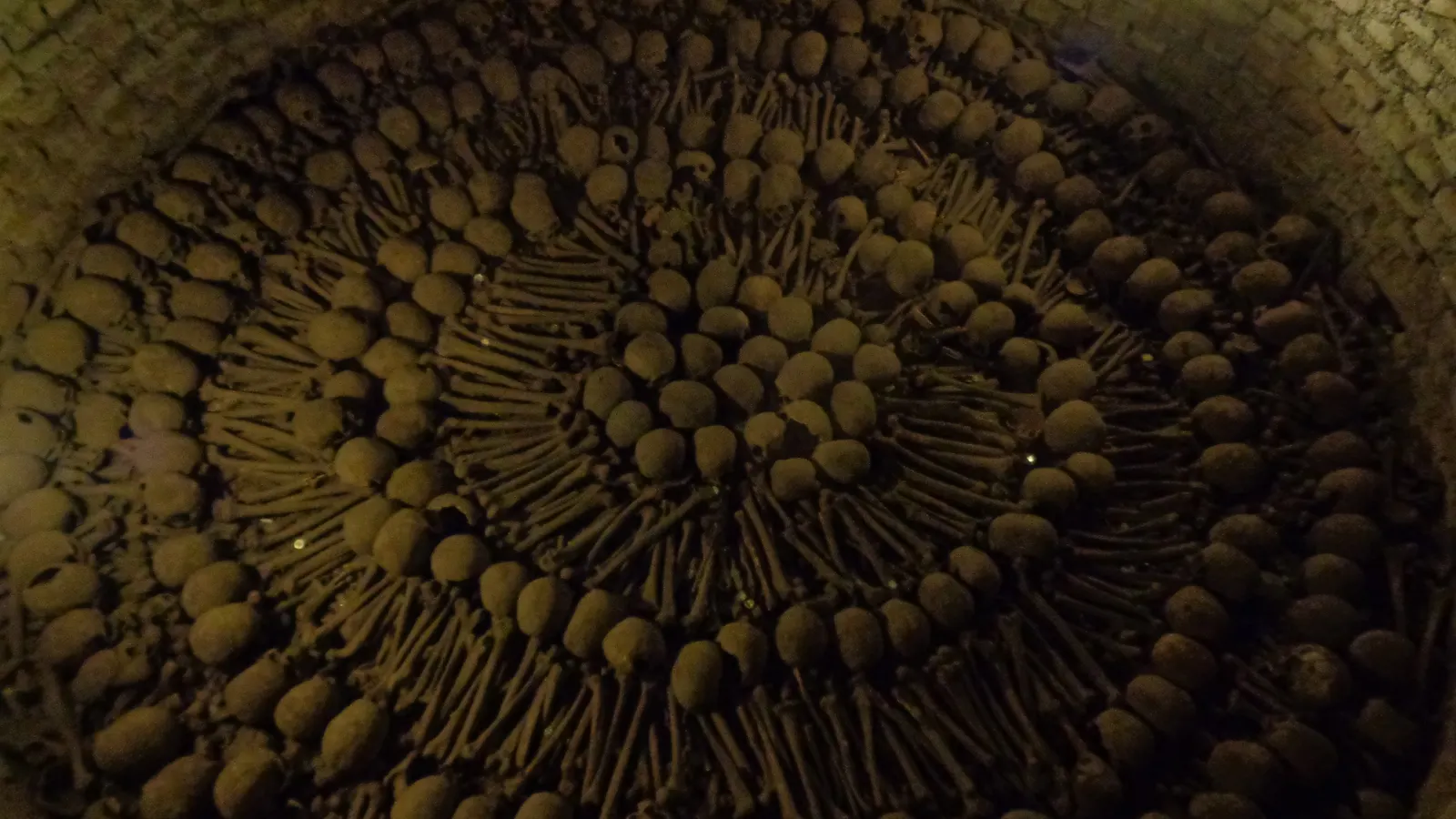
A colonial ossuary under a working Franciscan convent, and the only way in is the museum tour: guided, about 45 minutes, in Spanish or English, first come first served. Burials here stopped around 1808. The 25,000 dead that every guidebook quotes is an estimate of how many the vaults could hold, not a count from any excavation, and the historian who has worked the site longest puts the figure above 100,000. Admission in September 2026 is S/20 for adults, about $5.95 at the central bank rate, paid at the door - the operator sells nothing online and publishes no price list on its own website at all.
- TicketsNone.
- PriceS/ 20 (about $5.95) – Adult, Peruvian or foreign - museum, cloisters, library and catacombs, guide included
- OpenMonday to Sunday, 09:00 to 18:00, public holidays included.
- Best timeWeekday mornings, from opening at 09:00 until about 11:00.
- ClaustrophobiaThis is one of the few show sites where the warning is not boilerplate.
Tickets and prices
None. There is no timed entry, no booking system and no advance sale. You walk up to the desk in the Plazuela San Francisco, pay, and wait for the next group. The museum's own website has no ticket page: its sitemap lists exactly seven pages - home, about, services, history, contact, blog and a souvenir shop - and none of them sells admission.
Official prices
- Adult, Peruvian or foreign - museum, cloisters, library and catacombs, guide includedS/ 20 (about $5.95)
- University or technical student with student cardS/ 10 ($2.97)
- ChildrenS/ 5 ($1.49)
- Children under 5free
- Basilica of San Francisco, the church nave only - no museum, no catacombsfree
- Senior ratenone published; the neighbouring Santo Domingo convent does have one, this one does not advertise any
- Previous tariff, still printed on many sites: adult / student / school pupil / childS/ 15 / S/ 8 / S/ 3 / S/ 3
- Tariff of 2009, still on showcaves.com: adult / student / childS/ 5 / S/ 2.50 / S/ 1
As of 09/2026 · source and direct booking: museoconventosanfranciscoycatacumbas.com.pe
When everything is sold out
Not applicable in the usual sense. Groups form on the spot, so the only thing that sells out is your patience on a Sunday or a public holiday, when several city tours arrive at once and the wait for an English-speaking guide can run past half an hour.
Tours that include the Lima catacombs
Book direct and the whole thing costs S/20, about $5.95, paid at the desk on the Plazuela San Francisco - there is no online ticket, no timed entry and no queue to skip, because the operator sells nothing in advance through anyone. What a booked tour buys you is different: a guide who meets you in Miraflores, transport across a city where hailing a street taxi is a bad idea, and the historic centre explained around the visit rather than just the crypts. That is worth money if you have one day in Lima, and worth very little if you are already staying in the centre and speak enough Spanish to wait for the next group. Read the description carefully before you pay: some products include the S/20 admission and some drop you at the door to buy your own, and the difference is rarely in the headline. Check too whether you actually go inside - several "San Francisco" tours are exterior walks of the plazuela and the basilica, which is free anyway. If an offer promises skip-the-line access or a fixed English departure time, it is describing something the museum does not operate.
Lima City Tour: Historic Center, Love Park & Catacombs
Lima: Panoramic Sightseeing Bus, Walking, and Catacombs Tour
LIMA WALKING TOUR FROM MIRAFLORES, DOWNTOWN LIMA, CATACOMBS, CHURROS, WINERY+BUS
Lima: City Highlights Walking Tour & Catacombs
Show all 8 offers
Lima : City Tour by Panoramic Bus - Walking & Catacombs
Lima: Historic Center, Catacombs, and Water Show Tour
Sightseeing tour of the historic center + catacombs with hotel pick-up included
LIMA SIGHTSEEING TOUR: CATACOMBS FROM MIRAFLORES, HISTORIC CENTER, WINES + BUS
Booked through GetYourGuide (affiliate link, advertising). Most offers can be cancelled free of charge up to 24 hours ahead. Prices as of 20 September 2026.
Opening hours and best time
Monday to Sunday, 09:00 to 18:00, public holidays included. That is what the Franciscan province's own press office published in March 2026 and what the museum's Servicios and Contacto pages say. It is not what you will read elsewhere, and the contradictions start on the operator's own site: the footer of every page, including those two, gives 09:00 to 21:00. Peru's Ministry of Culture museum register still lists 09:00 to 20:15, the national tourism portal ytuqueplanes.com lists 09:00 to 17:45, and a string of travel sites still carry 09:00 to 20:45 from a 2021 press release. The 21:00 figure is real but seasonal: during Holy Week the museum has run 09:00 to 21:00, which is how the late closing got into the footer and stayed there. No published last-entry time exists. Tours leave when a group forms and run about 45 minutes, so treat 17:00 as the practical cut-off rather than 17:45. The church itself keeps separate hours from the museum and is free.
When it is quietest
Weekday mornings, from opening at 09:00 until about 11:00. That is when international groups pass through, so an English guide is easiest to come by, and it is before the afternoon city-tour wave. Avoid Sundays and Peruvian public holidays, when domestic visitors fill the courtyards. Lima has no season that makes the crypts better or worse - the temperature underground barely moves - but the city above is under low grey cloud from June to September and sunny from December to March, which matters for the rest of your day in the centre. Holy Week is the one exception worth planning around: the museum has opened until 21:00 in that week, which is the only time the catacombs are reliably open after dark.
Who it suits
With children
Children pay S/5 and are admitted, but this is an ossuary with open human remains and no interpretation aimed at children. Peruvian guides advise against bringing small children, and the 45-minute route through the upstairs museum before the descent tests short attention spans.
Minimum age
No minimum age is published and none is enforced. The constraint is temperament, not age.
Wheelchair
The museum floor is partly manageable; the catacombs are not. You go down and up stairs into low, narrow brick passages with uneven floors, and there is no lift and no alternative route. Wheelchair users and anyone with serious mobility problems will see the cloisters, the library and the Rubens-workshop room but not the crypts.
Pushchair
Leave the pushchair behind. The stairs and the width of the passages rule it out. There is a cloakroom at the museum for bags.
Dogs
Not permitted - this is a museum inside a working convent. Assistance dogs aside, do not plan on it.
Claustrophobia
This is one of the few show sites where the warning is not boilerplate. The passages are genuinely tight and low in places, the lighting is dim, the air is close, and you cannot turn back on your own once the group has moved on. If tight dark spaces are a problem for you, say so to the guide before you go down; the upstairs museum is worth the ticket by itself.
What to wear
Flat, closed shoes with grip. Floors are old brick and stone, worn smooth and uneven, and there are steps. Lima's climate is mild - roughly 14 to 18 C (57 to 64 F) in the grey winter months from June to September, 22 to 28 C (72 to 82 F) in summer - and the crypts feel cooler and damper than the street, so a light layer helps. Bags go in the cloakroom.
Photography
Photography and video are prohibited in the catacombs. Every Spanish and English source that describes a visit says the same, and guides enforce it. The convent and cloisters above ground are usually fine. The operator does not publish the rule anywhere on its own website, which is why English blogs keep contradicting each other about it; treat the ban as real and ask the guide if you want to photograph anything upstairs.
Getting there
By public transport
The Metropolitano bus rapid transit is the useful line. Coming from Miraflores or Barranco, ride north to the central stations - Jiron de la Union or Colmena are the closest - and walk about ten minutes east through the grid to the Plazuela San Francisco. Reckon on 30 to 45 minutes from Miraflores depending on traffic and the queue at the station. Lima's Metro Line 1 does not serve the historic centre usefully. Do not hail a street taxi: the UK Foreign Office advises using licensed telephone or app-based services, which in Lima means Uber, Cabify, Didi or InDrive.
By car
Driving into the Cercado is a bad idea and parking around the Plazuela San Francisco is worse. There are paid car parks a few blocks away towards Avenida Abancay, but with an app taxi costing a few dollars from Miraflores there is no reason to bring a car.
From the nearest city
About 350 m from the Plaza Mayor, a five-minute walk past the Government Palace and the Desamparados station building; roughly 8 to 10 km from Miraflores and San Isidro, which is 25 to 45 minutes by car depending on the hour. Most organised Lima city tours include this site and handle the transfer for you.
Tips for your visit
- Bring soles in cash, in small notes. Card payment is officially accepted but Peruvian writers keep reporting that it is not always working, and there is no cash machine on the plazuela worth using.
- Go in the morning if you want an English guide. Groups form by language as people arrive, and the English-speaking critical mass builds when the international tours come through, roughly 09:00 to 11:00.
- Say it out loud if you are claustrophobic, before the group starts down. The guides are used to it and there is no shame in waiting in the cloister.
- Put the camera away before the stairs. The ban is real and enforced, and guides will call you out. Photograph the tiled cloisters and the facade instead, where nobody minds.
- Do not skip the upstairs. The Sala De Profundis holds eleven large canvases from the workshop of Peter Paul Rubens, and the library, with something over 25,000 volumes, is the reason many Peruvians come. The catacombs are the last twenty minutes of a much better tour than the name suggests.
- The church is free and separate. If your budget is tight or the queue is long, the basilica nave costs nothing; the museum ticket is what buys the crypts.
- Check the state of the Plazuela San Francisco before you promise anyone a photogenic square. The perimeter wall was demolished during the municipal works, and as of early 2026 the plaza was still a building site with rubble and spoil on it; the contractor's stated timetable was about five months from January 2026.
- Keep your day visit a day visit. The UK Foreign Office calls street crime a significant problem in Lima and notes that protests often occur in the historic centre; the practical advice is the ordinary one - bag in front, phone out of sight, app taxi door to door rather than walking back after dark.
- Chain it with the Cathedral. The Museo Catedral de Lima, 350 m away, opens its own crypts, including the one where Francisco Pizarro's remains were identified in 1977; two crypt visits in one morning is an easy and coherent plan.
- Time the last entry generously. No last-admission time is published, groups run about 45 minutes and the doors close at 18:00. Be at the desk by 17:00.
What the internet gets wrong
that domain is no longer the museum's. On 20 September 2026 it answered with a chain of 301 redirects - to devenireleveurcanin.com, then spayneuterspringfield.org, then a seafood restaurant's menu page - and the page finally served carried a Thai online-casino title. Anyone following the link a major encyclopaedia and a government register still publish ends up somewhere they did not intend. The museum's live site is museoconventosanfranciscoycatacumbas.com.pe.
Free admission (visita-lima.limaciudaddelosreyes.com.pe, the tourism portal of PROLIMA and the Metropolitan Municipality of Lima, on its page for the Museo del Convento de San Francisco y Catacumbas): the museum costs S/20 for an adult. The city's own site has confused the free church with the paid museum. The nave of the basilica is free; the cloisters, the library and the catacombs are not, and never have been.
That was the tariff when the museum reopened after the pandemic. Peru's national tourism portal ytuqueplanes.com now lists S/20 for adults, S/10 for students, S/5 for children and free entry under five, and the Peruvian travel press has been printing the same since mid-2024. Turn up with S/15 in your hand and you are S/5 short.
S/10 is now the student rate, not the general one. viajandoalima.com's S/1 child ticket has not existed for years. These pages have been left to age in place - viajandoalima.com's own footer still reads 2016-2019.
The Franciscan province published 09:00 to 18:00, holidays included, in March 2026, and the museum's own Servicios and Contacto pages say the same. Plan on a 20:45 closing and you will find the door shut nearly three hours earlier. The late-evening figures are a fossil of the 2021 reopening schedule.
There is no Sunday-afternoon-only opening and no 09:30 start. Sunday is a full day, 09:00 to 18:00, like every other. This matters, because Sunday is the day most short-stay visitors have free in Lima.
No source of any kind stands behind 70,000 or 75,000. Where 70,000 came from is not documented anywhere we could find; TIME at least attributes its number honestly, to "tour guides". The figures in circulation that do have names attached are 25,000, which is an old estimate of capacity, and more than 100,000, which is the working estimate of Cayetano Villavicencio, the historian and curator who has spent years on the site.
25,000 is not a finding. Peruvian sources are careful where the encyclopaedia is not - RPP writes that the crypts "se calcula que ... debió albergar hasta 25 mil personas", an estimate of what the vaults could have held. Nobody has excavated and counted. Villavicencio told La Tercera in 2023 that he puts it above 100,000, and the archaeologist Pieter Van Dalen said in 2024 that only 30 to 40 per cent of the zone has even been reached. The honest answer to "how many are down there" is that it is unknown, and that is the single most misreported fact about this place.
the colonial monks did not build the flower of skulls and femurs you photograph in your memory. PROMPERU's own account is that the round pits were anti-seismic engineering and that bones were moved into them later, when the vaults ran out of space. The geometric display came with the 20th-century opening: showcaves.com states that after the 1943 excavation "some archeologist thought that the Catacombs would have more appeal with the human bones arranged artistically", thediscoveriesof.com reports that on reopening the skeletons were sorted and separated by body part, and machupicchuterra.com concedes that the remains are now "grouped in a capricious way to attract the visitor". What is colonial is the ossuary. What is modern is the pattern.
There is no English timetable. The Franciscan province's own wording is that tours run in Spanish and English, last about 45 minutes and that "el ingreso es por orden de llegada" - by order of arrival. Groups form at the desk as people turn up. myperuguide.com is closer to the truth than most when it warns that you wait "until there are enough people to form a group (around 14 people)".
the operator sells no ticket in advance, through anyone. Its own website has seven pages and none of them is a ticket page; its sitemap lists home, about, services, history, contact, blog and a souvenir shop. What the resellers sell is a guided city tour that calls here, and whether the S/20 admission is included differs from product to product. There is no queue to skip - there is a wait for a guide, and money does not shorten it.
the operator's own press office, franciscanos.pe, writes 1948. Four dates, three of them stated without a source. The two dates that can be pinned down are the opening of the catacombs to the public in 1950 and the opening of the museum above on 9 August 1968 - and the second of those is itself widely misprinted as 1969, including by es.wikipedia.org and by the city's own visita-lima portal.
Both halves are half right, in opposite directions. UNESCO inscribed the Convent Ensemble of San Francisco de Lima in 1988 - the convent was the whole of the original World Heritage property. The 1991 decision extended it to the Historic Centre of Lima, and a further extension followed in 2023. So the convent is not a component of a 1988 city listing; the city listing grew out of the convent.
stated without measurement, and contradicted three paragraphs earlier in the same Wikipedia article, which says the total area of the crypts has never been determined. The 1981 mapping attempt ended in exactly that conclusion. You cannot rank something whose extent nobody knows.
No excavation report, no researcher and no institution is cited for this, and nothing of the kind appears in PROMPERU's or the Franciscan province's accounts of the site. It is a tour-guide story written up as a fact, on a page that also supplies the unsourced 70,000.
History in brief
- 1546: the Franciscans are granted land two blocks from the Plaza Mayor and begin the Convento de San Francisco de Jesus el Grande. The complex eventually holds three churches - San Francisco, La Soledad and El Milagro - around cloisters and courtyards.
- Until the 1656 collapse the burial vaults were separate and sealed, each under a side chapel belonging to a confraternity or a wealthy family. When the church came down through faults in the original build, the foundations were opened, the central nave and transept were excavated, and the old vaults were connected to each other and to new ones by doors and passages cut through the original walls. That is the labyrinth visitors walk today.
- 1672: the rebuilt church is inaugurated, to plans by the Portuguese architect Constantino de Vasconcelos, who asked to be buried beneath it instead of being paid. No new burial vaults were opened after that.
- Seismic engineering, not funerary design, explains the famous round pits. Deep wells were sunk under the church to damp earthquake shock - the Cathedral of Lima has one 6 m deep and 4 m across - and only later, when the crypts ran out of room, were skeletal remains moved into them. Skulls and femurs survive longest, which is why they dominate what you see.
- 1808: Lima's first open-air cemetery, the Presbitero Matias Maestro, opens and burials under the churches wind down. A decree of Jose de San Martin in 1821 ends the practice in law, and the crypts are sealed.
- 1746 and after: the great earthquake of 28 October 1746 destroys much of the convent. The complex is repeatedly rebuilt; the church has since ridden out the quakes of 1940, 1966, 1970, 1974 and 2007.
- Rediscovery is dated to 1943, 1947 or 1948 depending on who is writing; the Franciscan press office itself says 1948. What is firm is that the blocked passages were cleared, lit and excavated in the 1940s and that the catacombs opened to the public in 1950. The museum in the convent above followed on 9 August 1968, with President Fernando Belaunde Terry at the ceremony.
- 1988: UNESCO inscribes the Convent Ensemble of San Francisco de Lima on the World Heritage List - the convent was the original property. The listing was extended in 1991 to cover the whole Historic Centre of Lima, and again in 2023.
- 1981 and since: attempts to map the tunnel system fail to establish its extent. Passages are believed to run towards the Government Palace, the Desamparados station and the Casa de Aliaga; the archaeologist Pieter Van Dalen said in 2024 that only 30 to 40 per cent of the excavation zone has been reached.
- 2021-2024: a subterranean burial chapel and a previously unknown crypt are found beneath the Santuario de Nuestra Senora de la Soledad, on the same plazuela. A legal dispute between the Franciscan province and the city council kept the find closed to the public; in January 2026 a geophysical survey of 3,220 sq m of the plazuela by the Spanish specialist Luis Avial reported crypts and monumental structures under the square, contradicting the council's position that nothing was there.
Frequent questions
How much does it cost to visit the Lima catacombs in 2026?
S/20 for an adult, about $5.95, S/10 ($2.97) for a university or technical student with a card, S/5 ($1.49) for children and free for under-fives. One ticket covers the convent museum, the cloisters, the library and the catacombs with a guide. Dollar figures use the Peruvian central bank's interbank selling rate of S/3.364 to the dollar for 17 September 2026. Ignore the S/15 and S/10 prices still printed on English travel sites - those are the 2021 and pre-2021 tariffs.
Do I need to buy tickets in advance?
No, and you cannot. There is no online sale, no timed entry and no booking system; the museum's own website does not even have a ticket page. You pay at the desk on the Plazuela San Francisco and join the next group. If a reseller is selling you a ticket, what you are buying is a city tour that stops here.
Is the catacomb entry separate from the convent ticket?
No. It is one ticket and one route: you walk the museum upstairs and down, and the catacombs are the last stage. You cannot buy the crypts alone and you cannot skip them. The basilica itself - the church nave - is free and entirely separate, which is where the persistent "free admission" claim comes from.
What are the opening hours and when is the last entry?
09:00 to 18:00 daily, holidays included, according to the Franciscan province in March 2026 and the museum's own contact page. No last-entry time is published. Since a tour takes about 45 minutes and groups leave only when they have formed, be at the desk by 17:00. Hours of 20:15, 20:45 and 21:00 appear on the Ministry of Culture register, on travel sites and even in the footer of the museum's own website; they are stale or seasonal.
Can I walk around the catacombs on my own?
No. Entry is guided only, in a group, from start to finish. The Franciscan province states it plainly: every tour is made in the company of a guide. This is not a rope-and-signage museum, and the guide sets the pace through the crypts.
Are there tours in English?
Yes, with the museum's own bilingual guides - but not to a timetable. Groups form by language as visitors arrive. Mornings between 09:00 and 11:00, when international tour groups come through, give you the best chance of a short wait; one guide site puts the threshold for forming a group at around fourteen people. Any page promising fixed English departure times is inventing them.
Can I take photos in the Lima catacombs?
No. Photography and video are prohibited underground and the guides enforce it. Above ground, in the cloisters and courtyards, cameras are generally fine. The confusion in English blogs exists because the operator publishes the rule nowhere on its own website - but every account of an actual visit, in Spanish and in English, says the same thing.
How long does the visit take?
About 45 minutes for the whole route, which is the figure the Franciscan province gives. The underground section alone runs roughly 30 minutes. Add waiting time for a group to form, particularly if you want English, and budget 90 minutes from arriving at the desk to walking back out.
Is it suitable for children, and is there a minimum age?
There is no minimum age and children pay S/5, but the site does not soften what it is: open human remains, stacked by the thousand, with a 45-minute guided walk and no child-facing interpretation. Peruvian guides advise against bringing small children, and pushchairs are impossible on the stairs. Older children who know what they are coming to see usually do fine.
Is the site wheelchair accessible?
The museum floor is partly manageable; the catacombs are not. The descent is by stairs into low, narrow passages with uneven brick and stone floors, and there is no lift and no bypass. If you cannot manage stairs, you will still get the cloisters, the tiled galleries, the library and the Rubens-workshop canvases - which is most of the ticket - but not the crypts.
What if I am claustrophobic?
Take the warning seriously here. The passages are tight and low in places, the light is dim, the air is close and you cannot leave the group on your own. Tell the guide before the descent. The upstairs museum is worth the S/20 on its own, so sitting the crypts out costs you less than you think.
How many people are actually buried under San Francisco?
Unknown. The 25,000 everyone quotes is an old estimate of how many the vaults could have held, not a count from any excavation - Peruvian sources phrase it as such, the encyclopaedias do not. Cayetano Villavicencio, the historian who has worked the site longest, puts it above 100,000. The 70,000 and 75,000 you will read on English travel sites have no source behind them at all. In 2024 an archaeologist on the wider site estimated that only 30 to 40 per cent of the excavation zone has been reached.
Were the bones really arranged like that by the monks?
Not the patterns you see. The round pits under the church were built as anti-seismic wells and only later filled with skeletal remains when the vaults ran out of room; skulls and femurs dominate because they survive longest. The neat concentric arrangement dates from the 20th-century opening, when the remains were sorted and laid out for display - one account says an archaeologist decided the catacombs would have more appeal that way. The ossuary is colonial; the flower of skulls is museography.
How do I get there from Miraflores?
Take the Metropolitano bus rapid transit north to one of the central stations - Jiron de la Union or Colmena - and walk about ten minutes to the Plazuela San Francisco; allow 30 to 45 minutes door to door. By app taxi it is 25 to 45 minutes depending on traffic. Do not hail a taxi in the street; the UK Foreign Office advises licensed telephone or app-based services only. From the Plaza Mayor it is a 350 m walk.
Is the historic centre safe?
By day, with ordinary care, yes - this is Lima's most visited quarter and there are police and tour groups everywhere. The UK Foreign Office describes street crime, including muggings and thefts, as a significant problem in Lima generally, warns that protests often happen in the historic centre and that access can be restricted, and advises against walking alone in quiet areas or at night. The practical version: visit in the morning, keep your phone out of sight, and take an app taxi rather than walking back after dark.
Are there night tours of the catacombs?
Not as a regular product. The museum closes at 18:00. The one documented exception is Holy Week, when the Franciscan province has advertised opening from 09:00 to 21:00, and Peruvian travel writers mention occasional special evening openings around Holy Week and in October, arranged in advance. Agencies selling a "tour nocturno" of San Francisco are usually selling an evening walk of the historic centre with a late-afternoon visit inside - check what time you actually go through the door.
Sources
Show 46 sources – every figure on this page is sourced
- museoconventosanfranciscoycatacumbas.com.pe/ – Operator's live site; footer hours "Lun a Dom 9:00 AM a 9:00 PM" on every page; address, phone, e-mail; no prices anywhere
- museoconventosanfranciscoycatacumbas.com.pe/servicios/ – "Guias bilingues (espanol e ingles)", tour about 1 hour, specialised tours; opening hours 09:00-18:00 including holidays; souvenir shop; free temporary exhibitions
- museoconventosanfranciscoycatacumbas.com.pe/contacto/ – Opening hours "Lunes a Domingo: 9:00 am - 6:00 pm, Feriados: 9:00 am - 6:00 pm"; address
- museoconventosanfranciscoycatacumbas.com.pe/historia/ – Operator's chronology: 1535 founding of Lima, 1546 convent founded, 1609 church begun, 1656 earthquake, 1672 inauguration, 1746 earthquake, library of more than 25,000 volumes
- museoconventosanfranciscoycatacumbas.com.pe/nosotros/ – Mission and vision; UNESCO claim; photo gallery
- museoconventosanfranciscoycatacumbas.com.pe/wp-sitemap-posts-pa… – Proof that the operator's site has seven pages and no ticket or price page
- franciscanos.pe/museo-catacumbas-san-francisco/ – Franciscan province press office, March 2026: hours 09:00-18:00 including holidays; tours with a guide in Spanish and English, about 45 minutes, by order of arrival; museum opened 9 August 1968; director Fr. Jose Rosas Surita OFM; library of about 25,107 volumes; room list
- franciscanos.pe/museo-san-francisco-y-catacumbas-de-lima-recibi… – Franciscan press office (April 2023): Holy Week opening 09:00-21:00, regular hours then 09:00-17:30; crypts "descubrimiento ... en 1948", exhibited from 1968; eleven Rubens-workshop canvases in the Sala De Profundis
- museos.cultura.pe/museos/museo-convento-de-san-francisco – Peruvian Ministry of Culture museum register: hours "9:00 a.m. a 8:15 p.m.", contact informes@museocatacumbas.com, services guiding and cloakroom, history of the complex
- www.ytuqueplanes.com/teapuntas-lima-callao/distritos-con-histor… – PROMPERU's national tourism portal: adult S/20, students S/10, children S/5, under-5s free, cash or card, church entry free; hours 09:00-17:45
- blog.redbus.pe/lugares-turisticos-de/misterio-y-devocion-el-con… – June 2024: S/20 adult, S/10 student, S/5 children; the "frailes" explanation of the bone patterns quoted in irrtuemer
- www.marvelousperu.com/blog/catacumbas-de-san-francisco-lima/ – 2025 Peruvian operator guide: S/20 / S/10 / S/5, hours 09:00-18:00, recommended last entry 17:30, no photography, special night visits around Holy Week or October, cash advice, Lima climate figures
- www.peru.travel/stories/5-details-about-the-catacombs-of-lima-o… – PROMPERU (English): more than 25,000 buried, burials ended 1808 with the Presbitero Matias Maestro cemetery, seismic pits up to 5 m later used as ossuaries, skulls and femurs, notable burials, San Francisco Solano, network of church crypts across Lima
- peru.info/es-pe/turismo/noticias/3/17/-que-secretos-esconden-la… – PROMPERU (Spanish): "dos gigantescas fosas", around 25,000 bodies, San Martin decree, Cripta de los Venerables, the Soledad chapel-crypt find with PROLIMA
- es.wikipedia.org/wiki/Catacumbas_de_Lima – 25,000 to 1810 with burials into the mid-19th century; five wells of about 10 m; vaults joined after the 1656 collapse; Vasconcelos 1672; clearance 1947 and public opening 1950; notable burials; the "second only to Paris" claim
- en.wikipedia.org/wiki/Catacombs_of_Lima – "with some 25,000 bodies lying within" sourced to Euronews/AFP; museocatacumbas.com given as the official website; 1950 reopening; 1981 mapping attempt; tunnels towards the Government Palace and Casa de Aliaga. Checked on 20 September 2026, that domain answered with a chain of 301 redirects ending on an unrelated commercial page; it is deliberately not linked here
- rpp.pe/cultura/mas-cultura/catacumbas-el-cementerio-colonial-de… – "se calcula que ... debio albergar hasta 25 mil personas"; two wells of almost ten metres; 1821 decree and 1950 reopening
- www.infobae.com/america/peru/2021/10/26/visita-las-catacumbas-d… – Origin of the S/15 / S/8 / S/3 tariff and the 09:00-20:45 hours still circulating; room list; UNESCO 1988
- parquedelareserva.com.pe/que-hay-para-ver-en-las-catacumbas-de-… – Repeats S/15 / S/8 / S/3 and 09:00-20:45; 45-minute tours in Spanish and English by order of arrival; claustrophobia warning
- www.latercera.com/tendencias/noticia/catacumbas-de-lima-como-es… – July 2023: Cayetano Villavicencio's estimate of more than 100,000 buried; who was buried ("espanoles, criollos, indios y negros", "no habia exclusiones"); skulls and femurs survive longest
- larepublica.pe/ciencia/2024/07/08/las-nuevas-catacumbas-de-lima… – July 2024: new catacombs under the Santuario de la Soledad closed to the public by a 22-month legal dispute; Villavicencio's 100,000; archaeologist Pieter Van Dalen on only 30-40 per cent of the zone being reached
- www.infobae.com/peru/2026/01/29/hallan-criptas-y-estructuras-mo… – January 2026 geophysical survey of 3,220 sq m of the Plazuela San Francisco by Luis Avial (Falcon High Tech) for the Franciscan province; crypts and monumental structures found; the plaza's perimeter wall demolished, rubble on site, 32-month stoppage, five-month completion plan; quote from Fray Jose Surita
- www.infobae.com/peru/2025/01/22/la-cripta-mas-grande-de-latinoa… – January 2025: rediscovery dated to 1943; "a mas de 10 metros de profundidad"; the 1991 UNESCO claim corrected in irrtuemer
- en.wikipedia.org/wiki/Historic_Centre_of_Lima – UNESCO inscribed the Convent Ensemble of San Francisco de Lima in 1988; extension to the Historic Centre of Lima in 1991; further extension 2023
- whc.unesco.org/en/list/500/ – World Heritage listing Historic Centre of Lima, inscription 1988, extensions 1991 and 2023 (reached via the article above; the UNESCO page itself refused automated access)
- www.showcaves.com/english/pe/subterranea/LimaCatacombs.html – 2009 tariff S/5 / S/2.50 / S/1 and hours 09:30-17:30; "several experts claim that the number of deceased here is actually closer to 70,000"; "some archeologist thought that the Catacombs would have more appeal with the human bones arranged artistically"
- content.time.com/time/travel/cityguide/article/0,31489,1977548_… – TIME Lima city guide: "Tour guides say an estimated 75,000 bodies are buried under San Francisco alone"
- www.quechuasexpeditions.com/fascinating-facts-about-the-catacom… – "More than 70,000 people buried"; the colonial-respect explanation of the bone patterns; the unsourced animal-sacrifice claim
- www.atlasobscura.com/places/convento-de-san-francisco-ossuary – Carries the 70,000 figure for the ossuary (page served only via search summary; direct access refused)
- www.machupicchuterra.com/lima/lima-city/church-san-francisco-lima/ – English page with a 2026 copyright still printing S/15 / S/8 / S/3 and hours 09:00-20:45; five wells up to 10 m deep; remains "grouped in a capricious way to attract the visitor"; "second only to the catacombs of Paris"
- myperuguide.com/convent-of-san-francisco-catacombs – "Hours: 9:30 to 17:30", "Entrance Ticket: S/. 10.00"; English tours form when about 14 people have gathered; catacombs built 1657-1672, closed 1821, hidden until 1947
- viajandoalima.com/catacumbas/ – "Entrada general 10 soles. Estudiantes 5 soles. Ninos 1 sol"; hours 10:00-20:00; no photos or video; cash only; site footer dated 2016-2019
- www.thediscoveriesof.com/monastery-san-francisco-lima/ – First-hand English account: paid "our 10 soles"; over 25,000 buried until 1808; rediscovered and reopened 1947; archaeologists sorted and separated the skeletons by body part on reopening
- conventosantodomingo.pe/cuanto-cuesta-la-entrada-a-las-catacumb… – S/15 / S/7 / S/3 / S/5 tariff and "Lunes a Sabado: de 9:30 a 17:45. Domingos: de 13:00 a 17:45" with a 17:15 last group; no photography in the catacombs
- visita-lima.limaciudaddelosreyes.com.pe/es/museos/museo-del-con… – PROLIMA / Municipality of Lima tourism portal: "Entrada Libre", hours 09:00-18:00, address Jr. Ancash 364, museum "fundado en 1969", library of 25,000 volumes
- www.limawalkingtour.com/attractions/lima-catacombs/ – Guided-only visits of about 45 minutes, no photos or video, narrow passages and stairs, hours around 09:00-18:00, cash preferred at the desk, English "at selected times"
- us.trip.com/travel-guide/attraction/lima/museo-convento-san-fra… – "Tickets [2026] - Promos, Prices, Reviews & Opening Hours" framing for a site that sells no advance tickets (page served only via search summary; direct access refused)
- estadisticas.bcrp.gob.pe/estadisticas/series/api/PD04638PD/json… – Banco Central de Reserva del Peru, interbank exchange rate (sell), series PD04638PD: S/3.364 per US$ on 17 September 2026, the last rate published before 20 September
- www.gov.uk/foreign-travel-advice/peru/safety-and-security – UK Foreign Office: "Street crime, including muggings and thefts, is a significant problem in Lima"; protests often in the historic centre with restricted access; use licensed telephone or app-based taxis, do not hail in the street; do not walk alone in quiet areas or at night
- catedraldelima.org.pe/criptas/ – Museo Catedral de Lima: Cripta Arzobispal with archbishops from Geronimo de Loayza, Pizarro's remains found there in 1977; Cripta de la Virgen de la Candelaria with five graves and about 70 people from the shoemakers' confraternity; Cripta de la Asuncion with at least 110 bodies and a 6 m anti-seismic well
- museoconventosantodomingolima.org/ – Santo Domingo museum: Tuesday to Sunday 09:00-13:00 and 14:00-17:00; S/15 general, S/7 over-60s and students, S/2 children 5-16; crypt of Saint Rose of Lima; library of more than 25,000 books; guided hour
- en.wikipedia.org/wiki/Museum_of_Congress_and_the_Inquisition – Museum of Congress and the Inquisition at Jr. Junin 548, closed since May 2016 for restoration, previously the most visited museum in the city
- www.infobae.com/peru/2025/06/10/congreso-gasto-mas-de-s5-millon… – June 2025: restoration of the Inquisition museum abandoned since February 2025 after nearly S/5 million spent, no restart date
- www.limatourperu.com/tour-en-lima-de-noche-las-catacumbas/ – Example of a private agency selling an evening "tour nocturno" that includes San Francisco; repeats the 25,000 figure and the 1808 end of burials
- perusim.com/blog/visit-lima-san-francisco-catacombs/ – English account: the catacomb section alone runs about 30 minutes; entry to the crypts from the Porteria; room-by-room route
- limacultura.pe/museo-convento-san-francisco-y-catacumbas-lima/ – Choir of 130 carved cedar stalls, rotating lectern, library figure of 20,000 given as an alternative to 25,000