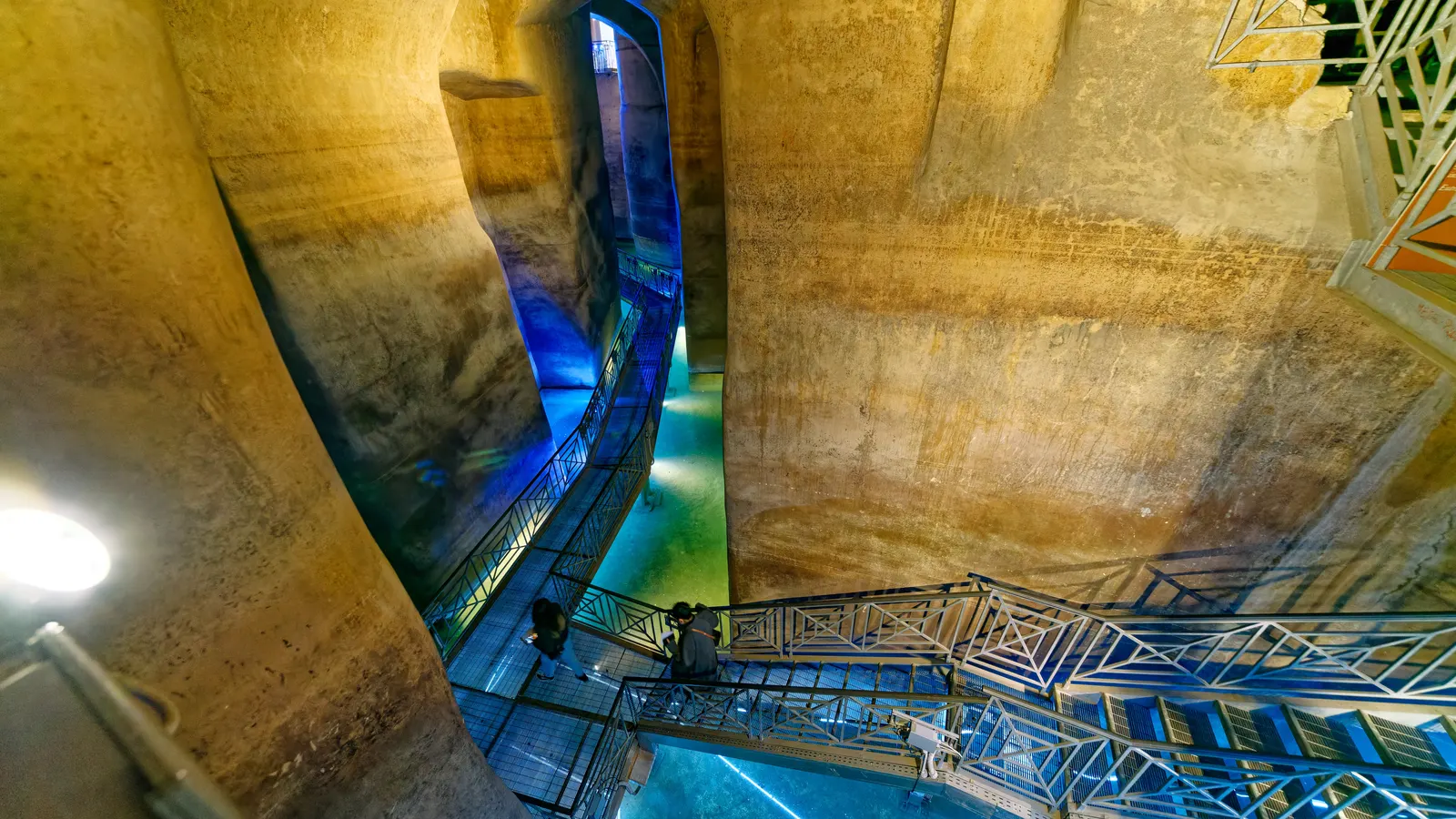
Matera is not an underground city, whatever the tour titles say. It is a city cut sideways into a limestone cliff — and underneath it lies a second one. The centre of that second city is the Palombaro Lungo, a cistern 16 metres deep under Piazza Vittorio Veneto that held five million litres and was only reopened in 1991, when the square was being relandscaped. This page separates what in Matera is genuinely below ground — cisterns, hypogea, crypts, a drainage ossuary — from what is merely carved into rock, and gives the September 2026 prices in euros and dollars, operator by operator, because there is no single ticket.
- TicketsThe Palombaro Lungo takes no advance bookings at all — not online, not by telephone, not for groups.
- Price€3.00 (about $3.44) – Palombaro Lungo, adult
- OpenPalombaro Lungo: daily 10.00–13.00 and 15.00–18.00, no weekly closing day (operator, 09/2026).
- Best timeApril to June and September to October.
- ClaustrophobiaRarely an issue.
Ten sites compared, and which are actually below ground
Palombaro Lungo
The great public cistern directly beneath Piazza Vittorio Veneto: 16 metres deep, 50 metres long, holding up to five million litres. Cut out of the limestone in several phases from the 16th century onwards and sealed with cocciopesto, a lime mortar with ground brick in it. It was only reopened in 1991, when the square was being relandscaped; today walkways cross it above the old waterline.
The one place in Matera where you can walk into a cistern of this size with no guide and no booking. The entrance leaflet comes in seven languages including English. No animals.
€3.00 (about $3.44) adult, under 18 free, school groups €1.50 (about $1.72) — 09/2026
Ipogeo MateraSum
A connected network of chambers, lanes, cisterns, stores and workrooms under the historic centre, 1,200 square metres in extent and up to 12 metres deep. The visit opens with a short film and then works down through the levels. This is where the penny drops that what lies under Matera is not a set of separate holes but a second city.
The operator itself advises a jumper or light jacket and flat, comfortable shoes. Address: Recinto XX Settembre 7, a few steps from Piazza Vittorio Veneto.
€8.00 (about $9.17) with audio guide, €5.50 (about $6.30) ages 10–17 and over 75; guided tour in Italian €12.00 (about $13.75) or €8.00 (about $9.17) — 09/2026
Storica Casa Grotta di Vico Solitario
A furnished cave dwelling in the Sasso Caveoso, left as the Sassi looked until the evacuation: one room for the family, the donkey and the hens, a bed on trestles, the chamber pot behind the bedstead. Admission also covers a neviera (snow store), a natural cave and the rock church of Sant'Agostino al Casalnuovo. Note that this is a house cut into the cliff, not a place below ground.
No live guide — a recorded commentary you start from a QR code on your own phone, in eleven languages including English. Access is by stairs only.
€8.00 (about $9.17) adult, €5.00 (about $5.73) reduced, €3.00 (about $3.44) ages 11–18 and school groups, under 10 free (in force from 04/04/2026)
Santa Maria de Idris and San Giovanni in Monterrone
Two linked rock churches inside the Monterrone, the rock spur standing in the middle of the Sasso Caveoso. Santa Maria de Idris dates from the 14th or 15th century and its name probably goes back to the Greek Odigitria. A narrow passage leads into the older crypt of San Giovanni in Monterrone, with frescoes from the 12th to the 17th century including a Christ Pantocrator of the 12th.
The passage between the two churches was broken through at the beginning of the 19th century and destroyed part of the frescoes in the process — you can read the damage off the broken edges.
Part of the Oltre l'Arte ticket: one church €4.50 (about $5.16), two €8.00 (about $9.17), three €10.00 (about $11.46) — Idris and Monterrone count as one admission together (09/2026)
San Pietro Barisano
The largest rock church in the city, three-aisled, with a façade of 1755. Beneath today's floor lies the first church of the 12th or 13th century. The real reason to come is the sepolcreto on the lower level: some 60 seat-shaped niches cut into the rock, where clergy were laid out to drain before their bones were finally buried.
In 1903 the parish moved to nearby Sant'Agostino because of the damp and took the font with it. Altarpieces were stolen in the 1970s, among them a Coronation of the Virgin of 1603 by Giovanni Donato Oppido, taken in 1977.
Part of the Oltre l'Arte ticket, prices as above (09/2026)
Santa Lucia alle Malve
The oldest Benedictine community of women in Matera, founded in the 8th century and cut into the rock in three aisles. Only the right aisle stayed a church; the other two were dwellings and stores until the 1950s. On the walls hang the best-known frescoes in the city: a Madonna del Latte of about 1270 and an Archangel Michael of 1250.
A solemn mass is still celebrated here on 13 December, St Lucy's day. The sawn-off blocks of fresco in the left niche show what conversion into housing did to the place.
Part of the Oltre l'Arte ticket, prices as above (09/2026)
Madonna delle Virtù and San Nicola dei Greci
Two rock churches, a rock monastery and further rooms on three levels in the Sasso Barisano, the whole thing carved out of the limestone with three domes and a three-aisled plan copied from Romanesque masonry building. After years as a fly-tip it was restored in 1967 by the Circolo La Scaletta, and since 1987 it has housed the sculpture exhibitions in the Sassi.
Not covered by the Oltre l'Arte ticket and not by the all-inclusive ticket either: separate operator, separate till.
Paid admission; the operator, Cave Heritage, publishes no price list (09/2026)
Cripta del Peccato Originale
A natural cave 14 kilometres south of the city, painted in the 8th and 9th centuries by an unknown hand that scholarship calls the Pittore dei Fiori di Matera, after the red rock-rose flowers growing between the scenes. Found on 1 May 1963 by the Circolo La Scaletta, restored from 2001 by the Fondazione Zétema and open to visitors since 2005. In the Fall of Man scene Eve hands Adam a fig, not an apple.
2 to 12 people per slot, 20 at most. No photography, no animals, no food. Access is down stairs over uneven ground, and the management asks visitors with limited mobility to ring first. Keep the ticket and it gets you into the MUSMA sculpture museum and the Casa di Ortega at a discount within seven days.
€8.00 (about $9.17), groups of 20 or more €6.50 (about $7.45), school groups €4.00 (about $4.58), journalists and under-10s free (09/2026)
La Raccolta delle Acque with the palombaro of the Sasso Caveoso
The small museum of the water system on Via Purgatorio Vecchio: collecting channels, a bell-shaped cistern, the overflow channel and a palombaro of its own more than 15 metres deep and over 120 square metres in area, which held up to 1.5 million litres. The complex sits in the birthplace of St John of Matera and the old Chiesa del Purgatorio Vecchio.
The second-largest walkable palombaro in the city. English pages still sell tickets for it and still file it under combined tickets — neither is true at the moment.
€2.50 (about $2.87) adult, under 17 free, groups of 20 or more €2.00 (about $2.29) — but the site is currently closed (09/2026)
Casa Cisterna Sotterranea
A cave dwelling on Via Bruno Buozzi in the Sasso Caveoso with its own cistern underneath it — the standard construction of the Sassi: living quarters on top, water below. A fallback when the Casa Grotta di Vico Solitario is full.
The entrance is easy to miss: take the steps up to the left by the Bar Idris, and after 20 metres a sign points left.
Not published by the operator; concessions for groups and young people, small children free (09/2026)
Tickets and prices
The Palombaro Lungo takes no advance bookings at all — not online, not by telephone, not for groups. You pay at the desk on Piazza Vittorio Veneto, in cash or by card, and walk in. The Cripta del Peccato Originale is the opposite case: booking is compulsory and closes 90 minutes before the slot starts. The Casa Grotta di Vico Solitario and the Ipogeo MateraSum sell timed slots through their own websites, and the Casa Grotta recommends booking ahead. Tickets for the three rock churches come from Oltre l'Arte's web shop or from the churches themselves.
Official prices
- Palombaro Lungo, adult€3.00 (about $3.44)
- Palombaro Lungo, under 18free
- Palombaro Lungo, school groups per person€1.50 (about $1.72)
- Ipogeo MateraSum, self-guided with audio guide, adult from 18€8.00 (about $9.17)
- Ipogeo MateraSum, audio guide, ages 10–17 and over 75€5.50 (about $6.30)
- Ipogeo MateraSum, guided tour in Italian, adult (€8.00 / about $9.17 reduced)€12.00 (about $13.75)
- Storica Casa Grotta di Vico Solitario, adult (includes the neviera snow store, a natural cave and the rock church of Sant'Agostino al Casalnuovo)€8.00 (about $9.17)
- Casa Grotta di Vico Solitario, reduced (groups with a licensed guide, FAI/CTG members, over 65, students)€5.00 (about $5.73)
- Casa Grotta di Vico Solitario, ages 11–18 and school groups€3.00 (about $3.44)
- Casa Grotta di Vico Solitario, under 10, visitors with disabilities, residents of Materafree
- Oltre l'Arte rock churches, one church of your choice (€3.50 / about $4.01 reduced)€4.50 (about $5.16)
- Oltre l'Arte rock churches, two churches (€5.50 / about $6.30 reduced)€8.00 (about $9.17)
- Oltre l'Arte rock churches, all three (Santa Lucia alle Malve, Madonna de Idris with San Giovanni in Monterrone, San Pietro Barisano)€10.00 (about $11.46)
- Oltre l'Arte rock churches, all three reduced (visitors with disabilities, FAI members, groups of 20 or more)€7.50 (about $8.60)
- Oltre l'Arte all-inclusive ticket: the three rock churches, Vicinato a Pozzo, Casa Grotta di via Fiorentini, the MATA diocesan museum, Chiesa del Purgatorio and the bread museum€25.00 (about $28.65), reduced €16.00 (about $18.34)
- Casa Grotta di via Fiorentini (Oltre l'Arte), including the Sassi in Miniatura model€2.00 (about $2.29)
- Cripta del Peccato Originale, adult€8.00 (about $9.17)
- Cripta del Peccato Originale, groups of 20 or more€6.50 (about $7.45)
- Cripta del Peccato Originale, school groups€4.00 (about $4.58)
- Cripta del Peccato Originale, surcharge for an exclusive slot for up to 20 people€85.40 (about $97.87)
- La Raccolta delle Acque with the palombaro of the Sasso Caveoso, adult — site currently closed€2.50 (about $2.87)
As of 09/2026 · source and direct booking: palombarolungo.it
When everything is sold out
The Palombaro Lungo caps the number of people inside at any one time; when the cap is reached the operator asks you to wait a few minutes, and groups are let in in waves. The real bottleneck is the Cripta del Peccato Originale: 2 to 12 people per slot, 20 at the absolute maximum, and only four to six slots a day depending on the season.
Tours and tickets for underground Matera
Book the Palombaro Lungo direct, or rather do not book it at all: it takes no reservations, costs €3 at the desk, about $3.44, and needs no guide. The same goes for the rock churches, €10 for all three on oltrelartematera.it, about $11.46. Where a reseller genuinely earns its keep is the Cripta del Peccato Originale: it is 14 km out on a country road with no bus, booking closes 90 minutes ahead and the meeting point is a winery, so a tour with transfer solves a real problem. A guide is also worth paying for in the Sassi themselves, where the story is in the stonework rather than on any panel. Read the description before you book, and check one thing: does the offer actually go below ground? Several listings sold as "Matera underground" are street-level walks through the Sassi that never leave daylight.
Matera: Sassi Tour with Cave House and Rupestrian Church
Matera: Tour of the Sassi with iconic rock-cut churches
Sassi di Matera: Guided Walking Tour with Cave House/Church
Matera & Alberobello: UNESCO Sites from Bari, Monopoli, Polignano with a LOCAL GUIDE
Show all 11 offers
Matera: Open-Top Bus Tour with Entrance to Casa Grotta
Matera & Alberobello Tour with a Tour Leader on board
Matera: 3-hour Full Sassi Guided Tour with Idris Church & Tasting
UNESCO Matera and Alberobello – Day Tour with Tour Leader
Tour of the Sassi of Matera in Italian. House and Church Included
Matera: Guided City Center Tour with Cave Churches & Houses
From Bari: Excursion to Matera by Bus
Booked through GetYourGuide (affiliate link, advertising). Most offers can be cancelled free of charge up to 24 hours ahead. Prices as of 20 September 2026.
Opening hours and best time
Palombaro Lungo: daily 10.00–13.00 and 15.00–18.00, no weekly closing day (operator, 09/2026). Ipogeo MateraSum: timed slots booked through the operator's own calendar, evening visits on request. Storica Casa Grotta di Vico Solitario: open almost every day; January to March and October to December Mon–Fri 9.30–18.00, Sat/Sun to 19.00; April to June and September Mon–Fri 9.30–19.00, Sat/Sun to 20.00; July and August daily 9.00–20.30; last admission 20 minutes before closing. Oltre l'Arte's rock churches: Santa Lucia alle Malve and Madonna de Idris/San Giovanni in Monterrone daily 9.30–19.30, San Pietro Barisano daily 10.00–19.00; everything Oltre l'Arte runs is shut on 25 December and on 2 July. Cripta del Peccato Originale: open every day of the week at fixed times — six slots a day from April to September, five in March and October, four from November to February; you meet at the ticket desk 30 minutes before your slot.
When it is quietest
April to June and September to October. In July and August the heat stands between the limestone walls of the Sassi, and that is exactly when the Palombaro Lungo shuts for lunch from 13.00 to 15.00 — the worst moment of the day for the underground and the best one for an air-conditioned museum. To see the cistern without a crowd, arrive at 10.00 or around 17.30. Book the Cripta del Peccato Originale onto a late-afternoon slot and write off the half day around it.
Who it suits
With children
The Palombaro Lungo is short enough for any age — a quarter of an hour, and under-18s pay nothing. The Casa Grotta explains in half an hour how twelve people and a donkey shared one room, which a primary-school child understands immediately. The Cripta del Peccato Originale asks for more patience: a fixed slot, low light, half an hour of sitting still and listening.
Minimum age
None. Minors must be accompanied by at least one adult in the Cripta del Peccato Originale and in Oltre l'Arte's rock churches.
Wheelchair
Largely not possible, and English listings tend to skip this. Stairs lead down into the Palombaro Lungo and the route runs on narrow walkways above the old waterline. The Casa Grotta di Vico Solitario says itself that the stair access from Vico Solitario may be unsuitable for visitors with certain disabilities. The Cripta's management warns explicitly about the stairs and the uneven ground in front of the entrance and asks people to ring ahead. Above ground the Sassi themselves are a landscape of steps and gradients.
Pushchair
Not workable in any of the underground sites, and hard work in the Sassi generally — a carrier beats a pushchair here.
Dogs
Expressly not allowed in the Palombaro Lungo, and not in the Cripta del Peccato Originale either. The Casa Grotta publishes its own rules page.
Claustrophobia
Rarely an issue. The Palombaro Lungo is a tall vaulted hall, not a tight passage, and the Ipogeo MateraSum is a series of connected chambers. The most enclosed spot on this page is the row of burial niches in the sepolcreto beneath San Pietro Barisano.
What to wear
It is noticeably cooler below ground than on the piazza — the Ipogeo MateraSum recommends a jumper or light jacket and flat, comfortable shoes in its own description. For the Cripta the operator advises rubber soles, and in summer a hat, sun cream and insect repellent, plus an umbrella if it rains. The limestone on the climbs through the Sassi has been polished smooth by feet and turns slippery when wet.
Photography
Allowed in the Palombaro Lungo, the Ipogeo MateraSum and the Casa Grotta. Photography and video are banned in the Cripta del Peccato Originale, as are eating and phone calls; the Casa Grotta requires a permit for commercial shoots.
Getting there
By public transport
By air, the gateway is Bari Karol Wojtyła (BRI), a little under an hour from Matera by road; Brindisi and Naples are the next options and both are a long way further. By rail from Bari, the line is not Trenitalia: the narrow-gauge Ferrovie Appulo Lucane run from their own terminal beside Bari Centrale, on the western side of Piazza Aldo Moro, via Altamura to Matera Centrale — 76 kilometres in a little under two hours. Matera Centrale is underground at Piazza della Visitazione, right in the centre and about ten minutes on foot from Piazza Vittorio Veneto and the Palombaro Lungo. The catch that English route planners hide: FAL trains do not normally run on Sundays and public holidays. Coaches run instead, on a separate timetable the company publishes as its holiday schedule, and they are also used during engineering work — the Bari–Gravina section was closed from 22 June to 30 August 2026. Check the 'Comunicazione di servizio' notices on the FAL site before you travel, and buy tickets in advance, because you cannot buy them on board the replacement coaches.
By car
The old town and the Sassi are a ZTL, a limited traffic zone: if you do not live there you may not drive in, and the Sassi cameras are live with different enforcement hours in the winter and summer halves of the year. Leave the car at the edge and walk. The practical choice is the multi-storey car park on Via Saragat, immediately beside the FAL station at Piazza della Visitazione: pay by the hour or take the day rate, with the top deck open to campervans. From there the Linea Sassi minibus runs down into the old town. The drive from Bari airport takes a little under an hour. For the Cripta del Peccato Originale you need a car: about 14 kilometres, 15 to 20 minutes on the SS7 Appia, with a free but unattended car park at the ticket desk.
From the nearest city
Bari 76 rail kilometres; Bari airport just under an hour by road. The Cripta del Peccato Originale lies 14 kilometres south of the city in Contrada Petrapenta (GPS 40.618611, 16.557006) and no public transport goes there.
Tips for your visit
- Do the Palombaro Lungo first, before the 13.00 to 15.00 lunch break gets in the way. It is right on Piazza Vittorio Veneto, costs three euros, about $3.44, and takes a quarter of an hour.
- Ask for the leaflet at the entrance to the Palombaro Lungo. There is no guide and no audio guide, the English version is one of seven, and without it you are standing in a dark hall with no explanation.
- Book the Cripta del Peccato Originale first and build the rest of the day around the slot, not the other way round. Without a booking you do not get in, not even on an empty weekday.
- The Cripta's ticket desk is not the crypt. You meet at the F.lli Dragone winery on the SS7, 30 minutes before your slot, and it is another 700 metres to the entrance.
- Do the arithmetic on the rock churches before you buy. One church is €4.50 (about $5.16) and all three are €10 (about $11.46). If you also want MATA, the bread museum and Vicinato a Pozzo, the €25 all-inclusive ticket (about $28.65) is the better buy — but it does not include the Palombaro Lungo.
- Wear shoes with grip. The limestone on the Sassi stairs has been polished smooth by generations of feet, and the walkways inside the Palombaro Lungo are damp.
- Leave the car at the edge of the old town: the Sassi and the historic centre are a camera-enforced ZTL. The Via Saragat car park sits next to Matera Centrale station, has a day rate, and the Linea Sassi minibus runs down from there.
- Coming by train from Bari: on Sundays and public holidays the Ferrovie Appulo Lucane normally run coaches rather than trains, and you cannot buy a ticket on board. Read the service notices on the FAL site before you travel — engineering closures are posted there too.
- In summer, put the underground in the early morning and the late afternoon and spend the midday heat in a cave museum. It is noticeably cooler below ground; a light jacket belongs in the daypack even in August.
What the internet gets wrong
The operator's own visiting page says the opposite on every count. You go in on your own — the wording is in modo autonomo — there is no guiding service at all, the round trip takes about 15 minutes, and no reservation of any kind is accepted, not online, not by phone, not for groups. What you get instead is a printed leaflet at the door in one of seven languages. You pay €3, about $3.44, at the desk on Piazza Vittorio Veneto and walk down. There are no English tour departure times because there are no tours.
Five errors circulating as though they were one description. There is no boat and no water to row on — the cistern was drained, and steel walkways now run through it above the old waterline, which is the thing you have come to see. The operator dates the digging to several phases from the 16th century onwards, not the 13th and not 1870. The render is cocciopesto, lime mixed with ground brick, a Roman technique; “thermol” is not a building material. The capacity is 5 million litres, which is 5,000 cubic metres — a thousandth of what materacitytour.it prints. And it is not the world's largest: the Basilica Cistern in Istanbul alone holds about 80,000 cubic metres, sixteen times as much. The Palombaro Lungo is the largest cistern in Matera, which is claim enough. Showcaves also still lists “Summer daily 9-13, 15-19, Winter after appointment” from a 2020 check; the 2026 hours are 10.00–13.00 and 15.00–18.00 every day of the year.
Checked in operator Oltre l'Arte's own web shop on 20 September 2026, one church is €4.50 (about $5.16), two are €8 (about $9.17) and all three are €10 (about $11.46), with the all-inclusive ticket at €25 (about $28.65). Free admission stops at 10, not 15. Santa Lucia alle Malve and Madonna de Idris open 9.30–19.30 and San Pietro Barisano 10.00–19.00, not 10.00–16.00, and everything Oltre l'Arte runs closes on 25 December and on 2 July. The same guide puts the Casa Grotta at “approximately €3 in 2026” and most English pages say about €5: the Storica Casa Grotta di Vico Solitario charges €8, about $9.17, under a price list in force since 4 April 2026, and €5 is its concession rate. The €2 or €3 figure belongs to a different cave house altogether — the Casa Grotta di via Fiorentini, run by Oltre l'Arte, €2 including the Sassi in Miniatura model. English pages routinely quote one price and link the other one's website. Neither of them, incidentally, is underground: both are rooms cut into the cliff face.
The operator's own page reports the Via Purgatorio Vecchio site as sito temporaneamente chiuso in September 2026, with no reopening date. It is also not part of Oltre l'Arte's all-inclusive ticket, which covers the three rock churches, Vicinato a Pozzo, the Casa Grotta di via Fiorentini, MATA, the Chiesa del Purgatorio and the bread museum. More generally there is no pass and no combined ticket for underground Matera at all: six operators, six tills, and the Palombaro Lungo is in none of the bundles.
the ranking comes from listicles, not from archaeology, and no two of them agree on the numbers. What is documented is UNESCO's own wording: the area was first settled in the Palaeolithic and shows evidence of continuous human occupation over several millennia to the present day. That is a strong claim and it does not need a league table behind it.
The Sassi are not underground. They are dwellings, lanes and churches cut sideways into the face of a limestone gorge — you walk into them off a street and look out of them over a ravine. What is genuinely below the pavement is a much shorter list: the Palombaro Lungo and the other cisterns, the Ipogeo MateraSum, the sepolcreto under San Pietro Barisano, the crypt of San Giovanni in Monterrone, the palombaro under the Raccolta delle Acque. The Casa Grotta, the cave hotels and most of the rock churches are carved, not buried. This matters when you book: several tours sold as “underground Matera” never go below ground level at all.
the crypt opens every day of the week on fixed slots — six a day from April to September, five in March and October, four from November to February — and the presentation runs about 30 minutes, not 20. The booking window closes 90 minutes before the slot, which is the detail that actually catches people out, and you meet at the F.lli Dragone winery on the SS7 half an hour early, not at the cave.
On Sundays and public holidays the Ferrovie Appulo Lucane normally run no trains at all, and replacement coaches operate on a separate published timetable — the journey is not merely longer, the train does not exist. Engineering work has the same effect: the Bari–Gravina section was closed from 22 June to 30 August 2026. Matera Centrale, not Matera Sud, is the central station, underground at Piazza della Visitazione and about ten minutes' walk from the Palombaro Lungo. And this is not a Trenitalia line: the FAL terminal in Bari is a separate building on the western side of Piazza Aldo Moro, which is why national timetable searches come up empty.
History in brief
- The rock Matera is cut into is called tufo locally, but it is not volcanic tuff at all. It is the Calcarenite di Gravina, a marine limestone sandstone laid down on a sea floor roughly 2 to 1 million years ago and resting on the older, hard Calcare di Altamura of the Upper Cretaceous. Soft enough to cut, firm enough to live in — that is the whole reason Matera exists where it does.
- The UNESCO World Heritage property covers the Sassi and the park of the rock churches across 1,016 hectares. The area was first settled in the Palaeolithic and shows evidence of continuous human occupation over several millennia to the present day. From the 8th century the town spread beyond the ancient walls of the Civita into the two ravines, the Sasso Caveoso and the Sasso Barisano.
- Because it rains so little here, every roof, lane and courtyard was turned into a catchment: channels led rainwater and spring water into cisterns. The Palombaro Lungo under what is now Piazza Vittorio Veneto was the largest of them, dug in several phases from the 16th century onwards. That water system is one of the reasons the site was inscribed in 1993.
- When the Apulian aqueduct reached the city from 1920 onwards, piped water arrived in the houses and the cisterns lost their purpose. Rebuilding the street network destroyed parts of the old collecting and drainage systems in the process.
- After the Second World War the Sassi were denounced as a national disgrace. On 17 May 1952 the De Gasperi government passed Law 619 for their clearance. Between 1952 and 1965 about 15,000 people — roughly half the city — moved into purpose-built new districts.
- The emptied Sassi decayed, and through the 1960s and 1970s frescoes and altarpieces were stolen or destroyed in the rock churches. Only the special law 771 of 1986 sorted out ownership, leasing and rebuilding. Residents have been moving back since the 1980s, and UNESCO cites precisely that return as the reason the place regained its authenticity.
- On 1 May 1963 the Circolo La Scaletta, a cultural club of young Materans, found an 8th- to 9th-century fresco cycle in a cave south of the city that was being used as a sheep pen: today's Cripta del Peccato Originale. Forty-two years passed before the public could see it.
- In 1991 the relandscaping of Piazza Vittorio Veneto struck the forgotten Palombaro Lungo, along with the rock church of Santo Spirito and the Vicinato del Fondaco di Mezzo. The underground has been explored systematically ever since; the current estimate is at least 1,500 cisterns beneath the city.
- In 1993 UNESCO inscribed the Sassi and the park of the rock churches as Italy's sixth World Heritage site and the first in the south. In 2019 Matera was European Capital of Culture.
Frequent questions
Can you visit the Palombaro Lungo without a tour?
Yes, and in fact you cannot visit it with one. The operator states that the visit is made independently and offers no guiding service at all. You pay at the desk on Piazza Vittorio Veneto, take the printed leaflet in one of seven languages — English included — and walk down. English-language guides listing tour departure times are describing something that does not exist.
How much does the Palombaro Lungo cost in 2026?
€3.00 for an adult, about $3.44, free for anyone under 18, and €1.50 per person, about $1.72, for school groups, as of September 2026. Cash and cards are both accepted at the desk, and groups of 20 or more can pay by bank transfer. There is no online ticket and no booking system.
How long does the Palombaro Lungo take?
About 15 minutes. You go down a staircase, walk the steel walkways above the old waterline, and come back up. If you want longer underground, add the Ipogeo MateraSum at roughly 50 minutes, or the Casa Grotta at about 30.
Is Matera really an underground city?
No, and the phrase causes more confusion than any other about this place. Matera is cut into the side of a limestone gorge: the Sassi are carved dwellings with doors onto streets and windows onto a ravine. The genuinely underground sites are the cisterns — the Palombaro Lungo above all — the Ipogeo MateraSum, the sepolcreto beneath San Pietro Barisano and the crypt of San Giovanni in Monterrone. Check any tour sold as “underground Matera” against that list before you book.
Is there a combined ticket for underground Matera?
No. Six different organisations run these sites, each with its own till. Oltre l'Arte's €25 all-inclusive ticket, about $28.65, covers only its own seven places: the three rock churches, Vicinato a Pozzo, the Casa Grotta di via Fiorentini, the MATA museum, the Chiesa del Purgatorio and the bread museum. It does not include the Palombaro Lungo, the Ipogeo MateraSum, the Casa Grotta di Vico Solitario or the Cripta del Peccato Originale.
How much are the rock churches in Matera and which one should I pick?
One church is €4.50 (about $5.16), two are €8 (about $9.17) and all three are €10 (about $11.46), as of September 2026 in the operator's web shop. The circuit is Santa Lucia alle Malve with the oldest frescoes, the double church of Santa Maria de Idris with San Giovanni in Monterrone, and San Pietro Barisano, the largest, with the underground sepolcreto. If you are picking one and you came for the underground, pick San Pietro Barisano.
Is anything in Matera free to enter?
Walking the Sassi is free and always will be — there are no gates and no city ticket. Every site on this page charges, though: the cisterns, the cave houses, the rock churches on the circuit and the crypt. Children go free in most places, up to 18 at the Palombaro Lungo and up to 10 at the Casa Grotta and with Oltre l'Arte. The rock churches out in the Murgia park are mostly grilled shut and can only be looked at from outside.
How do I get to the Crypt of Original Sin?
By car: about 14 kilometres south of the city on the SS7 Appia into Contrada Petrapenta, 15 to 20 minutes. No public transport goes there. You meet at the ticket desk inside the F.lli Dragone winery (GPS 40.618611, 16.557006) 30 minutes before your booked slot, and it is another 700 metres to the cave. Booking is compulsory and closes 90 minutes beforehand. Without a car, book a tour with transfer.
Are the underground sites in Matera wheelchair accessible?
Largely not. Stairs lead into the Palombaro Lungo and the route runs on narrow walkways. The Casa Grotta di Vico Solitario states on its own accessibility page that the stair access may be unsuitable for visitors with certain disabilities. The Cripta's management warns about stairs and uneven ground and asks people to ring ahead. Above ground the Sassi are steps and gradients throughout, so a wheelchair or a pushchair is hard work regardless of which sites you enter.
How do I get from Bari to Matera without a car?
Take the Ferrovie Appulo Lucane from their own terminal beside Bari Centrale, on the western side of Piazza Aldo Moro, via Altamura to Matera Centrale: 76 kilometres in a little under two hours. The station is underground at Piazza della Visitazione, ten minutes' walk from the Palombaro Lungo. This is not a Trenitalia route, so it will not show in national timetable searches. On Sundays and public holidays there are normally no trains — coaches run instead, on a separate timetable, and tickets cannot be bought on board.
Can you really sleep in a cave in Matera?
Yes, in the sense that the cave hotels are genuine rock-cut rooms in the Sassi, restored after the 1986 law allowed the districts to be rebuilt. But they are cut into the cliff, not dug under it, and they are nothing like what the Sassi were: the Casa Grotta di Vico Solitario shows a single room shared by a family, a donkey and the hens. A cave hotel is a hotel room with a limestone ceiling, and it is priced accordingly.
How long is the Matera underground worth in total, and can it be done in a day?
The city part fits into one full day: the Palombaro Lungo, the Ipogeo MateraSum, the Casa Grotta and the three rock churches, as long as you plan around the Palombaro's 13.00 to 15.00 lunch closure. The Cripta del Peccato Originale needs a half day of its own — fixed slot, country road, drive back.
What should I wear?
Shoes with grip: the limestone on the Sassi stairs is polished smooth and turns slippery in the wet. It is noticeably cooler below ground, and the Ipogeo MateraSum recommends a jumper or light jacket and flat, comfortable shoes in its own description. For the crypt the operator advises rubber soles, and in summer a hat, sun cream and insect repellent.
Can you take photographs underground in Matera?
In the Palombaro Lungo, the Ipogeo MateraSum and the Casa Grotta, yes. In the Cripta del Peccato Originale photography and video are banned, along with phone calls and food — the low light there is part of the staging. The Casa Grotta requires a permit for commercial shoots.
Is Matera the oldest city in the world?
No, and no source stands behind the ranking. The “third oldest after Aleppo and Jericho” line that English pages repeat traces back to travel listicles, and the year counts differ from one to the next. What is documented, in UNESCO's own inscription, is that the area was first settled in the Palaeolithic and shows evidence of continuous human occupation over several millennia to the present day.
Sources
Show 51 sources – every figure on this page is sourced
- www.palombarolungo.it/orari-e-modalita-di-visita – Palombaro Lungo: daily 10–13 and 15–18, prices €3 / free / €1.50, visit made independently with no guiding service, leaflet in seven languages, duration about 15 minutes, no reservations, staggered admission for groups, no animals, payment by cash, card or transfer
- www.palombarolungo.it/home – Palombaro Lungo: 5 million litres, 16 metres deep, 50 metres long, dug in phases from the 16th century, cocciopesto rendering, first explored 1991, walkways above the water, location Piazza Vittorio Veneto, contact GTA Basilicata
- www.casagrotta.it/tariffe-e-orari/ – Casa Grotta di Vico Solitario: prices in force from 04/04/2026 (€8 / €5 / €3, free under 10), monthly opening hours, last admission, recorded commentary in eleven languages, operator Associazione Culturale Gruppo Teatro Matera
- www.casagrotta.it/faq/ – Casa Grotta: 30 minutes, audio commentary only rather than a live guide, booking recommended, open almost daily, no refunds
- www.casagrotta.it/accessibilita/ – Casa Grotta: access by the stairs from Vico Solitario, unsuitable for visitors with certain disabilities
- www.oltrelartematera.it/en/ticketsonline/ – Opening hours for Santa Lucia alle Malve, Madonna de Idris/San Giovanni in Monterrone and San Pietro Barisano, closing days 25 December and 2 July, contact, no refunds
- www.oltrelartematera.it/en/prodotto/tour-1-chiesaeng/ – Price for one rock church: €4.50 full, €3.50 reduced, €2.50 with an authorised guide, €2 school groups; free under 10
- www.oltrelartematera.it/en/prodotto/tour-2-chiese-eng/ – Price for two rock churches: €8 full, €5.50 reduced; selectable combinations
- www.oltrelartematera.it/en/prodotto/tour-3-churces/ – Price for all three rock churches: €10 full, €7.50 reduced, €4 school groups
- www.oltrelartematera.it/en/prodotto/all-inclusive-tickets/ – All-inclusive ticket €25 / €16 reduced, contents: three rock churches, Vicinato a Pozzo, Casa Grotta, MATA, Chiesa del Purgatorio, bread museum
- www.oltrelartematera.it/en/prodotto/cave-dwelling/ – Casa Grotta di via Fiorentini €2 including Sassi in Miniatura
- www.oltrelartematera.it/san-pietro-barisano/ – San Pietro Barisano: largest rock church, first church 12th/13th century, façade 1755, underground rooms for the scolatura, parish moved 1903, thefts in 1977
- www.oltrelartematera.it/santa-lucia-alle-malve/ – Santa Lucia alle Malve: Benedictine community of women from the 8th century, Madonna del Latte about 1270, San Michele 1250, use as housing into the 1950s, mass on 13 December
- www.oltrelartematera.it/santa-maria-de-idris/ – Santa Maria de Idris: dated 14th/15th century, name from Odigitria, link to the crypt of San Giovanni in Monterrone; on the same page its description: first church 12th/13th century, frescoes 12th–17th century, 12th-century Christ Pantocrator, passage broken through at the start of the 19th century
- criptadelpeccatooriginale.it/info/opening – Cripta del Peccato Originale: capacity 20 people, visiting slots by season, exclusive slot for up to 20 people with an €85.40 surcharge, groups of 14 or more by form
- criptadelpeccatooriginale.it/info/alerts – Cripta: booking compulsory up to 90 minutes beforehand, meeting point 30 minutes before, 700 metres to the cave, audio presentation about 30 minutes, 2 to 12 people, ban on photography and animals, accessibility notes, free unattended car park, clothing advice
- criptadelpeccatooriginale.it/info/where – Cripta: ticket desk at the F.lli Dragone winery, Contrada Petrapenta, GPS coordinates, approach on the SS7, about 15 minutes from Matera
- arttrip.it/cripta-del-peccato-originale-matera/ – Cripta: prices €8 / €6.50 / €4, discovery on 1 May 1963 by the Circolo La Scaletta, restoration from 2001 by the Fondazione Zétema, opened to the public 2005, 8th/9th-century frescoes by the Pittore dei Fiori di Matera, fig rather than apple, distance 14 km; figures stated by the author as checked on 06/09/2026
- www.ipogeomaterasum.com/product/visita-con-audioguida/ – MateraSum: €8 for adults from 18, €5.50 for ages 10–17 and over 75
- www.ipogeomaterasum.com/product/visita-con-guida/ – MateraSum: guided tour €12 / €8, duration about 50 minutes including the film, advice to bring warm clothing and flat shoes
- www.ipogeomaterasum.com/dove-siamo/ – MateraSum: address Recinto XX Settembre 7, contact
- www.museimatera.it/matera-sotterranea/ – Overview of subterranean Matera: 1993 inscription on account of the water system, estimate of at least 1,500 cisterns, Ipogeo MateraSum at 1,200 square metres and up to 12 metres deep, Palombaro Lungo 16 m / 50 m / 5 million litres / 1991, about 60 seat niches in the sepolcreto of San Pietro Barisano, rock church of Santo Spirito, MUSMA, MOOM, San Giorgio al Paradiso, Cantina Affrescata del Sole
- www.museimatera.it/raccolta-delle-acque/ – La Raccolta delle Acque: site reported as 'sito temporaneamente chiuso', normal hours 10–16, prices €2.50 / free under 17 / €2 for groups of 20 or more, palombaro over 15 m deep, over 120 m², up to 1.5 million litres, address Via Purgatorio Vecchio 12
- whc.unesco.org/en/list/670/ – UNESCO: 1,016 hectares, more than a thousand dwellings, settlement since the Palaeolithic and continuous occupation, criteria iii/iv/v, clearance in the 1950s, return of residents from the 1980s, law 771/1986, regional law 11/1990 with about 6,500 hectares of park
- www.parcomurgia.it/pagina.php?id=14 – Geology: Calcarenite di Gravina (Pliocene/Pleistocene, marine, soft) above Calcare di Altamura (Upper Cretaceous, hard) – not a volcanic rock
- www.caveheritage.it/madonna-delle-virtu/ – Madonna delle Virtù: three-aisled complex with three domes, frescoes 14th–16th century, restored in 1967 by the Circolo La Scaletta
- ferrovieappulolucane.it/tratta/orari/ – Timetable overview Bari–Altamura–Matera–Potenza plus separate coach timetables for working days and holidays, fare table as of March 2026
- ferrovieappulolucane.it/comunic-di-servizio/interruzione-circol… – Service notice on the closure of the Bari–Gravina section from 22 June 2026 with replacement coaches
- www.talentilucani.it/la-metropolitana-di-matera-e-la-linea-bari… – Bari–Altamura–Matera line: 76 km, journey time about 1 hour 50 minutes, 950 mm narrow gauge, as a rule no train service on Sundays and public holidays, stations in Matera
- www.casacisterna.it/info/ – Casa Cisterna Sotterranea: summer and winter opening hours, access from Via Bruno Buozzi, ZTL note, concessions without an amount
- www.fleetmagazine.com/dove-parcheggiare-a-matera-anche-gratis/ – Sassi ZTL with camera enforcement and different hours in the winter and summer halves of the year, Via Lanera or Via Saragat recommended for day visitors, campervan spaces on the top deck at Via Saragat, Linea Sassi minibus from Via Saragat
- www.gazzettaufficiale.it/atto/serie_generale/caricaDettaglioAtt… – Law of 17 May 1952 no. 619, Risanamento dei rioni dei Sassi nell'abitato del comune di Matera, published in Gazzetta Ufficiale no. 139 of 18/06/1952
- www.ecb.europa.eu/stats/eurofxref/eurofxref-daily.xml – Exchange rate behind every dollar figure on this page: ECB euro reference rate, 18 September 2026, €1 = $1.1460
- www.lonelyplanet.com/italy/basilicata/matera/attractions/palomb… – English error: 'Book ahead for a 25-minute tour with the multilingual guides' plus alleged English tour departures at 10.30am, 12.30pm, 3.30pm and 5.30pm
- www.showcaves.com/english/it/subterranea/PalombaroLungo.html – English errors: 'The cistern is still water-filled and tours are made by boat', guided tours of 30 minutes, opening hours and €3 fee last checked in 2020, accessibility 'no'
- www.kupi.com/en/explore/italy/matera/palombaro-lungo – English errors: 'the world's largest man-made subterranean reservoir', history dating back to the 13th century with 19th-century enlargement, 40 minutes to an hour recommended, 'advance booking is often required'
- ita.travel/en/palombaro-lungo-matera-s-underground-cisterns-1205.htm – English errors: built in the 13th century, enlarged in the 19th, waterproof plaster called 'thermol'; page dated 17 December 2024
- www.materacitytour.it/en/scopri-matera/the-palombaro-lungo/ – English errors: 'a depth of 15 metres', 'a capacity of 5 million cubic metres of water', 'totally dug in 1870'
- www.materacitytour.it/en/scopri-matera/il-museo-della-raccolta-… – English error: the Raccolta delle Acque presented as visitable with prices €2.50 / €2.00 / €1.50 and free under 18, although the operator reports the site as temporarily closed
- sassidimatera.net/en/cosa-vedere/santa-lucia-alle-malve/ – English errors: rock church ticket €4.00, free admission under 15, hours 10:00–16:00; elsewhere on the site the combination prices €4.00 / €7.00 / €8.00
- www.machupicchu.org/matera-travel-guide-2026-complete-unesco-sa… – English errors in a guide badged as a complete 2026 guide: Palombaro Lungo by 'guided visits only' and 15 metres deep, Casa Grotta 'approximately €3 in 2026', rock churches '€2 entrance fees' with San Pietro Barisano at €3, combined tickets said to appear through tour operators, dwellings carved 9,000 years ago said still to shelter residents
- tourismattractions.net/italy/matera-attractions-tickets – English error: Palombaro Lungo access stated to be 'via guided tour groups'; correct on the Crypt requiring advance booking and on limited accessibility
- en.italiani.it/did-you-know-that-matera-is-the-third-oldest-inh… – English error: 'Matera is the third oldest inhabited city in the world' with 10,000 years, behind Aleppo at 13,000 and Jericho at 12,000; ranking credited to the travel portal Travel365
- www.stuff.co.nz/travel/destinations/europe/italy/89389020/mater… – English error in a headline: 'Matera, Italy's 9000-year-old city: The third-oldest continually inhabited settlement in the world'
- www.walksofitaly.com/blog/things-to-do/matera-italy-sassi-travel – English errors: the Sassi said to have earned Matera 'the title of the Underground City', and Matera called the third oldest city in the world and the oldest continuously occupied in Europe
- www.going.com/guides/matera-italy-caves – English claims on cave hotels and age: 'One of the oldest cities in the world, alongside Jericho and Aleppo… continuous human settlement for 10,000 years'; relocation dated to 1950
- travel-buddies.com/matera-underground-city-and-sassi-tour/ – English error in a product title: 'Matera: Underground City and Sassi Tour', also listed under that name on expedia.com
- www.italia.it/en/basilicata/matera/cripta-del-peccato-originale – English error on the Italian national tourist board's own site: the Cripta del Peccato Originale said to be visitable 'from Tuesday to Sunday, by appointment only'
- evendo.com/locations/italy/matera/attraction/crypt-of-original-sin – English error: the crypt said to be visitable 'Tuesday to Sunday in shifts (every hour and a half)' with a visit of about 20 minutes
- www.rome2rio.com/Train/Stazione-Bari-Centrale-FAL/Matera – English errors: trains said to arrive at 'Matera Sud station', about 16 departures a day between 5:09 am and 10:26 pm, and Sundays and holidays described only as making the journey longer
- en.wikipedia.org/wiki/Basilica_Cistern – Comparison for the 'world's largest cistern' claim: the Basilica Cistern in Istanbul holds about 80,000 cubic metres