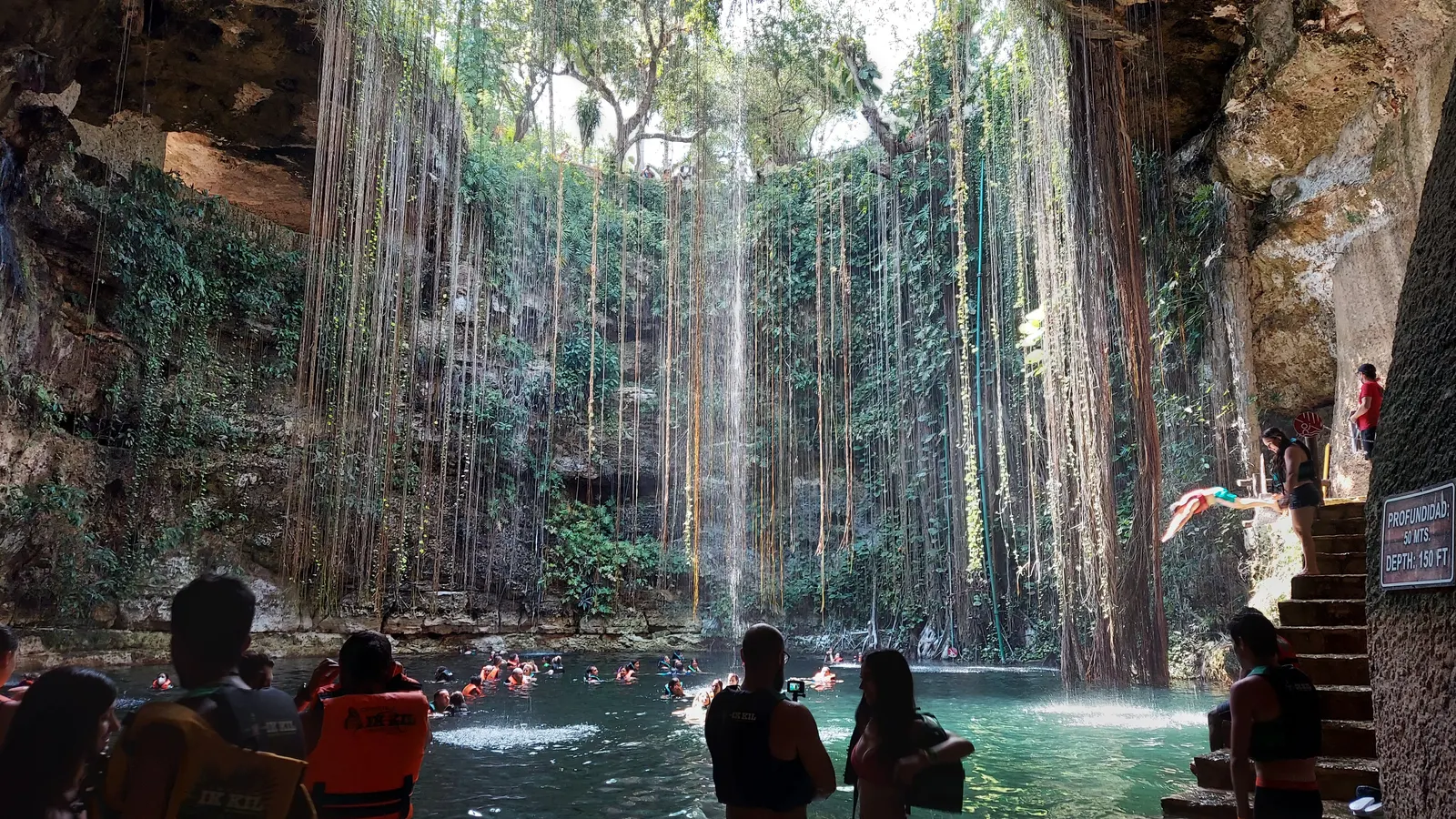
A cenote is a limestone cave whose roof has fallen in, exposing the groundwater that runs under the whole Yucatán Peninsula. The Maya treated them as sacred wells and as doorways to the underworld; today you swim in them. Inland, around Valladolid and Chichén Itzá, they are deep round shafts like Ik Kil and Zací and roofed caverns like Suytun. Towards the Caribbean coast around Tulum they are shallow, glass-clear cave cenotes like Gran Cenote and Dos Ojos, openings into flooded cave systems hundreds of kilometres long. Expect to pay 120 to 500 pesos, in cash, and to shower before you get in.
- TicketsFor almost every cenote you simply turn up and pay at the gate.
- Price240 MXN (about $14); with buffet 530 MXN (about $31) – Ik Kil, admission including life jacket, locker and parking (ticket portal)
- OpenMost cenotes open between 8am and 9am and close between 5pm and 6pm, with last admission often an hour before closing.
- Best timeBe at the gate when it opens, 8am or 9am, or come back after 3pm.
- ClaustrophobiaOpen cenotes (Cenote Azul, Jardín del Edén, Casa Cenote) are fine.
Twelve cenotes, compared
Ik Kil (near Chichén Itzá)
The postcard cenote: an almost perfectly round shaft about 60 m across, with a stairway carved into the rock descending 26 m to a swimming platform and curtains of vine hanging all the way to the water. It is 3 km from Chichén Itzá, which is both its appeal and its problem.
Life jackets compulsory, jumping only from the marked steps, shower before entering. It hosted the Red Bull Cliff Diving World Series in 2010, 2011 and 2014. Bones and jewellery have been found in the water. It is not part of the Chichén Itzá site and is not covered by that ticket.
240 MXN (about $14) at a ticket portal, including life jacket, locker and parking; 530 MXN (about $31) with the buffet; 2026 blogs quote 180-240 MXN (09/2026)
Suytun and Kaapeh (near Valladolid)
A cave cenote under a stalactite ceiling. A causeway runs out to a round stone platform in the middle of the pool, and on the right day a shaft of light drops through the hole in the roof onto it. The same ticket covers Kaapeh next door, a half-open cenote with a carved Kukulkán figure.
The light beam is the whole reason most people come and the operator states plainly that it is a natural phenomenon depending on the time of year, the position of the sun, cloud and weather, and cannot be guaranteed. The old 60-minute time limit has been dropped. Cabins on site, and night swimming for staying guests.
250 MXN online in advance (about $15), children 5-11 200 MXN; with a meal 400/350 MXN; guided walk +50 MXN (operator, 09/2026)
Zací (Valladolid town centre)
A half-collapsed cave cenote in the middle of a colonial town, a few blocks from the main square. A railed staircase drops to a pool roughly 35 by 25 m under a dripping rock overhang, with a restaurant on the rim above.
Named after the Maya settlement of Zací, 'white hawk', on which Valladolid was founded in 1543; it was the town's water supply for centuries. Wikipedia gives a maximum depth of about 100 m. Blogs report a jumping ledge of about 8 m.
150 MXN adults, 75 MXN children, life jacket included (local press 09/2026); older sources still say 30-60 MXN
Oxman (Hacienda San Lorenzo Oxman) and Saamal (Hacienda Selva Maya)
Two hacienda cenotes on the edge of Valladolid. Oxman is a deep shaft with a rope swing over the water and a hacienda pool to dry off beside; Saamal has a curtain of water falling from the rim.
Oxman is about 45 m deep with the water some 25 m below ground level; the rope swing is supervised and a life jacket is compulsory. In November 2025 a tourist died at Saamal after jumping in on a full stomach and losing consciousness climbing back up the stairs.
Oxman about 250 MXN (about $15) including roughly 150 MXN of food and drink credit, with a cheaper swim-only ticket; Saamal about 200 MXN (about $12), 350-400 MXN with the buffet (guidebooks 2026)
Gran Cenote (Tulum)
Two half-open pools joined by a shallow passage under stalactites, with boardwalks, freshwater turtles and water so clear it is hard to judge depth. It is the entrance through which divers first pushed into the Sac Actun system.
Life jackets compulsory, cavern diving with a guide only. The sunscreen rule is enforced hard: showers at the entrance, staff watching, no lotion, bug spray, oil or make-up in the water. There is no ATM on site. Coach groups from about 11am.
about 500 MXN (about $29), cash only; older guides still say 300 MXN; lockers about 50-80 MXN and snorkel hire 80-150 MXN extra (2026)
Calavera (Tulum)
A small cenote with three round holes in its roof that look like a skull from above. You either jump through the big one or climb down a ladder into the dark water below.
Jumping, swimming and diving. Local press warns that the depth and the undercurrent make it unsuitable for non-swimmers. Toilets, changing rooms and a shower on site.
about 250 MXN (about $15), life jacket for a surcharge (04/2026)
Dos Ojos (between Tulum and Playa del Carmen)
Two round openings - the 'two eyes' - feeding one huge, daylight-filled cavern. It is one of the best-known cave diving sites in the world and part of Sistema Sac Actun, but you do not have to dive: snorkelling over the cavern from the platform is what most visitors do.
You can swim and snorkel the two open eyes on a plain ticket without a guide - the guide is only required for the Bat Cave route and for diving. Life jackets are compulsory. The cavern zone is about 10 m deep. Several more cenotes sit inside the same park, including Jaguar, Nicte Ha and The Pit.
about 370-400 MXN (about $21-23) including a life jacket; guided snorkel tour with the Bat Cave 700-850 MXN (about $41-49); cavern dives considerably more (2026)
Casa Cenote (Tankah, Tulum)
An open, snaking cenote through the mangroves, directly across the road from the Caribbean. It is brackish - the channel connects to the sea - shallow, full of fish, and home to a resident crocodile that is entirely used to people.
Snorkelling along the channel and diving to the sea exit. The beach is on the other side of the road, so you can do cenote and Caribbean in one morning. Yes, the crocodile is real, and yes, guides swim with it.
Inconsistent: 500 MXN in one 06/2026 blog, 150-200 MXN elsewhere
Cenote Azul and Jardín del Edén (Riviera Maya)
Two open, shallow cenotes side by side at km 266 of Highway 307 south of Playa del Carmen: turquoise water, limestone ledges to jump from and plenty of small fish.
The cheapest of the famous cenotes and the most swimmable. Sunscreen is banned without a shower first, and pets are not allowed. In September 2023 a US tourist died at Cenote Azul after a headfirst dive onto rock - jump feet first, from the marked spots only.
Cenote Azul 120 MXN (about $7), Quintana Roo residents 100, children 4-8 80, life jacket 40 extra; Jardín del Edén 200 MXN, children 100, divers 300 (09/2026); cash only
Chikin-Ha (near Puerto Aventuras)
A park with several cenotes - Chikin-Ha, X'tabay - plus the Ta'ak Bil-Ha cave, sold either as plain admission or as an adventure package with bikes, zip line and rappel.
Swimming, snorkelling and a dry cave walk in the same park. Quieter than the Tulum cenotes because it is off the main tourist route.
350 MXN for two cenotes, packages 750-950 MXN - but that is 01/2023 and no current price could be verified
Cuzamá (Chunkanán, near Mérida)
Three cenotes - Chelentún, Chacsinicché and Bolonchojol - reached along the rails of an old henequén plantation on a mule-drawn flatbed cart called a truck, about 7 km of track through scrub. Getting there is the attraction.
Shaft and cave cenotes with entry partly by wooden ladder. The cart ride is rough and jolting and is not recommended if you have back trouble.
A few hundred pesos per cart (up to 4 people); no current figure could be verified. GetYourGuide day trips from Mérida start around $160
Río Secreto (Playa del Carmen)
Not a swimming hole at all: a guided walk and swim through a half-flooded cave river hung with stalactites, in a wetsuit, helmet and headlamp. You are underground, in the dark, for most of it.
Water is 22-24 °C and the wetsuit is included for good reason. Minimum age 4, personal cameras banned inside the cave, mandatory shower before entering. Not recommended for pregnant visitors or anyone with claustrophobia, heart problems or limited mobility.
Classic Tour $89, children 4-11 $64.50; with transport $119 / $79.50 (operator, retrieved 09/2026)
Tickets and prices
For almost every cenote you simply turn up and pay at the gate. Two exceptions: Suytun sells discounted online tickets that have to be bought at least a day ahead (undated, valid for a year, non-refundable), and Río Secreto is a guided tour with fixed departure times, minimum age 4, minors only with an adult.
Official prices
- Ik Kil, admission including life jacket, locker and parking (ticket portal)240 MXN (about $14); with buffet 530 MXN (about $31)
- Suytun, online advance ticket, covers both Suytun and Kaapeh (operator)adults 250 MXN (about $15), children 5-11 200 MXN (about $12)
- Suytun, ticket with a meal / day pass with pool and meal (operator)adults 400 / 420 MXN (about $23 / $24), children 350 / 370 MXN
- Suytun, guided walk through both cenotes / with the Ruta del Alux, surcharge (operator)50 / 100 MXN per person (about $3 / $6)
- Zací, adults / children, life jacket included (local press)150 / 75 MXN (about $8.70 / $4.35)
- Gran Cenote, adults, cash only (guidebooks)about 500 MXN (about $29)
- Dos Ojos, admission including life jacket / with guided snorkel tour and Bat Cave (guidebooks)about 370-400 MXN (about $21-23) / 700-850 MXN (about $41-49)
- Cenote Azul, adults / Quintana Roo residents / children 4-8, life jacket extra (guidebook)120 / 100 / 80 MXN (about $7 / $5.80 / $4.65), life jacket 40 MXN
- Río Secreto, Classic Tour without transport, adults / children 4-11 (operator)$89 / $64.50
- Río Secreto, Classic Tour with transport from Cancún or the Riviera Maya (operator)$119 / $79.50
- Chichén Itzá archaeological zone, foreign adult, federal INAH fee plus Yucatán state fee - not a cenote, listed because it is so often confused with oneabout 697 MXN (about $40)
As of 09/2026 · source and direct booking: hotelikkil.com/en/hotel-ikkil-cenote
When everything is sold out
Ordinary cenotes do not sell out, but between about 11am and 3pm the coach parties from Chichén Itzá, Cancún and Playa del Carmen arrive and the platforms fill. Suytun caps the site at 150 people at once. Río Secreto runs groups of no more than 10 and is booked out on some days.
Cenote tours and day trips
Going direct is almost always cheaper, because the gate fee is small and it is cash: Cenote Azul 120 MXN (about $7), Ik Kil 240 MXN (about $14), Gran Cenote about 500 MXN (about $29). What you are really buying from a tour operator is the drive. Most cenotes sit on back roads with no bus, several are a dirt track off the highway, and an organised trip is the sensible option if you are not renting a car or want Chichén Itzá and a swim on the same day. Two things to check in the description before you book: which cenote is actually named - plenty of itineraries promise "a cenote" and deliver Chichikan or Saamal rather than Ik Kil - and whether admission is included or collected in cash on the day. Río Secreto is the exception where booking a tour is the only way in: it is sold as a guided cave walk, groups of ten, wetsuit and helmet supplied.
Cancun: Chichen Itza, Cenote & Valladolid Tour with Lunch
Chichen Itza: Guided Tour with Valladolid & Cenote Chichikan
Riviera Maya: Tulum Ruins and 2 Cenotes Half-Day Tour
Riviera Maya: Coba & Chichen Itza Ruins with Cenote Swim
Show all 12 offers
From Merida: Chichen Itza, Cenote & Izamal Tour
From Cancun: Tulum Ruins, Cenote Mariposa & Playa del Carmen
From Cancun: Tulum and Akumal Cenote and Turtle Swim Tour
Cancún: Cenotes Adventure with Tequila Tasting & Mayan Snack
Merida: Uxmal, Cenote and Kabah Archaeological Site Tour
Merida:Chichen Itza Private Cenote, Food Experience & Izamal
From Riviera: Coba, Tulum Ruins, Cenote Mariposa & Lunch
Tulum Highlights Tour including Cenote and Mayan Village, Half-Day, Small Group
Booked through GetYourGuide (affiliate link, advertising). Most offers can be cancelled free of charge up to 24 hours ahead. Prices as of 20 September 2026.
Opening hours and best time
Most cenotes open between 8am and 9am and close between 5pm and 6pm, with last admission often an hour before closing. Ik Kil: daily 9am to 5pm (hotel guests also 8-9am and 6-8pm). Suytun: daily 9am to 5pm, last admission 4pm. Zací: local press gives roughly 9.15am to 5pm, other sources 8am to 5.30pm. Oxman: about 9am to 6pm. Gran Cenote: from about 8am to 5pm. Dos Ojos: 8am to 5pm daily. Jardín del Edén closes one weekday for cleaning, and a 2023 report had Chikin-Ha closed on Saturdays. Watch the time zone: Quintana Roo (Cancún, Playa del Carmen, Tulum) runs one hour ahead of Yucatán state (Valladolid, Chichén Itzá), and Suytun warns about this on its own site - drive over from Tulum without adjusting and you arrive after last admission.
When it is quietest
Be at the gate when it opens, 8am or 9am, or come back after 3pm. Between about 11am and 3pm the tour coaches from Chichén Itzá, Cancún and Playa del Carmen turn up and the platforms fill. Weekends are busier because Mexican families swim too. For the light beam at Suytun, season and cloud matter more than the hour on the clock, and the operator guarantees nothing. November to April is the dry season and the most comfortable time to travel, but it is also when the noon sun sits lowest. And if sargassum is on the beaches - 2026 has been a record year, with 56 of Quintana Roo's 140 beaches flagged red in early August, worst between Tulum and Xcalak - the cenotes are the obvious alternative: they are inland freshwater and completely unaffected.
Who it suits
With children
Good, as long as the cenote is shallow or the life jacket is compulsory. Family-friendly: Gran Cenote (boardwalks, shallow sections, freshwater turtles), Casa Cenote (mangroves, waist-deep), Cenote Azul, and Suytun and Zací for looking rather than swimming. Deep shaft cenotes such as Ik Kil or Calavera only with a life jacket and an adult in the water. Río Secreto takes children from 4.
Minimum age
Usually none. Río Secreto: 4 and up (the Plus tour 7 and up).
Wheelchair
Effectively no cenote is step-free. You get down by steep, wet stone stairs or wooden ladders, often with a rope for a handrail. Río Secreto explicitly excludes visitors with limited mobility.
Pushchair
Not possible - stairs everywhere. Bring a carrier.
Dogs
Generally not allowed; Cenote Azul bans pets outright.
Claustrophobia
Open cenotes (Cenote Azul, Jardín del Edén, Casa Cenote) are fine. Suytun, Kaapeh and parts of Gran Cenote and Dos Ojos sit under a rock ceiling. Río Secreto goes through narrow, dark passages and the operator advises against it for anyone with claustrophobia or a heart condition.
What to wear
Swimsuit obviously, and bring your own towel - not every site rents them. Water shoes help on sharp limestone. Instead of sunscreen, wear a rash guard: at most cenotes you have to shower off any lotion, repellent, perfume or make-up before you go in, and that includes the reef-safe kind. The water is 24-25 °C, cooler than the Caribbean, so a rash guard earns its place twice over.
Photography
Fine at swimming cenotes. At Suytun a queue forms on the round platform for the light-beam photo, and the carved alux figure may not be photographed. Río Secreto bans personal cameras inside the cave and sells its own photographer's images.
Getting there
By public transport
Cancún (CUN) is the gateway: 29.3 million passengers in 2025, 19.4 million of them international, with nonstops from most large US and Canadian cities. Mérida (MID), at 3.94 million passengers in 2025, is the quieter way in and much closer to the western cenotes. From Cancún, ADO coaches run to Playa del Carmen, Tulum, Valladolid and Mérida; Cancún to Tulum takes about 2 hours 5 minutes and costs roughly 250-500 MXN depending on whether you board at the airport or downtown. Between Playa del Carmen and Tulum the cheapest option is a colectivo, a shared white van that leaves when full, about 50 MXN and an hour, and will drop you at the highway turn-off for the coastal cenotes - though at Dos Ojos that still leaves 2.5 km of dirt track. The Tren Maya stops at Cancún Aeropuerto, Puerto Morelos, Playa del Carmen, Tulum, Tulum Aeropuerto, Valladolid and Chichén Itzá, but the stations sit outside the towns: Valladolid about 7 km north of the centre with a shuttle to the ADO terminal, Chichén Itzá about 3 km from the ruins with a shuttle for 50-55 MXN. From any of them you still need a taxi, a colectivo or a bike.
By car
A rental car is the honest answer if you want more than one cenote a day, because most of them sit on back roads or gravel tracks. Parking is nearly always free and often included in the ticket, as at Ik Kil. Rent in Cancún, Tulum or Mérida, take the toll road (cuota) between Cancún and Mérida if you are in a hurry, and carry cash for the tolls. Drive-up cenotes have a guard on the gate rather than a parking meter.
From the nearest city
From Tulum: Gran Cenote and Calavera 3-5 km on the Cobá road, 15-20 minutes by bike; Dos Ojos about 20 minutes north on Highway 307; Casa Cenote about 10 km north. From Valladolid: Zací in the town centre on foot; Suytun about 13 minutes towards Cancún; Oxman about 4 km southwest; Ik Kil about 45 minutes west near Chichén Itzá. From Playa del Carmen: Cenote Azul and Jardín del Edén about 25 km south at km 266 of Highway 307; Río Secreto at km 283.5; Chikin-Ha about 20 minutes south. From Mérida: Cuzamá about 45 km southeast. From Cancún, Valladolid is about two hours by road and Tulum about two hours - a day trip is possible but you will arrive in the middle of the coach-party window.
Tips for your visit
- Bring cash in small peso notes. Most cenotes take nothing else, there is no ATM at Gran Cenote, and the gate fee is rarely the whole cost once you add a locker, snorkel hire or a life jacket.
- Do not put sunscreen on that morning. Wear a rash guard instead. Almost every cenote makes you shower first and wash off lotion, insect repellent, perfume and make-up, and the reef-safe kind counts as lotion.
- Arrive at opening. At 8 or 9am you can have Gran Cenote, Ik Kil or Suytun nearly to yourself; from 11am the coaches arrive and stay until about 3pm.
- Mind the time zone. Quintana Roo (Cancún, Playa del Carmen, Tulum) is an hour ahead of Yucatán state (Valladolid, Chichén Itzá). Drive west without resetting your watch and you arrive at Suytun or Ik Kil after last admission.
- Jump feet first, from marked spots only, and not after a big meal or a drink. A tourist died at Cenote Azul in 2023 after a headfirst dive onto rock and another at Saamal in 2025 after jumping in on a full stomach. Wear the life jacket even if you swim well - fresh water gives less lift than the sea and the ladder can be a long way off.
- Do not swim past the warning signs. Cavern dives stay in daylight, no more than 60 m from the entrance and 21 m deep, and need a certified guide; going beyond that is cave diving and needs a cave diving qualification.
- Think about where you are sleeping, not which cenote is prettiest. Valladolid puts Zací, Suytun, Oxman and Ik Kil within half an hour. Tulum puts Gran Cenote, Calavera, Dos Ojos and Casa Cenote within twenty minutes. Trying to do both from Cancún in one day means four hours in a car.
- If sargassum has taken the beaches - 2026 is a record year - switch to cenotes. They are inland fresh water and entirely unaffected, and Gran Cenote, Dos Ojos and Casa Cenote are 10 to 30 minutes from the coast.
What the internet gets wrong
English pages state this as if it were a timetable, and they do not even agree with each other - mayan.org gives 11.30am to 1.30pm, dreambigtravelfarblog.com "around 12 PM", tourtochichenitza.com 1pm to 3pm, travelmexicosolo.com simply "in the afternoon", victorherrera.net "midday through early afternoon". The operator's own site says the beam is a completely natural phenomenon that depends on the time of year, the position of the sun, cloud and weather, and that its appearance cannot be guaranteed. The reason the advice contradicts itself is geometry: Suytun is at 20.71° N, south of the Tropic of Cancer, so the noon sun climbs to about 87° above the horizon at the June solstice and the sun passes directly overhead twice a year, in late May and around 20 July - but at the December solstice the noon sun reaches only about 46°, and light through a hole in the roof arrives at a slant instead of a column. The dry season most people travel in, November to April, is the half of the year with the lowest noon sun.
This is the most common piece of English cenote advice and it will get you turned away at the shower. cancun-trip.com's 2026 Gran Cenote guide tells readers to use "biodegradable, reef-safe sunscreen only" and, two lines later, that staff expect you to rinse off before getting in; thecenoteguy.com tells divers to "apply your reef-safe sunscreen at least 20 minutes before you enter the water". Cenotes Suytun's published environmental policy says that a visitor wearing sunscreen, insect repellent, perfume or any substance that could harm the water must shower before entering the cenote - not switch brands. Río Secreto requires the same. Nor is this a law you can look up: a 2021 study in Applied Sciences found that in Quintana Roo only two of eleven municipalities, Solidaridad and Tulum, regulate sunscreen in sinkholes at all, and those two still permit biodegradable products. What binds you is the operator's rule at the gate, and it is stricter than the law. Wear a rash guard and apply sunscreen afterwards.
Guinness World Records still carries Sistema Sac Actun at 371.958 km as of July 2019 under the heading "longest cave system underwater explored", and Qantas Travel Insider still runs the 2018 story under "The World's Longest Underwater Cave Has Been Discovered". Ox Bel Ha, south of Tulum, passed it around 2023 and stood at 541.7 km in February 2026; Sac Actun is second, with 378.56 km of underwater passage. It makes no practical difference to a swimmer, but it tells you how old the English-language material on cenotes often is.
Casa Loltún's 2026 Mérida guide describes water that "stays at a near-constant 75°F (24°C) year-round", and plenty of pages round that up to "surprisingly warm". Twenty-four degrees is about twelve below body temperature, and the sea you have just come from off Tulum is 27 to 30 °C. Río Secreto measures its cave river at 22-24 °C and hands out wetsuits. yorkadventures.com puts it more honestly: after acclimatising to 84°F seawater, a cenote feels like an ice bath. It is a lovely temperature for an hour and a cold one for three. Bring a rash guard, and do not plan a long snorkel with a small child.
Out of date, and it is the figure most English lists still carry - castawaywithcrystal.com's Tulum cenote guide still prints "$300 MXN pesos normal entry". 2026 guides put it at about 500 MXN, roughly $29, cash only with no ATM on site. The same drift has hit the cheap ones: Cenote Zací was 30 MXN in older guides, 60 MXN in the Diario de Yucatán in 2024 and 150 MXN in the local press in September 2026, and Suytun, still quoted at 60 to 80 MXN in places, sells its own advance ticket at 250 MXN. As a rule of thumb, take any English cenote price older than a year and add half again.
Traveltourister.com's cenote guide, updated in June 2026, opens with "Mexico's 100+ cenotes". The Yucatán Peninsula alone is estimated to hold 6,000 to 10,000; the Diario de Yucatán reports at least 8,000, and the state of Yucatán by itself has some 3,200 to 3,300 formally registered. The same page prices Ik Kil at "$30-40" and open-air cenotes at "$15-40" - Ik Kil is 240 MXN, about $14, and Cenote Azul is 120 MXN, about $7. Dollar estimates written without checking the peso price are how the English-language error gets doubled.
You do not. A plain ticket of about 370 to 400 MXN, life jacket included, lets you swim and snorkel both open eyes on your own, and the park is open 8am to 5pm. What the guide is actually for is the Bat Cave route and any diving; that package runs 700 to 850 MXN. The genuine constraints are different ones and rarely mentioned: the life jacket is compulsory, payment is in cash, and the entrance is 2.5 km of dirt road off Highway 307, which is a long walk from where a colectivo drops you.
It is not, and it is not on the site. Ik Kil belongs to a hotel about 3 km east of the archaeological zone and has its own gate and its own cash-only till. The Chichén Itzá ticket - a federal INAH fee plus a Yucatán state fee, about 697 MXN for a foreign adult in 2026 - covers the ruins only, and the Sacred Cenote inside the site cannot be swum in at all: it is an archaeological feature with a viewing platform. Package day trips do often bundle a cenote, but check which one; plenty of them use Chichikan or Saamal rather than Ik Kil.
History in brief
- Sixty-six million years ago the Chicxulub asteroid struck the northern edge of the Yucatán Peninsula. Cenotes cluster in a conspicuous arc above the rim of the resulting crater, about 180 km across - the so-called Ring of Cenotes.
- The word comes from the Yucatec Maya ts'onot, a place where groundwater can be reached. Yucatán has almost no surface rivers, so cenotes were the water supply that decided where Maya settlements could exist at all.
- To the Maya, cenotes were entrances to Xibalba, the underworld. Offerings and human remains were dropped into the Sacred Cenote at Chichén Itzá, and bones and jewellery have been recovered from Ik Kil too.
- Valladolid was founded by the Spanish in 1543 on the site of the Maya town of Zací; the cenote of the same name stayed the town's water source long afterwards.
- In 2008 divers in the Sac Actun system found the skeleton of a teenage girl in a flooded chamber called Hoyo Negro, alongside the bones of a mastodon. Named Naia, she is among the oldest human remains found in the Americas.
- Ik Kil was a stop on the Red Bull Cliff Diving World Series in 2010, 2011 and 2014.
- In January 2018 divers from the Gran Acuífero Maya project proved that Sistema Dos Ojos connects to Sistema Sac Actun, briefly making it the longest underwater cave known. Ox Bel Ha, south of Tulum, has since overtaken it at 541.7 km as of February 2026.
- The Tren Maya began running in December 2023 and the Valladolid station opened in January 2024, putting the inland cenotes within reach of coastal resorts for the first time by rail - if not quite as conveniently as the timetable suggests.
Frequent questions
How much does it cost to visit a cenote in Mexico in 2026?
Most of the well-known ones fall between 120 and 500 pesos, roughly $7 to $29. The cheap end is Cenote Azul at 120 MXN and Zací at 150 MXN; the middle is Suytun at 250 MXN and Ik Kil at 240 MXN; the expensive end is the Tulum cenotes, with Gran Cenote at about 500 MXN. A guided cave tour such as Río Secreto is $89. Dollar figures here use the xe.com mid-market rate of 20 September 2026, $1 = 17.23 MXN.
Are cenotes free?
Almost never. A handful of small ones are, such as Cenote Aldea Zama within walking distance of Tulum town, but every cenote with a car park, a shower block and a life jacket rack charges for it - each one privately, at its own gate. There is no combination ticket and no city pass that covers them.
Do cenotes take credit cards?
Assume not. Several 2026 guides state specifically that Gran Cenote, Dos Ojos, Jardín del Edén and Cenote Azul are cash only, and there is no ATM at Gran Cenote. A few of the bigger operations have a card machine that works when the connection does. Draw pesos in Tulum, Valladolid or Playa del Carmen before you set off, in small notes, and budget for the extras: lockers 30-80 MXN, snorkel hire 80-150 MXN, sometimes a life jacket at 40-50 MXN.
Can you wear sunscreen in a cenote?
Not before you swim, and the reef-safe kind is not an exemption. Most operators make you shower and wash off sunscreen, insect repellent, perfume and make-up, because this is the groundwater the region also drinks. Suytun's environmental policy says exactly that, Río Secreto and Gran Cenote enforce it, and Cenote Azul refuses entry to anyone who has not rinsed. Wear a long-sleeved rash guard for the sun and put sunscreen on when you are out and dry.
Is the water in cenotes cold?
Colder than you expect. Cenotes sit at about 24-25 °C (75-77 °F) all year, and Río Secreto measures its cave river at 22-24 °C. That sounds warm until you compare it with the Caribbean off Tulum, which runs 27 to 30 °C. Coming out of the sea into a cenote is a three-to-six degree drop and it registers as cold for the first minute. It is pleasant for an hour's swim and chilly for a long snorkel - another reason for a rash guard.
What time is the light beam at Cenote Suytun?
There is no reliable time, and the operator says so: the beam depends on the season, the position of the sun, cloud and the weather, and is not guaranteed. English blogs quote everything from 11.30am to 3pm because the geometry changes through the year - the noon sun at this latitude stands about 87° high in June and only about 46° in December. Your best chance is a cloudless day between late spring and midsummer, somewhere around solar noon. Go anyway: the cave and the causeway are worth the ticket without the beam.
Do you need a guide to visit cenotes?
For swimming and snorkelling, no. You buy a ticket at the gate and get in, at Ik Kil, Zací, Gran Cenote, Cenote Azul, Calavera and the open parts of Dos Ojos alike. Guides become compulsory for cave routes such as the Bat Cave at Dos Ojos, for Río Secreto, which is sold only as a guided tour, and for any diving. Cavern dives must be led by a certified cavern guide and stay within daylight.
Is Cenote Ik Kil included with a Chichén Itzá ticket?
No. Ik Kil is private property about 3 km east of the ruins with a separate, cash-only admission of around 240 MXN. The Chichén Itzá ticket, about 697 MXN for a foreign adult in 2026, is a federal and a state fee for the archaeological zone alone, and the Sacred Cenote on the site is for looking at, not swimming in. Many organised day trips include a cenote in the price - check the itinerary for which one, because it is often Chichikan or Saamal rather than Ik Kil.
Do you have to wear a life jacket in a cenote?
In most of them yes, and it is usually included in the ticket - Ik Kil, Zací, Oxman, Gran Cenote and Dos Ojos all require it. Others, such as Cenote Azul and Calavera, rent them for 40 to 50 MXN. There is no single law covering every cenote; the operators impose it. Wear it even if you swim well: fresh water gives less buoyancy than the sea, some of these shafts are 40 m deep, and the only way out is a single ladder.
Are cenotes safe to swim in?
Yes, with sense. The deaths that make the news come from jumping, not from swimming: a US tourist died at Cenote Azul in September 2023 after diving headfirst onto rock, and another at Saamal in November 2025 after jumping in on a full stomach. Jump feet first from marked spots only, keep the life jacket on, stay out of the water after alcohol or a large meal, and never swim past a warning sign into a dark passage.
Which cenote near Tulum is the best?
For a first visit and for families, Gran Cenote: clear water, stalactites, turtles, boardwalks - though it is the priciest at about 500 MXN and busy from 11am. For snorkelling and diving, Dos Ojos. For jumping, Calavera. For mangroves, a crocodile and the beach on the same morning, Casa Cenote. If cost matters most, drive 40 minutes north to Cenote Azul at 120 MXN.
How do you get from Cancún to the cenotes?
By rental car if you want more than one a day, since most sit on side roads. Otherwise: ADO coaches from Cancún to Tulum take about 2 hours 5 minutes for roughly 250-500 MXN; colectivo vans between Playa del Carmen and Tulum are about 50 MXN and will stop at the highway turn-offs; and the Tren Maya serves Cancún Aeropuerto, Playa del Carmen, Tulum, Valladolid and Chichén Itzá, though every station is some way outside the town it names. From Valladolid station a shuttle runs the 7 km into the centre, where Zací is a short walk away.
How many cenotes are there in Yucatán?
Estimates for the peninsula run from 6,000 to 10,000, and the Diario de Yucatán reports at least 8,000. The state of Yucatán alone has about 3,200 to 3,300 formally registered. Only a small fraction have a gate, a car park and a shower - if an English guide tells you Mexico has a hundred cenotes, it is off by two orders of magnitude.
Are cenotes worth it when there is sargassum on the beaches?
That is precisely when they are worth it. 2026 has been a record sargassum year: in early August 56 of Quintana Roo's 140 beaches were flagged red, worst on the stretch from Tulum south to Xcalak. Cenotes are inland fresh water and completely unaffected, and from Tulum the nearest are ten to twenty minutes away.
Sources
Show 61 sources – every figure on this page is sourced
- www.hotelikkil.com/en/hotel-ikkil-cenote – Ik Kil: opening hours 9am-5pm for the public, 8am-5pm and 6-8pm for hotel guests
- cenotetickets.com/en.html – Ik Kil: ticket prices 240 / 530 MXN, what is included (life jacket, locker, parking), compulsory life jacket
- en.wikipedia.org/wiki/Ik_Kil – Ik Kil: 26 m down to the water, about 60 m across, about 48 m deep, coordinates, finds, Red Bull Cliff Diving
- chichenitzaprivatetour.com/blog/cenote-ik-kil – Ik Kil 2026: 180 MXN adults, cash only, 3 km east of Chichén Itzá, separate from the ruins ticket
- cenotessuytun.com/ – Suytun: daily 9am-5pm, last admission 4pm, max 150 people, time zone warning, 60-minute limit dropped
- cenotessuytun.com/boletos – Suytun: online, meal and day-pass prices, guided walk times and surcharges
- cenotessuytun.com/cenotes – Suytun and Kaapeh: cave type, operator statement that the light beam depends on season, sun position, cloud and weather and cannot be guaranteed, Kukulkán carving
- cenotessuytun.com/pol%C3%ADtica-ambiental – Suytun environmental policy: anyone wearing sunscreen, insect repellent or perfume must shower before entering the cenote
- mayan.org/attractions/cenote-suytun/ – English misconception: light beam given as 11.30am-1.30pm on sunny days
- www.dreambigtravelfarblog.com/blog/cenote-suytun – English misconception: beam shines on the platform "around 12 PM"
- tourtochichenitza.com/destinations/cenote-suytun – English misconception: beam given as 1pm to 3pm
- www.victorherrera.net/cenote-suytun-light-beams-best-time-of-da… – English misconception: "most dramatic light beams ... midday through early afternoon", no month excluded
- travelmexicosolo.com/cenote-suytun-mexico/ – English page (updated 06/2025): beam "in the afternoon", cards accepted, life jackets compulsory, shower before entering, 280/230 MXN
- www.yucatan.guide/posts/cenote-suytun-guide/ – Suytun: beam not guaranteed, cash in pesos, higher-than-average entrance fee
- www.tusbuenasnoticias.com/noticias/turismo/2026/04/14/34206-cen… – Suytun: 13 minutes from Valladolid, prices 04/2026
- elmomento.mx/2026/09/03/cenote-zaci-de-valladolid-lo-que-debes-… – Zací: prices 09/2026 (150 / 75 MXN), dimensions, depth, opening hours, rules
- en.wikipedia.org/wiki/Cenote_Zac%C3%AD – Zací: coordinates, location, depth, history, 2024 price
- www.yucatan.com.mx/yucatan/2024/04/07/cenotes-en-valladolid-yuc… – Valladolid cenotes: prices 04/2024 (Zací 60 MXN, X'Kekén and Samulá 226 MXN, Suytun)
- www.jonnymelon.com/cenote-zaci-valladolid/ – Zací: blog figures 02/2026 (60 MXN, jumping ledge) - the outdated price still circulating in English
- chichenitzaprivatetour.com/blog/cenote-oxman – Oxman: price including food credit, depth, rope swing, location, opening hours
- grillodeyucatan.com/2025/12/01/muere-un-turista-estadounidense-… – Death at Cenote Selva Maya (Saamal), November 2025
- www.cancun-trip.com/guides/gran-cenote-tulum/ – Gran Cenote 2026: about 500 MXN (roughly $30), cash only, locker 50-80 MXN, snorkel 80-150 MXN, opens about 8am, life jacket compulsory - and the contradictory advice to use "biodegradable, reef-safe sunscreen only" while also rinsing off before entering
- yourtulumconcierge.com/guide/things-to-do/gran-cenote/ – Gran Cenote: price, cash only, no ATM, 5 km from Tulum
- castawaywithcrystal.com/best-cenotes-tulum/ – English misconception: "$300 MXN pesos normal entry" for Gran Cenote, Dos Ojos 350 MXN, Calavera 250 MXN; page originally 2016, presented as a 2022 guide
- www.traveltourister.com/articles/cenotes-mexico-complete-guide/ – English misconception (updated 06/2026): "Mexico's 100+ cenotes", Ik Kil "$30-40", open-air cenotes "$15-40", no mention of the sunscreen rule
- quintanaroo.heraldodemexico.com.mx/estilo-de-vida/2026/4/2/ceno… – Calavera: price 04/2026, three openings, location, warning for non-swimmers
- www.mexicocenotesandruins.com/cenote-dos-ojos/ – Dos Ojos: 350 MXN plain admission, 700 MXN guided tour with Bat Cave, life jacket compulsory, open 8am-5pm, bring pesos in cash, visitable without a guide
- www.voyagemexique.info/en/cenote-dos-ojos-tulum/ – Dos Ojos: admission 400 MXN, snorkel tour 800 MXN, routes, cash only, other cenotes in the park
- cenotedosojos.com/cenote_info.htm – Dos Ojos: cavern depth about 10 m, cavern limits (60 m from entrance, 21 m deep), warning signs
- www.dresseldivers.com/blog/cenote-dos-ojos/ – Dos Ojos: water 25-26 °C year round, "a bit colder than the temperature of the Caribbean Sea"
- www.letstraveltomexico.com/casa-cenote-tulum/ – Casa Cenote: price 06/2026, location, type, crocodile, opening hours
- conlamochila.com/costo-o-precio-de-entrada-al-cenote-azul-playa… – Cenote Azul: prices 2026, hours, km 266, rules, no pets
- www.yucatan.com.mx/mexico/2023/09/17/mortal-clavado-estadounide… – Death at Cenote Azul, September 2023
- yourtulumconcierge.com/guide/things-to-do/cenote-jardin-del-eden/ – Jardín del Edén: prices, weekly closing day, location
- amoplayadelcarmen.info/precio-cenote-chikin-ha/ – Chikin-Ha: prices and opening hours, as of 01/2023
- www.riosecreto.com/ – Río Secreto: FAQ (minimum age, water 22-24 °C, compulsory shower, camera ban, suitability)
- www.riosecreto.com/tours.asp – Río Secreto: tour prices in US dollars, duration, group size
- thecenoteguy.com/the-best-mexican-reef-safe-sunscreens-for-ceno… – English misconception: "apply your reef-safe sunscreen at least 20 minutes before you enter the water", no mention of a compulsory shower
- www.mdpi.com/2076-3417/11/15/6882 – Applied Sciences 2021: only two of eleven Quintana Roo municipalities (Solidaridad, Tulum) regulate sunscreen use in sinkholes, and both still allow biodegradable products (read via search summary, full text refused)
- www.janineintheworld.com/best-biodegradable-sunscreen-for-mexico/ – Confirms there is no federal or state law banning sunscreen in Mexico, and that some cenotes allow no sunscreen at all
- www.guinnessworldrecords.com/world-records/66725-longest-cave-s… – English misconception at the most authoritative address: Sac Actun still listed as the longest underwater cave system at 371.958 km, July 2019
- www.qantas.com/travelinsider/en/explore/north-america/mexico/lo… – English misconception: Sac Actun presented as "the world's longest underwater cave"
- en.wikipedia.org/wiki/Ox_Bel_Ha – Ox Bel Ha: 541.7 km as of 02/2026, longest underwater cave
- en.wikipedia.org/wiki/Sistema_Sac_Actun – Sac Actun: 378.56 km underwater, second longest, 2018 connection with Dos Ojos, Naia, Gran Cenote
- en.wikipedia.org/wiki/Cenote – Cenote: definition, ts'onot, numbers, types, Chicxulub ring, Xibalba
- www.casaloltun.com/blog/cenotes – Cenote water "stays at a near-constant 75°F (24°C) year-round"
- yorkadventures.com/blog/riviera-maya-water-temperature-by-month/ – Cenote water against sea water: after acclimatising to 84°F seawater a cenote feels like an ice bath
- seatemperature.net/current/mexico/tulum-sea-temperature – Sea temperature off Tulum: 27 °C January to April, 30 °C September and October
- chichenitza-cenote.com/can-you-swim-in-chichen-itza-cenote – Sacred Cenote at Chichén Itzá: swimming and access to the water prohibited, viewing platform only
- chichenitzamexico.org/entrance-fee/ – Chichén Itzá 2026: federal INAH fee plus Yucatán state fee, about 697 MXN for a foreign adult, cenotes not included
- yourfriendthenomad.com/cenote-aldea-zama/ – Cenote Aldea Zama: a genuinely free cenote within walking distance of Tulum town
- www.yucatan.com.mx/mexico/2025/08/31/peninsula-de-yucatan-8000-… – At least 8,000 cenotes on the peninsula, pollution of the aquifer
- www.trenmaya.gob.mx/ – Tren Maya: stations
- infotrenmaya.com.mx/tramo-4/estacion-valladolid/ – Tren Maya Valladolid: 7 km from the centre, shuttle, opened 01/2024
- yucatanmagazine.com/the-many-problems-with-taking-tren-maya-to-… – Tren Maya Chichén Itzá: station away from the site, shuttle 50 MXN
- en.wikipedia.org/wiki/Canc%C3%BAn_International_Airport – Cancún airport: 29.3 million passengers in 2025, 19.4 million international
- theyucatantimes.com/2026/01/merida-international-airport-surpas… – Mérida airport: 3,939,692 passengers in 2025
- www.cancun-trip.com/guides/cancun-to-tulum-transport/ – Cancún to Tulum: ADO about 2 hours 5 minutes and 250-500 MXN, colectivo Playa-Tulum about 50 MXN and an hour
- www.ambito.com/mexico/lifestyle/56-las-140-playas-del-litoral-q… – Sargassum 08/2026: 56 of 140 beaches flagged red, Tulum to Xcalak worst affected
- www.zonaturistica.com/que-hacer-en/yucatan/merida/truck-cenotes… – Cuzamá: 45 km from Mérida, 7 km of track, three cenotes, 3.5 hours, 4 people per cart, hours
- www.xe.com/currencyconverter/convert/?Amount=1&From=USD&To=MXN – Exchange rate: $1 = 17.23 MXN, mid-market, 20 September 2026