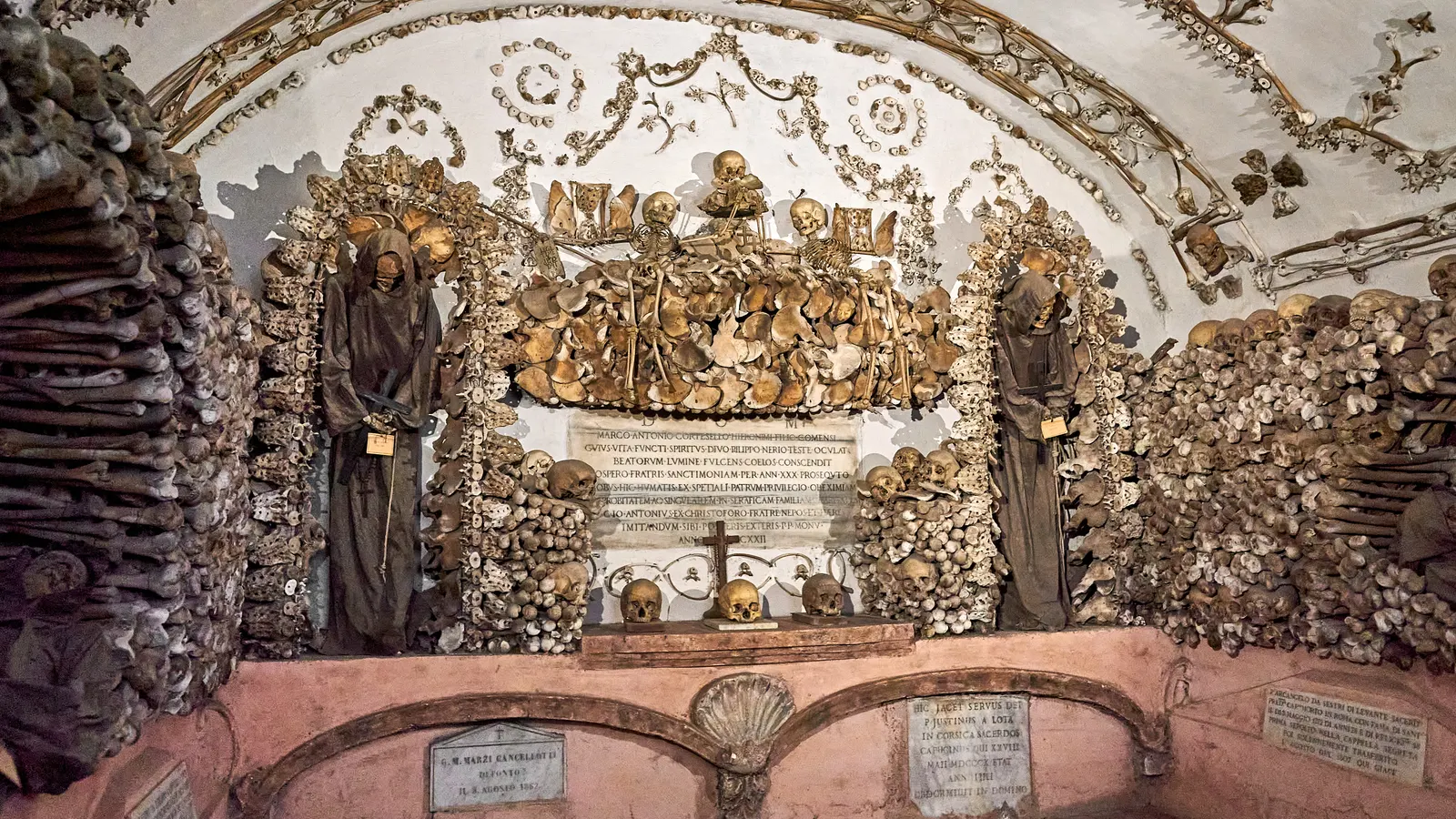
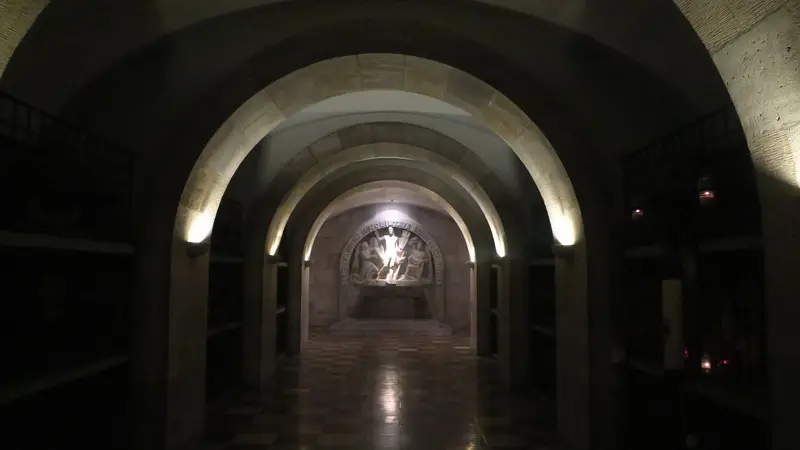
A corridor of about 30 metres with six small rooms off it, five of them decorated from floor to vault with the bones of some 3,700 dead – mostly Capuchin friars – arranged into rosettes, arches, hourglasses and chandeliers. It is a bone crypt, not a catacomb: it lies under a 17th-century church in the middle of Rome, two minutes from Barberini metro, and was given its decoration in the 18th century. You walk it on your own with an audio guide included in the €10 ticket, after a small museum of the order that you cannot skip. It is open every day bar three, but closes for an hour at lunchtime, and the last admission is an hour before each closing time – which is where most English listings go wrong.
- TicketsThe operator's shop on 3 October 2026 offered dates through to 30 December 2027.
- Price€10 (about $11.23) – Full ticket, museum and crypt, audio guide included
- OpenOpen every day, in two sessions: 9:30am to 1:30pm (last admission 12:30pm) and 2:30pm to 6:30pm (last admission 5:30pm).
- Best timeFirst thing in the morning, at 9.30am opening, or late in the afternoon session before the 5.30pm last admission.
- ClaustrophobiaLess of an issue than in the catacombs.
The museum and the six rooms of the crypt
Museum of the Capuchin Friars (Museo dei Cappuccini)
Eight rooms on the first floor of the friary, opened in 2012: the history of the convent, the order and its saints, liturgical objects, the Capuchins in the 20th century and their missions worldwide. Every visit passes through here first.
Room five is devoted to "Saint Francis in Meditation", which the operator itself calls attributed to Caravaggio – the attribution is disputed, and some scholars consider this version a good copy of a lost original. Reached by lift on request.
included in the €10 ticket
Crypt of the Resurrection (Cripta della Resurrezione)
Skulls, femurs and tibias form triangular niches holding two Capuchins; rosettes of sacrum bones and arches of ribs decorate the vault. A painting of the raising of Lazarus stands for the hope of resurrection.
The floor marks the graves of seven friars.
included
Mass Chapel (Cappella per la Messa)
The only room without bones, used for Masses for the dead. Above the altar, a painting by Jan François Courtois of the Virgin and Child with the souls in purgatory.
The heart of Maria Felice Peretti (d. 1656), grand-niece of Pope Sixtus V, is kept in the left wall; Giuseppe Matteo Orsini (d. 1660) is buried on the right.
included
Crypt of the Skulls (Cripta dei Teschi)
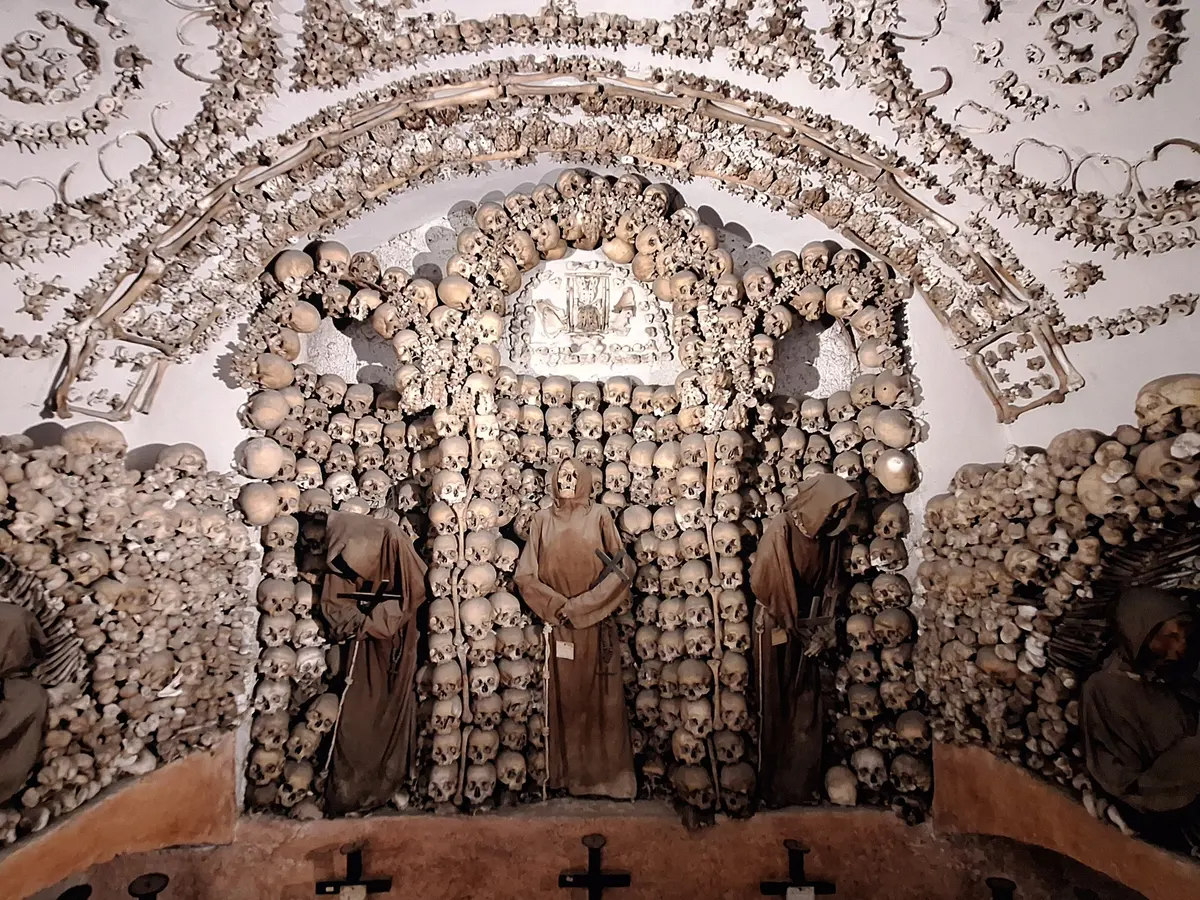
Capuchins lying and standing in niches built from skulls and bones; a winged hourglass on the back wall for the passing of time; bands of fibulae and humeri across the vault.
The chandelier hangs from an eight-pointed star; triangles of jawbones line the corridor. Crosses in the floor mark seven burials.
included
Crypt of the Pelvises (Cripta dei Bacini)
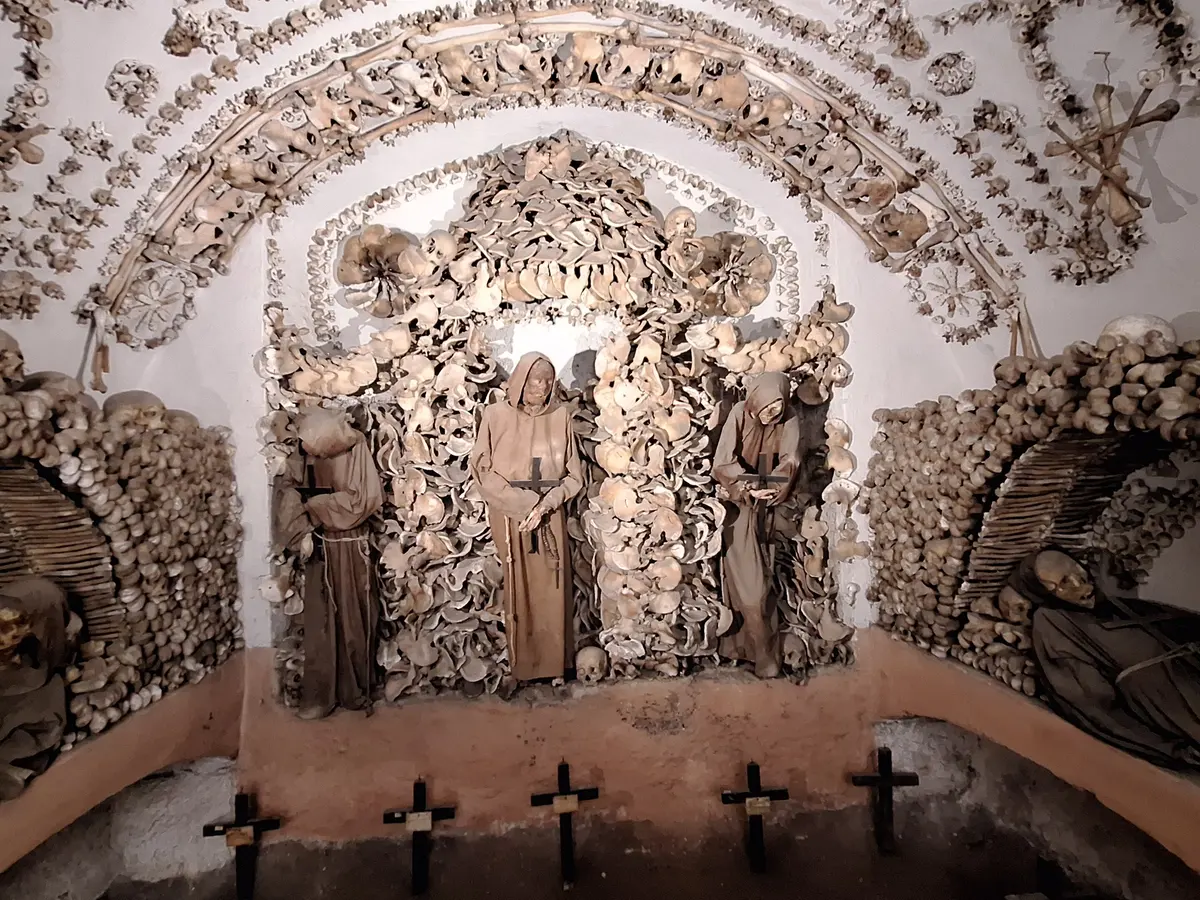
Friars laid out under arched niches, three more standing in niches on the back wall, the centre one under a canopy of bones and vertebrae. Bands of pelvic bones run across the vault and end in eight-pointed stars.
The central rosette is made of shoulder blades and vertebrae; crosses referring to the instruments of the Passion mark seven graves.
included
Crypt of the Leg Bones and Thigh Bones (Cripta delle Tibie e dei Femori)
Stacks of long bones and skulls build the arches and capitals; the back wall and vault carry floral patterns and crosses made of vertebrae.
The side niches hold figures of Capuchins, among them Father Raimondo da Olot, known for translating a life of Saint Francis into Arabic.
included
Crypt of the Three Skeletons (Cripta dei Tre Scheletri)
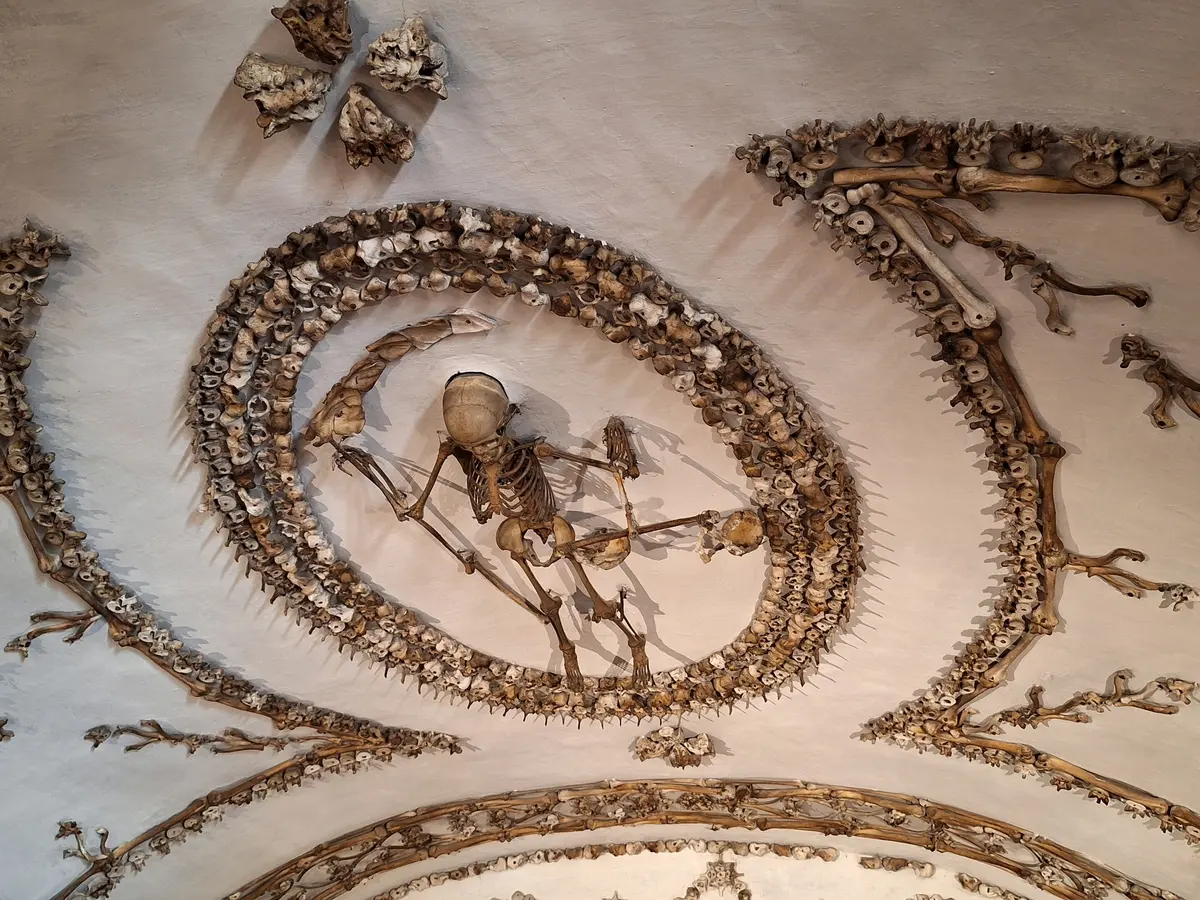
Three young skeletons stand for how precarious life is. At the centre of the vault a skeleton holds a scythe and a pair of scales – death and judgement – inside an oval.
The operator says the central figure is "probably" a Barberini princess; its director suggests Anna Barberini – neither is documented. Wikipedia places here the plaque that reads, in several languages: what you are now we used to be; what we are now you will be.
included
Church of Santa Maria della Concezione dei Cappuccini (above)
The Capuchin church built for Cardinal Antonio Barberini, first stone blessed by his brother Pope Urban VIII on 4 October 1626, first Mass 8 September 1630. Single nave, five side chapels each side.
Guido Reni's St Michael defeating Satan hangs in the first chapel on the right. The cardinal's floor slab near the high altar reads "Hic iacet pulvis cinis et nihil" – here lies dust, ashes and nothing. Open Mon–Sat 7am–7pm, Sun 8am–7pm.
separate from the museum; no admission fee is published
Capuchin Crypt in pictures
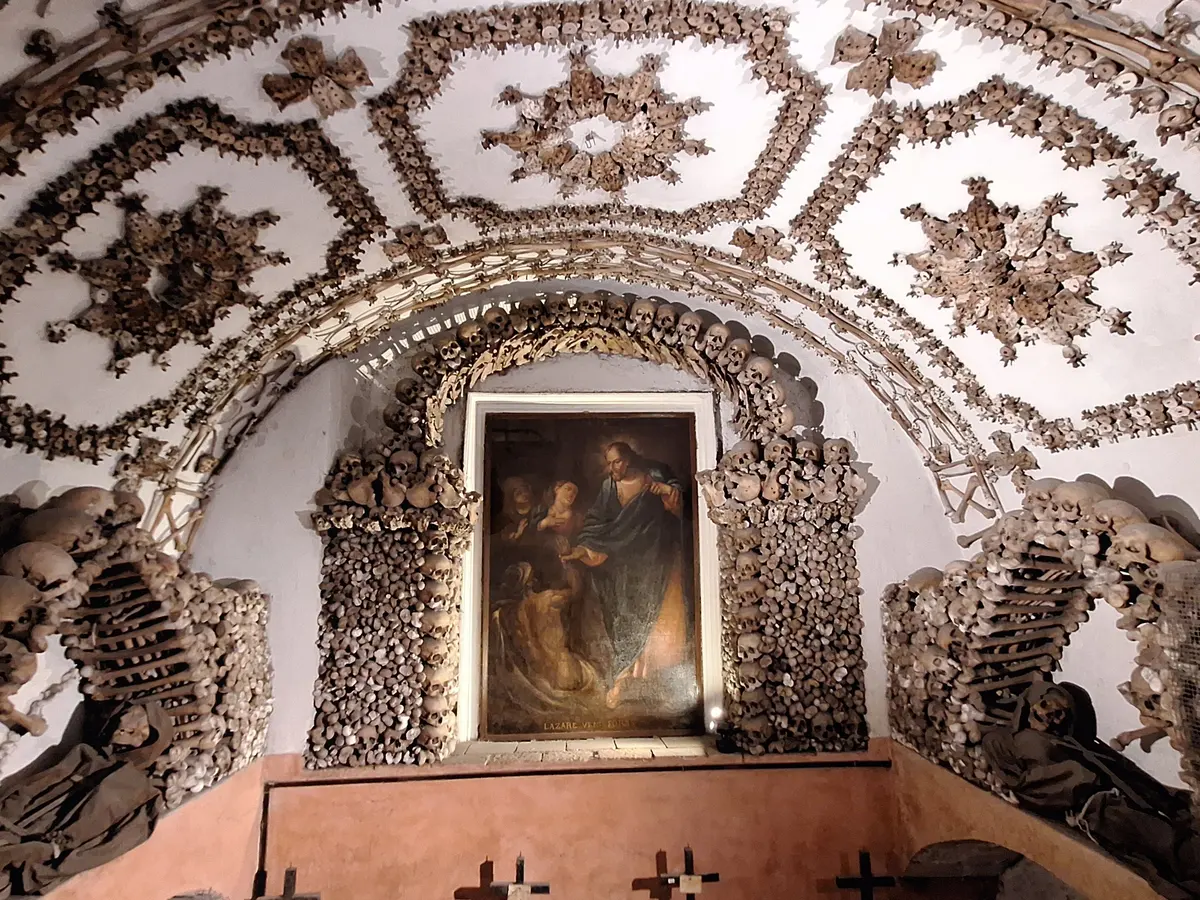
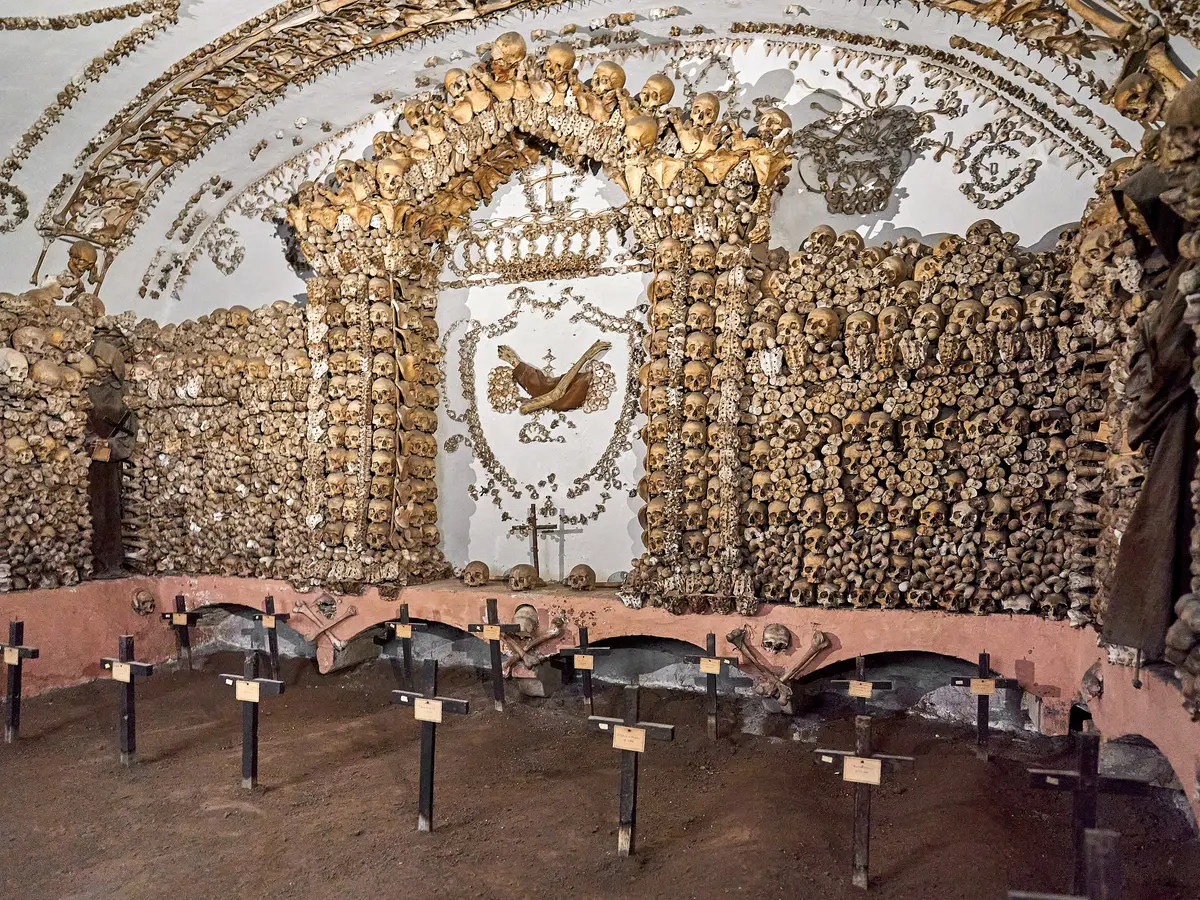
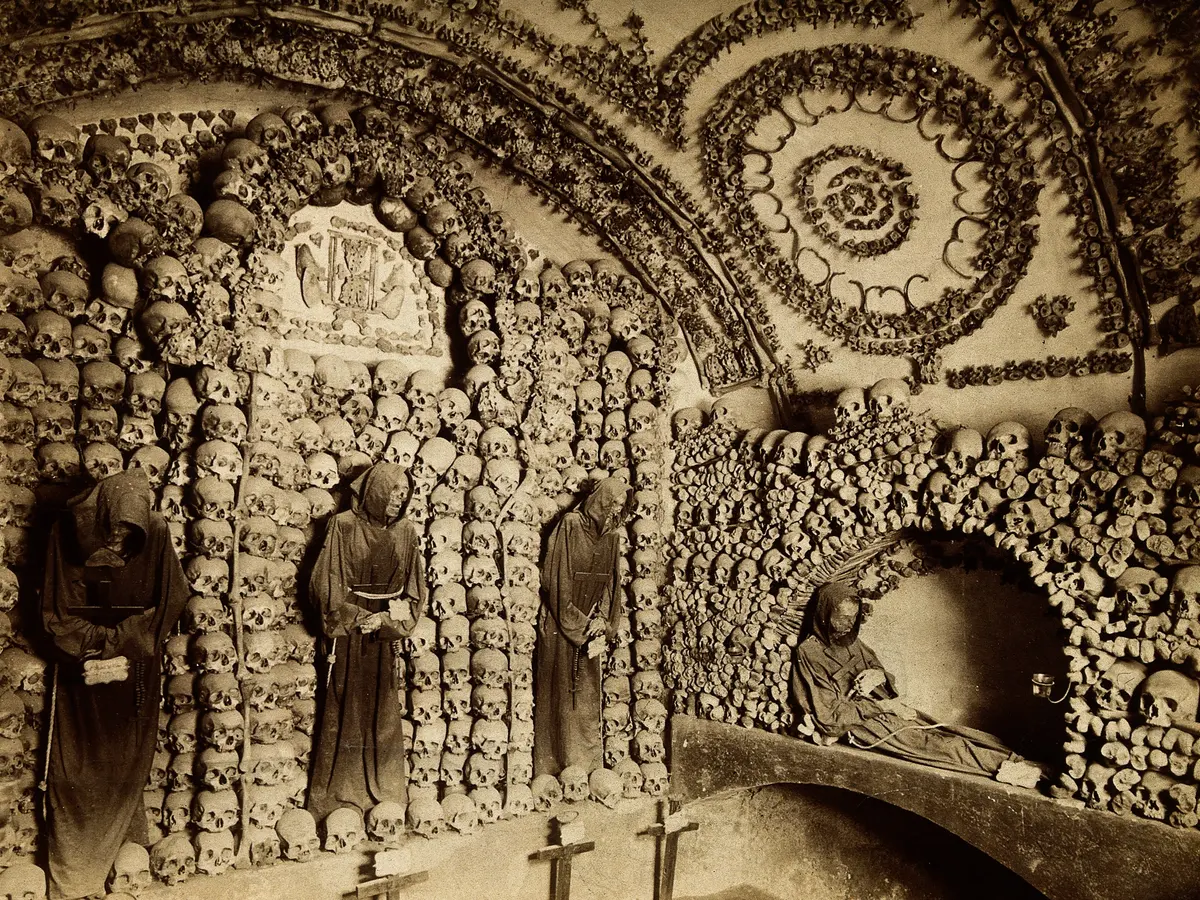
Capuchin Crypt tickets and prices
The operator's shop on 3 October 2026 offered dates through to 30 December 2027. No minimum or recommended lead time is stated. Children up to 6 and visitors with a disability need no booking at all.
Official prices
- Full ticket, museum and crypt, audio guide included€10 (about $11.23)
- Full ticket bought online, including the €1.50 booking fee€11.50 (about $12.91)
- Reduced: ages 7 to 17, over 65, students with proof, international tour guides with licence, members of Catholic religious orders, FAI members€6.50 (about $7.30); €8 ($8.98) online
- Groups of at least 10, per person, audio guide included€7.50 (about $8.42); €9 ($10.10) online
- Free: children up to and including 6, visitors with a disability and, where stated, one companion, Italian national tour guides with licence, Capuchin friarsfree (proof required, no booking needed)
- Online booking fee, per ticket+€1.50 (about $1.68)
- Guided visit with a museum guide (Italian, English, French or Spanish), per group, booked at least a week ahead, on top of admission€90 by bank transfer (about $101.03) or €95 by PayPal (about $106.64)
- Group with its own licensed guide (max. 10 people), booked by e-mail a week ahead; radio headsets compulsory and includedno surcharge beyond admission
- Roma Pass, Turbopass, MIC card, ICOM cardnot accepted
- Reseller example: Tiqets "Skip The Line Ticket + Audio Guide"from €22 (about $24.70) – the same entry the operator sells for €11.50 online
- Conversion€1 = $1.1225, ECB reference rate of 2 October 2026; dollar figures rounded to the cent. You pay in euros.
As of 10/2026 · source and direct booking: museoecriptacappuccini.it
When everything is sold out
No capacity limit was shown for either half-day window when the shop was checked on 3 October 2026, and the operator does not warn of sell-outs. Reseller pages that tell you to book two to three weeks ahead, or that tickets "sell out quickly", are selling their own inventory. The real constraint is the queue at the desk at busy times, and the lunchtime closure.
Capuchin Crypt tickets and tours
For the crypt alone you do not need a partner: the museum sells the €10 ticket at the desk, audio guide included, and €11.50 online. A booked product is worth it if you want a live guide who explains the friars and the decoration, or a combined tour that also takes you out to the catacombs on the Appian Way with transport – the crypt and the catacombs are two different places with two different tickets. The prices below are the partners' own and always above the desk price.
Rome: Capuchin Crypts and Catacombs Tour with Transfers
Rome: Catacombs Guided Tour with Transfer & Capuchin Option
Rome: Catacombs and Capuchin Crypt Guided Tour with Transfer
Rome: Capuchin Crypts Guided Tour with Audio Guide Option
Show all 15 offers
Rome: Capuchin Crypts and Museum Ticket and Tour
Capuchin Crypt: Entry + Guided Tour or Audio Guide
Rome: Capuchin Crypts & Rome’s Dark Secrets Walking Tour
Capuchin Crypt: Skip The Line Ticket + Audio Guide
Rome: Capuchin Crypt & Museum Guided Tour or Entry Ticket
Rome: Capuchin Crypt & Museum Entry with AudioGuide
Rome: Catacombs and Capuchin Crypt Guided Tour + Transfer
Rome: Explore Capuchin Museum & Crypt with Audio guide
Rome: Capuchin Crypt Ticket & Multilingual Audio Guide
Capuchin Crypt & Roman Catacombs: Guided Tour + Transfer
Capuchin Crypt & Catacombs of Priscilla: After-Hours Guided Tour
Booked through GetYourGuide or Tiqets (affiliate links, advertising). Cancellation terms differ by provider and offer – please check before you buy. Prices as of 20 September 2026.
Capuchin Crypt opening hours and best time
Open every day, in two sessions: 9:30am to 1:30pm (last admission 12:30pm) and 2:30pm to 6:30pm (last admission 5:30pm). It is closed between 1:30pm and 2:30pm. Closed all day on Easter Sunday, 25 December and 1 January. Morning only, closing at 1:30pm with last admission at 12:30pm, on Holy Saturday, 2 November (All Souls), 24 December and 31 December. Visitors arriving after the last admission are not let in, even with a ticket. The church upstairs keeps its own hours: Monday to Saturday 7am to 7pm, Sunday 8am to 7pm, with Mass at 7.30am on weekdays and 11am on Sundays and holy days. Private evening visits with a guide, the museum closed to everyone else, run at 6.45pm and 8pm on request.
When it is quietest
First thing in the morning, at 9.30am opening, or late in the afternoon session before the 5.30pm last admission. Tour groups bunch up mid-morning, and the lunchtime closure from 1.30pm to 2.30pm creates a small rush at 2.30pm. Do not aim for 1pm: the last morning admission is 12.30pm. The crypt is open every day of the year except Easter Sunday, Christmas Day and New Year's Day, which makes it the natural back-up when an Appian Way catacomb has its weekly rest day. On Holy Saturday, 2 November and 24 and 31 December it closes at 1.30pm.
Who it suits
With children
Children are admitted and go free up to and including age 6; from 7 to 17 they pay the reduced rate. The operator recommends that minors visit the crypt with an adult. Most children cope better than parents expect – there is nothing hidden, no dark tunnel, no jump scares – but the last room holds the skeletons of children, and a child who is frightened of skeletons will be frightened here. The museum also runs a Kids Tour so that parents can do the crypt on their own.
Minimum age
None. Claims of a minimum age of six are wrong; under-sevens simply go free.
Wheelchair
Split answer. The museum is on the first floor of the friary and reached by a lift that staff open on request; the exhibition rooms are level and wide. The crypt has three low steps, and the historic floor rules out ramps: a manual wheelchair can get through with the help of a companion, but motorised wheelchairs are not allowed in the crypt at all, to protect the floor. Visitors with a disability and one companion go free, without booking. The operator asks you to get in touch beforehand if you have specific needs.
Pushchair
Not addressed clearly. The operator's FAQ says "carrozzine" are admitted in the museum and points to the accessibility page – in Italian the word can mean either wheelchairs or prams. Allow for the three steps in the crypt and use the free lockers if in doubt.
Dogs
The operator says nothing about dogs. Assume only assistance dogs and ask by e-mail before you go.
Claustrophobia
Less of an issue than in the catacombs. There are no tunnels: a single straight corridor runs past the six rooms, which you look into from the corridor, and it is lit through windows. At busy times the corridor gets crowded and the flow is one-way.
What to wear
The crypt is a consecrated place, and the operator requires shoulders covered and legs covered to the knee – it says so on the ticket page and in the visitor rules. A shawl or light trousers in the bag solves it in summer.
Photography
The operator's own FAQ now says that photographs and video are allowed for private, non-commercial use; anything for publication or profit needs permission from the state Fondo Edifici di Culto. This contradicts most English guides and many older visitor reports, which describe a strictly enforced ban. Guides leading groups may not use digital devices during the visit. Keep the flash off, follow the custodians if they tell you otherwise on the day, and note that drawing in the crypt is expressly allowed.
Capuchin Crypt: getting there
By public transport
Metro line A to Barberini – Fontana di Trevi, which opens onto Piazza Barberini; the church is a couple of minutes' walk up the start of Via Veneto. From Termini it is two stops on line A (via Repubblica); from Ottaviano, the Vatican stop, it is four (Lepanto, Flaminio, Spagna, Barberini). Buses 52, 53, 62, 63, 80, 83 and 160 are among the most used lines serving Piazza Barberini.
By car
The museum names no car park and offers no parking. In central Rome the metro is the realistic choice.
From the nearest city
In the historic centre. On foot, the Trevi Fountain and the Spanish Steps are both within about ten minutes. To reach the catacombs on the Appian Way from here by public transport, take metro A to Termini, change to line B for Colosseo or Circo Massimo, and take bus 118 – it is perfectly possible on the same day, as long as you mind each site's rest day and the crypt's lunchtime closure.
Tips for your visit
- Mind the gap at lunchtime: last admission is 12.30pm in the morning and 5.30pm in the afternoon, and the doors are shut from 1.30pm to 2.30pm. Pages that say "10am to 7pm" will put you on the pavement.
- Buy at the desk if you are flexible – it is €1.50 cheaper per ticket than online, cash and cards are taken, and the operator shows no sell-outs. Book online only to fix a half-day window for a group or a tight schedule.
- Do not pay €20-plus for a "skip-the-line ticket with audio guide". The operator's own ticket already includes the audio guide, at €10 at the desk or €11.50 online.
- Cover shoulders and knees. It is a requirement, not a suggestion, and applies to men and children too.
- Leave big bags at the free lockers before the museum; rucksacks and suitcases are not allowed on the route, and you cannot go out and come back in.
- Give the museum twenty minutes. It is what explains the crypt – and you cannot bypass it anyway.
- Wheelchair users: ask for the lift to the museum, and note that the crypt has three steps and is closed to motorised chairs. Bring a companion – they go free.
- Combine it on foot with the Trevi Fountain and the underground Vicus Caprarius site next to it, or use it as the fallback on the day your chosen Appian Way catacomb has its rest day.
Capuchin Crypt: what the internet gets wrong
The Capuchin Crypt is not a catacomb. It is a 17th-to-19th-century ossuary under a church on Via Veneto in the city centre, run as a museum by the Capuchin order. The catacombs are ancient underground cemeteries on the Appian Way and elsewhere outside the old walls, owned by the Holy See and visited only with a guide. Different place, different operator, different ticket, different rules. Where this claim appears: tickets-rome.com; "catacombs of the bone chapel in Rome" (romesite.com), "How many bodies are in the Capuchin Catacombs?" (rome.us), and Headout's Capuchin Crypt ticket page, which warns that photography is prohibited "inside the Catacombs".
The operator gives about 3,700 dead, most of them friars, and its director adds benefactors. Wikipedia manages both figures in one article. The 4,000 most likely goes back to Mark Twain, whose guide told him in 1867 that these were "the bones of four thousand"; it has been copied ever since. Where this claim appears: "the remains of over 4000 Capuchin friars" (rome.info), "the bones of 4,000 monks who died between 1528 and 1870" (ricksteves.com), "an estimated 4,000 individuals" (archaeology-travel.com), "nearly 4,000 friars" (turismoroma.it, the city's own tourist portal).
The operator opens 9.30am to 1.30pm and 2.30pm to 6.30pm, with last admissions at 12.30pm and 5.30pm. Turn up at 2pm or after 5.30pm on the strength of those pages and you will not get in. It is also closed on Easter Sunday, 25 December and 1 January. Where this claim appears: througheternity.com; the same 10am–7pm on myromepass.com, toorists.com and liisawanders.com; "open every day from 9:00 to 19:00" (rome.info).
The operator sells dated tickets on its own website at €10 plus a €1.50 fee, audio guide included. Paying a reseller for a tour is not the only way to book ahead – and Tiqets' "Skip The Line Ticket + Audio Guide" from €22 is twice the operator's online price for the same entry. Where this claim appears: rome.info; "There is no option to skip-the-line … you will need to reserve place on a guided tour" (archaeology-travel.com).
Out of date. In October 2026 the museum's own guide costs €90 by bank transfer or €95 by PayPal per group on top of admission and needs a week's notice, and the ticket is €10 full and €6.50 reduced, audio guide included. Where this claim appears: "Regular: €8.50 Reduced: €5.00" (archaeology-travel.com).
The operator's own FAQ says photographs and video are allowed for private, non-commercial use, and only publication or commercial use needs permission from the Fondo Edifici di Culto. Older visitor accounts of a strict ban were accurate at the time; the rule has since been written differently. Custodians on the day still have the last word. Where this claim appears: yondli.com; "Photography is not permitted inside the crypt. This is strictly enforced" (catacombs-of-rome.com), and the same on througheternity.com and archaeology-travel.com.
There is no minimum age. Children up to and including 6 go free and need no booking; the reduced rate applies from 7 to 17, and the operator only recommends that minors visit the crypt with an adult. Where this claim appears: catacombs-of-rome.com; "kids aged 5, or below can enter free … children aged 6–17 need to buy … tickets at child prices" (myromepass.com).
The operator gives the €6.50 reduced rate to students of any age who can prove it, and has no EU-citizenship or under-25 rule. Over-65s, international tour guides, members of Catholic religious orders and FAI members pay the reduced rate too. Where this claim appears: toorists.com; and, the other way round, "students aged 25 and under" (througheternity.com) and reductions "if you are an EU citizen under 25" (rome.info).
Both are wrong in opposite directions. The museum is on the first floor and reached by lift; the crypt has three low steps without ramps, passable in a manual wheelchair with a companion, but closed to motorised wheelchairs. Where this claim appears: italy-tourist-information.com; "The museum and crypt is wheelchair accessible" (archaeology-travel.com), against "This experience is not wheelchair accessible" (Headout) and "not accessible for strollers or wheelchairs" (catacombs-of-rome.com).
Michele da Bergamo was the architect of the church, the friary and the crypt as a burial place, and died in 1641. The bone decoration dates from the 18th century; the operator says there are no documents on who made it, and the museum's director says the Jerusalem soil is a tradition with no documentary evidence. Where this claim appears: "The soil in the crypt was brought from Jerusalem, by order of Pope Urban VIII" (en.wikipedia.org, Capuchin Crypt).
The Mass Chapel is not at the end of the corridor but the second of the six rooms from the Resurrection end, between the Crypt of the Resurrection and the Crypt of the Skulls. The room at the far end is the Crypt of the Three Skeletons – which is where most visitors expect the famous plaque, and find it. Where this claim appears: rome.info.
The operator itself calls its "Saint Francis in Meditation" attributed to Caravaggio, and Caravaggio scholarship disputes it – John Gash, cited on Wikipedia, regards the Capuchin version as a good copy of a lost original. Worth seeing, but not a certain Caravaggio, and not the "Ecstasy". Where this claim appears: througheternity.com; "a Caravaggio painting — Saint Francis of Assisi in Ecstasy" (catacombs-of-rome.com).
Metro A from Barberini to Termini, line B to Colosseo or Circo Massimo and bus 118 take you to San Callisto and San Sebastiano. It is slower than a minibus and bus 118 is irregular, but it is public transport, and the crypt's afternoon session runs until 6.30pm. Where this claim appears: througheternity.com, which sells a tour with transport.
The operator's shop showed no capacity limit on either half-day window when checked on 3 October 2026, and the desk sells tickets on the day. What fills up is the reseller's allocation, not the museum. Where this claim appears: tickets-rome.com; tickets that "get sold out quickly" (myromepass.com).
History in brief
- Pope Urban VIII Barberini blessed the first stone of the church on 4 October 1626; his brother, Cardinal Antonio Marcello Barberini, was himself a Capuchin and paid for church and friary. The Capuchin architect Michele da Bergamo (d. 1641) designed both. The first Mass was said on 8 September 1630.
- The friars moved in on 16 April 1631 and brought the remains of their dead with them from the cemetery of their previous house, San Bonaventura near the Trevi Fountain. Wikipedia speaks of 300 cartloads. The order's rule required an underground cemetery separate from the church, and that is what the crypt was built as.
- For more than two centuries the dead were buried in the earth of the crypt; when space ran out, the longest-buried were dug up to make room, and their bones were kept. Tradition has it that the soil was brought from Jerusalem on the pope's orders – the museum's director says no document confirms it.
- The decoration came later than most pages suggest: according to the museum's director the idea of arranging the bones artistically seems to have emerged in the mid-18th century, with the work at least partly complete by 1764; the operator dates it to the 18th and 19th centuries. The operator states plainly that there are no documents on who made it, only legends – including one about Capuchins who fled the French Terror.
- The Marquis de Sade saw it in 1775. The operator quotes him as writing that a German priest of the house had made a funerary monument worthy of English genius; English sources usually give "I have never seen anything more striking". Nathaniel Hawthorne set a chapter of The Marble Faun (1860) here.
- Mark Twain visited in 1867 and wrote it up in chapter 28 of The Innocents Abroad (1869) under the heading of "picturesque horrors". The friar who showed him round told him the six rooms held "the bones of four thousand" – which is very probably where the round figure still printed everywhere comes from.
- Burials ended in 1870. The old friary was later demolished for the new street layout of the district; only the church and the crypt survive from the 17th-century complex, and the friars' present house was begun in 1925.
- In 2012 the province opened the museum in the friary, making the crypt the last stage of a route through eight rooms on the history of the order, with an audio guide included in the ticket.
Capuchin Crypt: frequently asked questions
How much is the Capuchin Crypt in Rome in 2026?
€10 (about $11.23) for adults at the desk, or €11.50 ($12.91) online because of a €1.50 booking fee. The reduced ticket is €6.50 ($7.30) for ages 7 to 17, over-65s, students and a few other groups, and children up to 6 go free. Every ticket includes the museum, the crypt and an audio guide. Dollar figures use the ECB rate of 2 October 2026.
Do I need to book Capuchin Crypt tickets in advance?
No. The desk sells tickets on the day, for cash or card, and saves you the €1.50 online fee. Online tickets are for a date and a morning or afternoon window, and when we checked on 3 October 2026 there was no sign of either window selling out. Book ahead if you are a group or want certainty in high season; otherwise just go.
What are the Capuchin Crypt opening hours?
Every day from 9.30am to 1.30pm and from 2.30pm to 6.30pm, with last admission at 12.30pm and 5.30pm. It is closed on Easter Sunday, 25 December and 1 January, and closes at 1.30pm on Holy Saturday, 2 November and 24 and 31 December. The "10am to 7pm" on many English sites is wrong.
Is the Capuchin Crypt a catacomb?
No. It is an ossuary – a crypt decorated with bones – under a 17th-century church on Via Veneto in central Rome, and its decoration dates from the 18th century. The catacombs are ancient underground cemeteries on the Appian Way and elsewhere outside the old city, with a separate owner and ticket and a compulsory guide. Many tour sellers file the crypt under "catacombs", which is why people confuse them.
How long does it take to visit the Capuchin Crypt?
About an hour for the museum and the crypt together, by the operator's own estimate. The crypt itself is a single corridor of about 30 metres with six rooms, and takes ten to fifteen minutes at a slow pace. You have to go through the museum first; there is no crypt-only ticket.
How many bones or friars are in the Capuchin Crypt?
About 3,700 dead, most of them Capuchin friars, according to the museum; its director says benefactors are among them too. The 4,000 you see on many websites is not the operator's figure – it seems to go back to what a friar told Mark Twain in 1867. Five of the six rooms are decorated with the bones; the Mass Chapel has none.
Can you take pictures in the Capuchin Crypt?
According to the operator's own FAQ, yes – photographs and video for private, non-commercial use are allowed, and commercial or published use needs permission from the state Fondo Edifici di Culto. Most English guides still say photography is strictly banned, which was the long-standing rule. Keep the flash off and follow the custodians if they say otherwise on the day.
What is the dress code for the Capuchin Crypt?
Shoulders covered and legs covered to the knee, for everyone. The crypt is a consecrated place and the operator states the rule on its ticket page and in its visitor regulations. A shawl or a pair of light trousers in your bag solves it in summer.
Is the Capuchin Crypt suitable for children?
Children are admitted at any age – there is no minimum age, and under-sevens go free. The operator recommends that minors go into the crypt with an adult. It is not dark or cramped, but it is full of skulls, and the last room contains the skeletons of children; parents of sensitive younger children should think about it. The museum also offers a Kids Tour for families.
Is the Capuchin Crypt wheelchair accessible?
Partly. The museum is on the first floor and reached by a lift that staff open for you, and its rooms are level. The crypt has three low steps and no ramp: a manual wheelchair can get through with a companion's help, motorised wheelchairs are not allowed. Visitors with a disability and one companion go free without booking.
Is the Capuchin Crypt included in the Roma Pass?
No. The operator states that Roma Pass, Turbopass, MIC and ICOM cards are not accepted, and the crypt is not part of any catacombs ticket either. You buy the €10 ticket separately at the desk or online.
How do I get to the Capuchin Crypt?
Take metro line A to Barberini – Fontana di Trevi; the church is a couple of minutes' walk up Via Veneto from Piazza Barberini. From Termini it is two stops, from the Vatican stop Ottaviano four. Buses 52, 53, 62, 63, 80, 83 and 160 serve Piazza Barberini, and on foot it is about ten minutes from the Trevi Fountain or the Spanish Steps.
Is a guided tour of the Capuchin Crypt worth it?
For most people, no: the audio guide is in the ticket, the museum explains the crypt, and you walk it on your own. A tour earns its money when it adds something you cannot easily do yourself – usually transport to the Appian Way catacombs on the same afternoon. If you want a live guide just for the crypt, the museum provides one for €90–95 per group plus admission, booked a week ahead.
Can you visit the Capuchin Crypt and the catacombs on the same day?
Yes. The crypt is open every day and its afternoon session runs until 6.30pm, so a catacomb on the Appian Way in the morning and the crypt after lunch works well. By public transport it is metro A to Termini, line B to Colosseo or Circo Massimo and bus 118; check the rest day of the catacomb you choose first.
Is the Capuchin Crypt worth visiting?
If you are curious about how earlier generations lived with death, yes – there is nothing quite like it in Rome, it is central, cheap by Roman standards and open every day. It is small: one corridor and six rooms, an hour with the museum. If you expect an underground labyrinth, go to the catacombs instead.
Who made the Capuchin Crypt, and when?
Nobody knows by name. The friars moved here in 1631 and buried their dead in the crypt until 1870; the bones were turned into decoration from around the middle of the 18th century, by the friars themselves according to the operator. Wikipedia's claim that the architect Michele da Bergamo arranged the bones does not fit – he died in 1641 – and the museum states that no documents survive.
Capuchin Crypt: nearby and similar
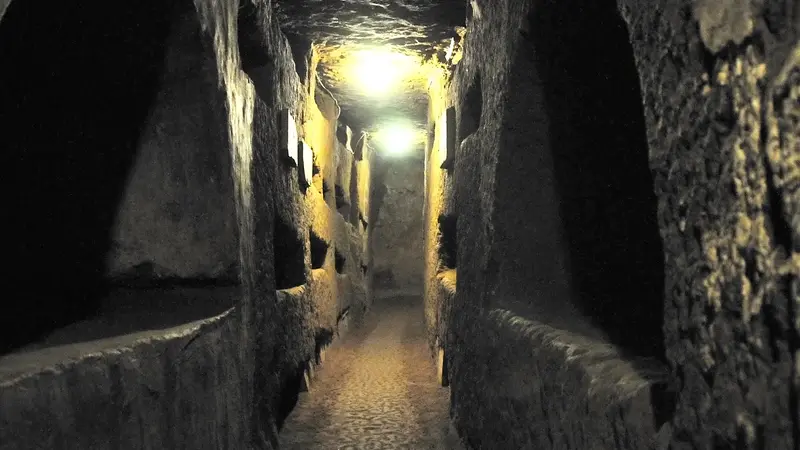
Catacombs of Rome
Five catacombs, five different closing days: 2026 prices and rules.
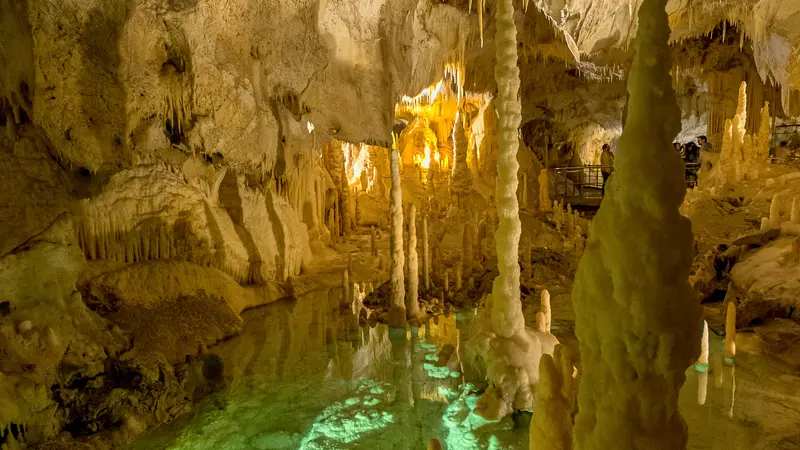
Frasassi Caves
€20 in 2026, English tours only in summer, and a chamber that swallows Milan Cathedral.
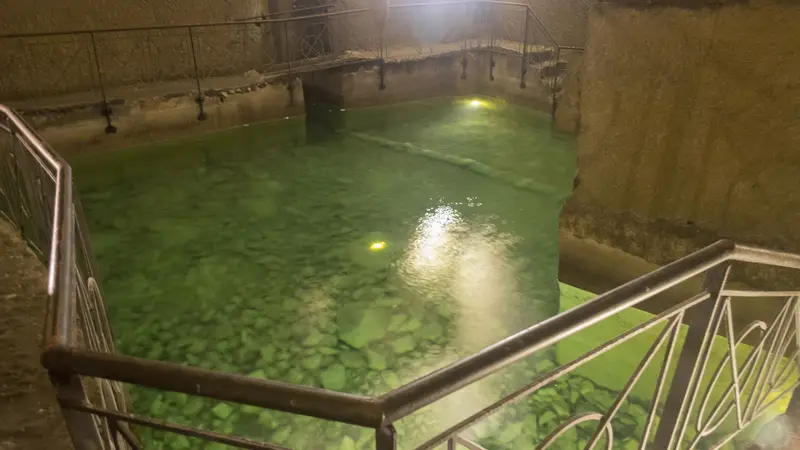
Underground Naples
Five operators, one name, and no ticket that covers them all.
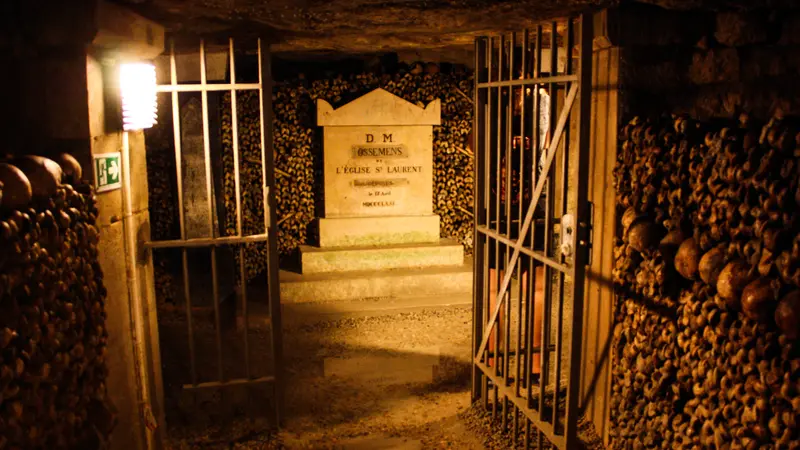
Paris Catacombs
Six million dead, 200 at a time: how to get a ticket.
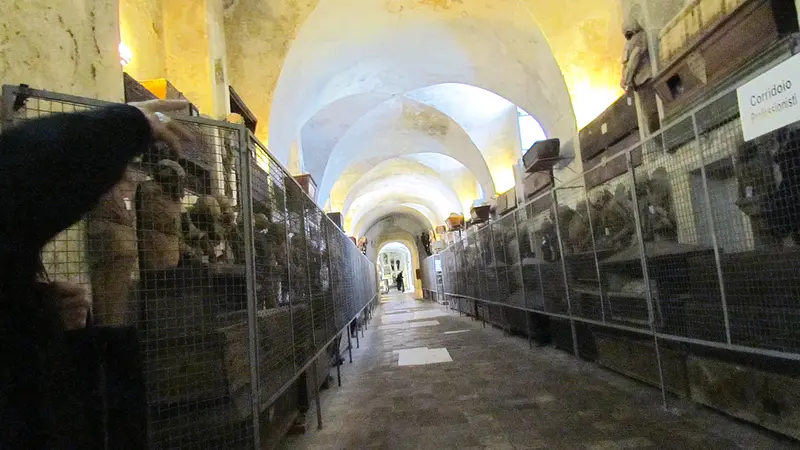
Capuchin Catacombs
1,252 mummies, a €5 ticket sold only at the door, and no photos.
Underground Vienna
Three crypts, one film sewer, no joint ticket: 2026 prices and times.
Sources
Show 45 sources – every figure on this page is sourced
- www.museoecriptacappuccini.it/ – Operator: opening hours 9:30–13:30 and 14:30–18:30, last admissions 12:30 and 17:30, open every day, closed Easter Sunday, 25 December and 1 January, closing at 13:30 on Holy Saturday, 2 November, 24 and 31 December; address, phone 06 88803695
- www.museoecriptacappuccini.it/acquista-i-biglietti/ – Operator ticket page: €10 / €6.50 / €7.50 groups (audio guide included), €1.50 online fee per ticket, reduced and free categories, guided visits €90 bank transfer or €95 PayPal plus admission with one week's notice, own guides max. 10 with radio headsets, cancellation terms, dress code, no ICOM/MIC/Roma Pass/Turbo Pass, minors recommended accompanied; visitor rules (bags, lockers, water only, no entry after closing); FAQ: 60-minute visit, no refunds, cash and cards, no booking for under-6s, Kids Tour, private photos and video allowed, FEC permission for commercial use, no re-entry, drawing allowed, groups max. 10 with guide or 25 with audio guides, no crypt-only visit
- www.museoecriptacappuccini.it/la-cripta/ – Operator: corridor of about thirty metres with six rooms, about 3,700 dead mostly Capuchin friars, no documents on its origin, legends, Sade quotation, Jerusalem soil as tradition, descriptions of all six rooms (Three Skeletons, Leg Bones and Thigh Bones, Pelvises, Skulls, Mass Chapel, Resurrection)
- www.museoecriptacappuccini.it/portfolio/la-cripta-dei-cappuccini/ – Operator catalogue entry: crypt dated 18th–19th century, author "frati cappuccini", texts after R. Cordovani, La Cripta dei Cappuccini: Guida Breve
- www.museoecriptacappuccini.it/accessibilita-museale/ – Museum on the first floor reached by lift via staff, level exhibition rooms, crypt with three low steps, no ramps, access with a companion, motorised wheelchairs not permitted, free entry for visitors with a disability and one companion without booking
- www.museoecriptacappuccini.it/la-storia/ – Museum opened 2012, convent built from 1626 under Urban VIII, Cardinal Antonio Barberini a member of the order, architect Michele da Bergamo, convent inhabited by 1631, only church and crypt survive, eight exhibition rooms, Caravaggio's St Francis in Meditation, bones of over 3,700 dead
- www.museoecriptacappuccini.it/il-convento-e-la-chiesa/ – Friars moved in on 16 April 1631, remains brought from the cemetery of San Bonaventura, old convent demolished, first stone of the present house 1925, church hours Mon–Sat 7–19 and Sun 8–19, Masses 7.30 and 11.00, first stone 4 October and first Mass 8 September 1630, architect Michele da Bergamo (d. 1641), Guido Reni's St Michael, "Hic iacet pulvis cinis et nihil"
- www.museoecriptacappuccini.it/sezioni-espositive/ – The eight sections of the museum route, section five devoted to St Francis in Meditation, the crypt as the end of the route
- www.museoecriptacappuccini.it/missione/ – Operator's mission page: crypt under Santa Maria della Concezione with the remains of about 3,700 Capuchin friars (the simplified version of the figure)
- www.museoecriptacappuccini.it/saluto-del-direttore/ – Museum founded 2012 by the former Roman Province, now part of the Provincia Serafica Immacolata Concezione; Caravaggio painting described as attributed
- www.museoecriptacappuccini.it/visite-serali/ – Private evening visits 18:45–19:45 and 20:00–21:00, about 50 minutes, booking two weeks ahead, prepayment by bank transfer, cancellation terms
- www.museoecriptacappuccini.it/servizi-educativi/ – Kids Tour while parents visit with the audio guide; school groups 8:30–9:30, booking 10 days ahead
- www.museoecriptacappuccini.it/product/biglietto-intero-audioguida/ – Operator's booking form: full ticket with audio guide €10 plus fee, dates bookable through 30/12/2027 (25 December excluded); slot query of 3 October 2026 returned two windows, Mattina 09:30–12:15 and Pomeriggio 14:30–17:15, with no stock limit set
- www.museoecriptacappuccini.it/wp-json/wc/store/v1/products – Operator's shop catalogue: ticket products with prices (€10, €6.50, €7.50 with audio guide; hidden €8.50, €5, €6 without; audio guide €1.50), guided visit €95 with language options Italian, English, French, Spanish
- www.cappucciniviaveneto.it/ – Former official address, now an automatic redirect to museoecriptacappuccini.it
- www.ecb.europa.eu/stats/eurofxref/eurofxref-daily.xml – ECB reference rate of 2 October 2026: €1 = $1.1225, basis of all dollar figures
- www.turismoroma.it/en/node/222 – Rome's official tourist portal: eight museum rooms, St Francis "possibly made by Caravaggio", crypt built in the mid-18th century; claims "nearly 4,000 friars" and "five chapels", still links cappucciniviaveneto.it and an old ticket platform
- en.wikipedia.org/wiki/Capuchin_Crypt – 3,700 bodies and, later in the same article, 4,000 friars; six rooms and their English names; 300 cartloads in 1631; claims that Michael of Bergamo arranged the bones and that the soil came from Jerusalem by order of Urban VIII; Sade, Hawthorne and Twain; plaque in the Crypt of the Three Skeletons; heart of Maria Felice Peretti; opening only after All Souls' Day as of 1851
- en.wikipedia.org/wiki/Santa_Maria_della_Concezione_dei_Cappuccini – Church: first stone 4 October 1626, first Mass 8 September 1630, completed 1631, Cardinal Antonio Marcello Barberini, single nave with five chapels each side, Guido Reni's St Michael, coordinates 41°54′16.7″N 12°29′19.2″E; describes the crypt as "five chapels"
- en.wikipedia.org/wiki/Saint_Francis_in_Prayer_(Caravaggio) – Attribution dispute: John Gash identifies the version in the Capuchin church as a good copy of a lost original
- en.wikipedia.org/wiki/Barberini_%E2%80%93_Fontana_di_Trevi – Metro station Barberini – Fontana di Trevi, line A, under Piazza Barberini, opened 1980
- en.wikipedia.org/wiki/Line_A_(Rome_Metro) – Station order Ottaviano – Lepanto – Flaminio – Spagna – Barberini – Repubblica – Termini
- www.thecollector.com/capuchin-crypt-rome-interview-pietro-costantini/ – Interview with museum director Pietro Costantini: about 3,700 dead buried 1631–1870 including remains from the previous convent, bones of friars and benefactors, artistic arrangement from the mid-18th century and partly complete by 1764, Michele da Bergamo as architect of church, friary and crypt, no documentary evidence for the Jerusalem soil, central skeleton possibly Princess Anna Barberini, three children's skeletons, Sade quote in English
- www.gutenberg.org/cache/epub/3176/pg3176.txt – Mark Twain, The Innocents Abroad, chapter 28: "picturesque horrors of the Capuchin Convent", six divisions, the friar's "These are the bones of four thousand"
- www.gutenberg.org/cache/epub/2181/pg2181.txt – Nathaniel Hawthorne, The Marble Faun, chapter 21 "The Dead Capuchin": cemetery beneath the church but above ground, lit by grated windows, earth of Jerusalem as tradition
- www.justroma.it/en/squares/barberini-square/ – Metro Barberini (line A) opens onto the square; buses 52, 53, 62, 63, 80, 83 and 160 among the most used
- www.catacombesancallisto.it/de/dove-siamo.php – Public transport to the Appian Way catacombs: buses 118, 218, 660, 714
- www.vicuscaprarius.com/ – Nearby site Vicus Caprarius – Città dell'Acqua by the Trevi Fountain: imperial domus, castellum aquae of the Aqua Virgo, open Tuesday–Sunday 11–17, closed Mondays
- www.througheternity.com/travel-guide/how-to-visit-the-capuchin-… – Claims "open every day of the week from 10 AM to 7 PM", reduced rate for "students aged 25 and under", "Caravaggio's St. Francis in Prayer, one of the finest works", no photography, and that crypt and catacombs are "not connected via public transport"
- www.rome.info/attractions/capuchin-crypt/ – Claims "Bone Chapel with 4,000 Monks", "over 4000 Capuchin friars", "open every day from 9:00 to 19:00", "Regular entrance tickets are not available in advance", reductions "if you are an EU citizen under 25", and that the Mass Chapel is the final room; correctly says the crypt is not in the Roma Pass
- archaeology-travel.com/italy/capuchin-crypt-rome/ – Claims "an estimated 4,000 individuals", museum tour "two weeks in advance … €60 (Italian) or €80", "Regular: €8.50 Reduced: €5.00", no skip-the-line without a tour, "wheelchair accessible", photography "strictly forbidden"
- catacombs-of-rome.com/capuchin-crypt-rome/ – Claims a "minimum age for admission … 6 years old", "five small rooms", "not accessible for strollers or wheelchairs", photography "strictly enforced" ban, "a Caravaggio painting — Saint Francis of Assisi in Ecstasy"
- yondli.com/attractions/rome/capuchin-crypt – Correct hours and prices; claims "Photography and filming are prohibited inside the museum and crypt"
- www.myromepass.com/capuchin-crypt – Claims "10:00 AM to 07:00 PM every day", free only for kids "aged 5, or below", tickets "sold out quickly", strict photo ban
- toorists.com/rome/capuchin-crypt/ – Claims "opens at 10 am and closes at 7 pm daily" and "no dedicated discounts for students"; correctly says the Roma Pass does not include it
- www.tiqets.com/en/capuchin-crypt-tickets-l175645/ – Reseller price "Capuchin Crypt: Skip The Line Ticket + Audio Guide" from €22
- www.headout.com/roman-catacombs-tour/capuchin-crypt-tickets-wit… – Capuchin Crypt ticket listed under "Roman Catacombs Tour", photography prohibited "inside the Catacombs", "not wheelchair accessible", from €11.50, correct hours
- italy-tourist-information.com/rome/historical-landmarks/museums… – Claims "The museum and crypt are fully wheelchair accessible" and that tickets can sell out
- www.tickets-rome.com/catacombs-tours/capuchin-crypt/ – Page title "Capuchin Crypt Tickets & Tours | Exploring Rome's Catacombs"; mixes 3,700 and 4,000; advises booking "at least 2-3 weeks in advance"
- romesite.com/capuchin-crypt.html – Heading "La Cripta dei Frati Cappuccini, catacombs of the bone chapel in Rome"
- rome.us/churches/capuchin-crypt.html – FAQ headed "How many bodies are in the Capuchin Catacombs?" alongside Roman catacomb questions
- www.ricksteves.com/watch-read-listen/read/tms/boning-up-on-europe – Claims "the bones of 4,000 monks who died between 1528 and 1870"
- liisawanders.com/italy/romes-capuchin-crypts-the-good-the-bad-a… – Claims "Open every day from 10am to 7pm" and no photos allowed; uses the 3,700 figure
- theculturemap.com/bone-cemetery-visit-capuchin-crypt-rome/ – Outdated details: "Admission fee: €7", "Fri – Wed. 9am – 2pm and 3pm – 6pm", "nearly 4000 bodies"
- theromanguy.com/tours/italy/rome/capuchin-crypts-tickets – Reseller ticket: dress code enforced ("may be refused entry"), all ages welcome, about one hour, not wheelchair or stroller accessible